
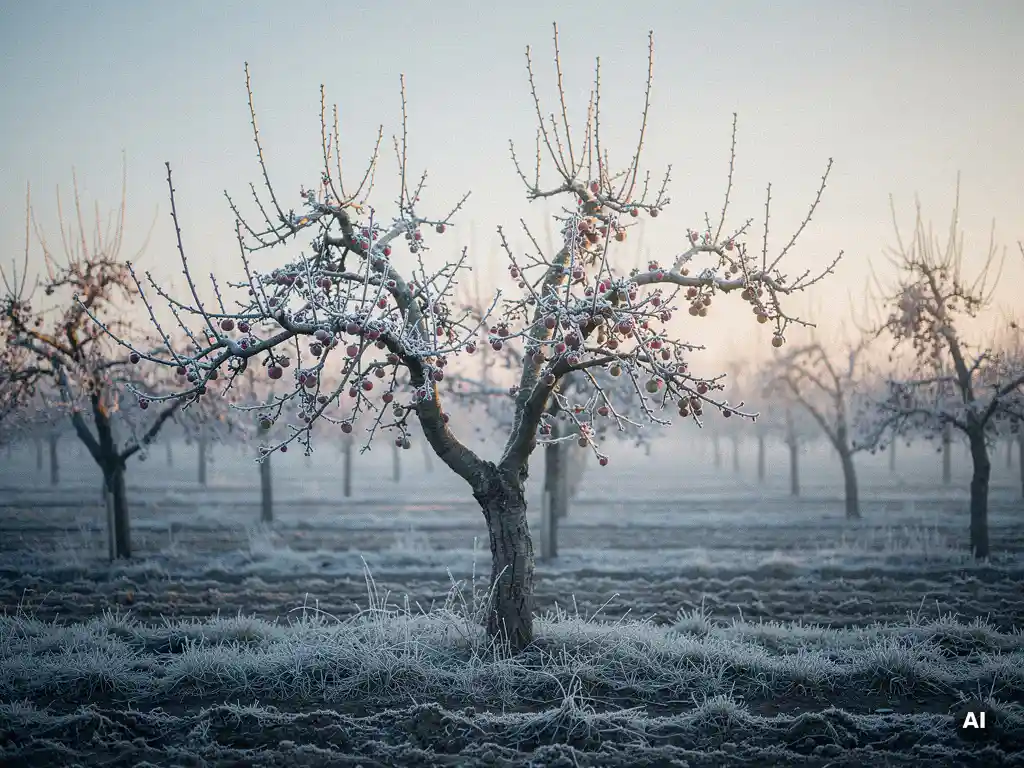
The chill unit requirement of a variety matters because apple and pear trees need a specific period of cold temperatures during winter to break dormancy properly and produce a reliable crop the following season. Choose a variety whose chilling requirement matches your region’s typical winter, and the tree will perform as expected. Choose one that is mismatched, and you risk poor flowering, uneven fruit set, and reduced yields year after year. The sections below walk through how chilling works, why it varies between varieties, and how to use this knowledge to make smarter planting decisions. If you have questions about specific varieties and their suitability for your region, feel free to get in touch with us and we will be happy to help.
How do chill units affect apple and pear tree performance?
Chill units determine whether an apple or pear tree completes its winter dormancy correctly. Without enough accumulated cold, trees enter spring in a weakened, confused state: buds open unevenly, flowering is staggered, fruit set is poor, and the overall yield drops significantly. With sufficient chilling, trees wake up uniformly in spring, flower well, and deliver consistent, high-quality fruit.
Dormancy is not simply a resting phase. It is an active biological process during which the tree resets itself, clears growth inhibitors, and prepares the hormonal signals needed for a productive growing season. Chill units are the currency the tree uses to complete that process. A tree that has accumulated enough units moves through dormancy efficiently. One that has not struggles to synchronise bud break, leading to patchy canopy development and vulnerability to late frost because some buds open earlier than others.
Beyond yield, insufficient chilling also affects fruit quality. Fruit from under-chilled trees can be smaller, less uniform in shape, and lower in sugar content, making it harder to meet the standards required for premium markets.
What exactly is a chill unit and how is it measured?
A chill unit is a standardised measure of the cumulative cold exposure a fruit tree receives during its dormant period. The most widely used method counts one chill unit for each hour a tree spends at temperatures between roughly 2°C and 7°C. The total number of these hours accumulated between autumn leaf fall and the end of winter is called the chilling hours total for that season.
Several models exist to calculate chill units, and they differ in how they weight different temperature ranges. The simple Chilling Hours model counts every hour below 7°C. The Utah model, developed to reflect real tree physiology more accurately, assigns positive values to temperatures in the optimal range, neutral values to temperatures that are cold but less effective, and negative values to warm spells that can actually cancel out previously accumulated chilling. The Dynamic model, now widely regarded as the most physiologically accurate, tracks the accumulation of a biological intermediate in the tree and is particularly useful in mild-winter climates where temperatures fluctuate frequently.
For practical purposes, most growers and breeders refer to chilling hours as a shorthand, but the underlying model matters when comparing data from different sources or evaluating a variety’s performance in a region with warm, variable winters.
Why do different apple varieties have different chill requirements?
Different apple and pear varieties have different chill requirements because they evolved in, or were bred for, different climates. Varieties originating from regions with cold, reliable winters developed high chilling requirements to prevent premature bud break during a warm autumn spell. Varieties bred for warmer growing regions were selected to complete dormancy with far less accumulated cold.
Breeding plays a central role here. At Better3Fruit, we select parent varieties with specific traits in mind, and chill requirement is one of those traits. When we cross two parents, the resulting seedlings inherit a range of chilling needs from both genetic lines. Over successive generations of evaluation, we identify which seedlings perform best in target growing regions, and their chilling requirement becomes a key part of the variety’s profile.
Genetics also explains why two varieties that look similar at harvest can behave very differently in the same orchard. Flavour, texture, and colour are the traits consumers see, but dormancy behaviour is equally important for growers deciding what to plant. A variety with a high chilling requirement planted in a warm region will consistently underperform, regardless of how well it is managed in other respects.
What happens if you plant a variety in the wrong chill zone?
Planting a variety in the wrong chill zone leads to a predictable set of problems that compound over time. If the variety’s chilling requirement is higher than your region typically delivers, the tree will not complete dormancy properly. The consequences include delayed and uneven bud break, reduced and poorly timed flowering, low fruit set, and fruit that is smaller and less uniform than expected.
In practice, growers who plant high-chill varieties in warm regions often see the first season look acceptable because the tree is young and still drawing on reserves. By the second and third seasons, the pattern of underperformance becomes clear and difficult to reverse without replanting. The economic cost of a mismatched variety is therefore not just one bad harvest but several years of lost income and the cost of eventual replanting.
The reverse situation, planting a low-chill variety in a region with very cold winters, is less common but also carries risk. These varieties may break dormancy too early in a mild spell mid-winter, leaving developing buds exposed to subsequent hard frosts. The result can be significant frost damage to flowers and young fruitlets, again reducing yield.
How is climate change shifting chill unit availability for growers?
Climate change is reducing the number of chilling hours available in many traditional apple and pear growing regions. As winters become milder and shorter, growers in areas that previously accumulated sufficient cold are finding that some seasons fall short of the threshold their current varieties need. This is already a measurable trend in parts of southern Europe, the Mediterranean basin, and comparable growing regions worldwide.
The challenge is not just the average reduction in chilling hours but the increased variability from season to season. A grower may have an adequate season followed by a severely deficient one, making long-term planning and investment decisions harder. Varieties that performed reliably for decades are now showing inconsistent results in regions where winters have warmed noticeably.
For breeding programmes, climate resilience has become a primary long-term goal. At Better3Fruit, we are actively selecting for varieties that perform well across a broader range of chilling conditions, so that growers have options that remain productive even as regional climates shift. This means evaluating varieties not just for how they perform in ideal conditions but for how they hold up when chilling is lower than average.
How should growers match a variety’s chill requirement to their region?
Growers should match a variety’s chill requirement to their region by first establishing the average and minimum chilling hours their location reliably delivers across recent seasons, then selecting varieties whose documented requirement falls comfortably within that range, with a buffer to account for warmer-than-average winters.
A practical approach involves three steps:
- Gather local climate data. Use weather station records from the past ten to fifteen seasons to calculate average chilling hours and identify the lowest seasons on record. This gives a realistic picture of what your region can deliver in a typical year and in a poor year.
- Identify the variety’s documented chill requirement. Reputable breeders and trial networks publish chilling requirements for named varieties. When reviewing this data, check which model was used to calculate it, so you are comparing like with like.
- Build in a safety margin. Select varieties whose chill requirement is met even in your lower-than-average seasons. A variety that only just meets its threshold in a good year will underperform regularly as climate variability increases.
It is also worth consulting regional trial data, which shows how specific varieties actually perform in conditions similar to yours, rather than relying solely on figures from the breeder’s home region. Variety performance can differ between the trial environment where it was developed and the conditions a grower faces in a different country or microclimate.
Exploring the full range of available varieties is a useful starting point. You can browse our variety portfolio to see which apple and pear varieties we have developed and the growing conditions they are suited to. Matching the right variety to your region from the outset is one of the most important decisions a grower makes, and getting it right avoids years of underperformance and costly replanting. If you would like guidance specific to your situation, contact us directly and we will help you find the best fit for your orchard.
This content was generated with the help of AI and it may contain mistakes