
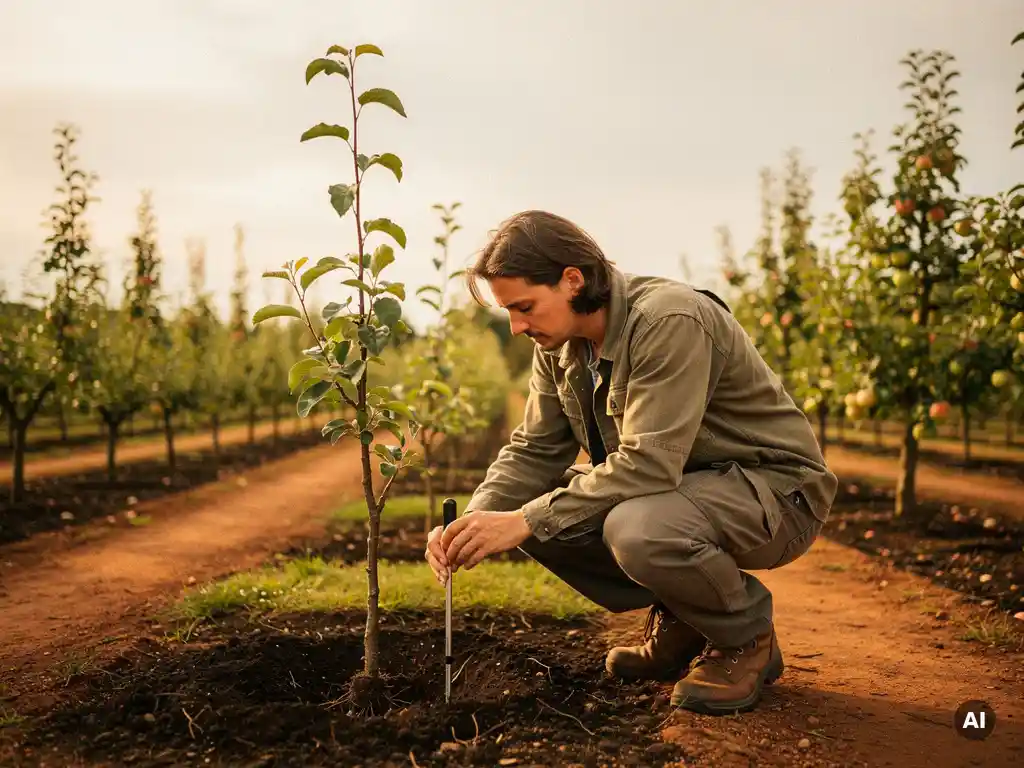
To test whether an apple variety suits your climate, you need to evaluate its chilling hour requirements, frost tolerance, heat accumulation needs, and disease pressure response against your local growing conditions. The most reliable method combines reviewing published trial data with running small-scale on-site trials over at least three to four growing seasons. Below, we answer the most common questions growers and licensing partners ask about apple variety climate testing and selection. If you want to discuss your specific situation directly, feel free to get in touch with us, and we are happy to help.
What climate conditions do apple varieties actually need?
Apple varieties need a specific combination of chilling hours in winter, sufficient heat accumulation in spring and summer, adequate rainfall or irrigation, and a frost-free window around flowering. The exact thresholds vary significantly between cultivars, which is why apple variety climate suitability cannot be assessed with a single universal standard.
Chilling hours are the number of hours the temperature sits between roughly 0°C and 7°C during dormancy. Varieties with high chilling requirements struggle in mild winters and may fail to break dormancy evenly, leading to erratic flowering and poor fruit set. Conversely, varieties bred for low chilling requirements can overcrop or develop poorly in colder continental climates.
Beyond chilling, heat accumulation during the growing season determines fruit maturity and flavour development. A variety that ripens beautifully in a warm Belgian summer may remain underripe in a cooler Scottish season or overheat and lose crunch in a hot Mediterranean summer. Humidity and rainfall patterns also influence which disease pressures a variety will face, making disease tolerance a climate-linked trait rather than a standalone one.
How do you find out a variety’s specific climate requirements?
The most direct way to find a variety’s climate requirements is to consult the breeder’s technical documentation, published trial reports from research stations, and grower networks in comparable regions. Breeders typically characterise varieties by chilling requirement, ripening window, frost sensitivity at flowering, and known performance in different climate zones.
When reviewing this information, look for trial sites that share similar latitude, altitude, soil type, and rainfall patterns with your own orchard. A variety that performs consistently across multiple trial sites with climates similar to yours is a far stronger candidate than one with a single outstanding result from a site that bears little resemblance to your growing environment.
Industry databases, national fruit research institutes, and breeder networks are all useful starting points. We publish variety-specific information for our portfolio on our variety pages, which gives growers a structured starting point for understanding where each cultivar has been trialled and how it has performed across different conditions.
What’s the difference between a climate trial and a taste trial?
A climate trial evaluates how a variety performs agronomically in a specific growing environment, measuring fruit set, yield consistency, ripening timing, disease pressure, and tree health over multiple seasons. A taste trial evaluates the sensory quality of fruit, including flavour, texture, aroma, and appearance, typically under controlled tasting conditions with a panel of evaluators.
The two trial types answer fundamentally different questions. A climate trial tells you whether a variety can be grown successfully in your location. A taste trial tells you whether the fruit it produces is commercially desirable. Both are necessary for a complete apple variety selection decision, but they are not interchangeable.
Importantly, climate conditions directly affect taste trial outcomes. A variety that scores highly in a taste trial at its origin site may produce fruit with different sugar levels, acidity, or texture when grown in a warmer or cooler climate. This is why taste trials should ideally be conducted using fruit grown in the target climate, not fruit imported from a different growing region.
How long does it take to properly trial an apple variety?
Properly trialling an apple variety for climate suitability takes a minimum of three to four growing seasons, and five to seven seasons is considered more reliable. This timeframe is necessary because a single season’s results can be skewed by unusual weather events, and meaningful patterns in yield, fruit quality, and disease response only emerge over multiple years.
In the first one to two seasons, trees are still establishing, and results are not representative of mature orchard performance. From season three onwards, you begin to see how the variety handles a range of seasonal conditions, including late frosts, drought stress, wet summers, and variable chilling winters. This multi-season view is what separates a genuine climate trial from a first impression.
For growers who cannot wait five to seven seasons before making a commercial planting decision, the practical solution is to combine early on-site observations with existing multi-year trial data from comparable regions. This hybrid approach reduces risk without requiring you to delay your decision by a decade.
Should you trial a variety yourself or rely on existing trial data?
The most effective approach is to do both. Existing trial data from research stations and breeders gives you a broad, multi-site picture of how a variety performs across different climates, which is invaluable for initial screening. Your own on-site trial then confirms whether that performance translates to your specific microclimate, soil, and management system.
Relying exclusively on existing data carries the risk that no published trial site is a close enough match to your orchard. Relying exclusively on your own trial means waiting many years before you have enough evidence to act confidently, and you bear the full cost and risk of that discovery process.
When reviewing existing trial data, prioritise results from sites with similar chilling accumulation, summer heat units, and disease pressure to your own. Discount results from sites that differ significantly in altitude, rainfall, or soil drainage, even if the variety performed impressively there. The goal of apple cultivar climate adaptation assessment is to find evidence that is genuinely transferable to your conditions, not simply impressive in the abstract.
Which apple varieties are being bred for climate resilience?
Breeders across Europe and beyond are actively developing apple varieties with broader climate adaptability, including tolerance to reduced winter chilling, resilience to late spring frosts, and the ability to maintain fruit quality under higher summer temperatures. Disease resistance is also a core climate resilience trait, as changing climates alter the timing and intensity of fungal and pest pressure.
At Better3Fruit, climate resilience is a primary long-term goal in our breeding strategy. We work with molecular markers to bring together multiple desirable traits, including disease and pest tolerance, taste and texture, and grower yield, without sacrificing fruit quality. Our newer varieties are developed with an awareness that the climate conditions of the next thirty years will differ from those of the past thirty.
Our portfolio includes varieties at different stages of commercial development, from the established Kanzi® to the fast-emerging Morgana® and Giga®, each with distinct agronomic profiles suited to different growing regions. As our breeding programme evaluates over 30,000 new varieties at any time, climate performance is embedded in the selection criteria from the earliest stages of evaluation, not added as an afterthought.
Choosing the right apple variety for your climate is one of the most consequential decisions in orchard planning, and it deserves more than a single season of observation or a hunch based on a neighbour’s experience. If you are ready to take the next step in your apple variety selection process, contact us to discuss your growing region and find out which varieties in our programme are the best fit for your conditions.
This content was generated with the help of AI and it may contain mistakes