
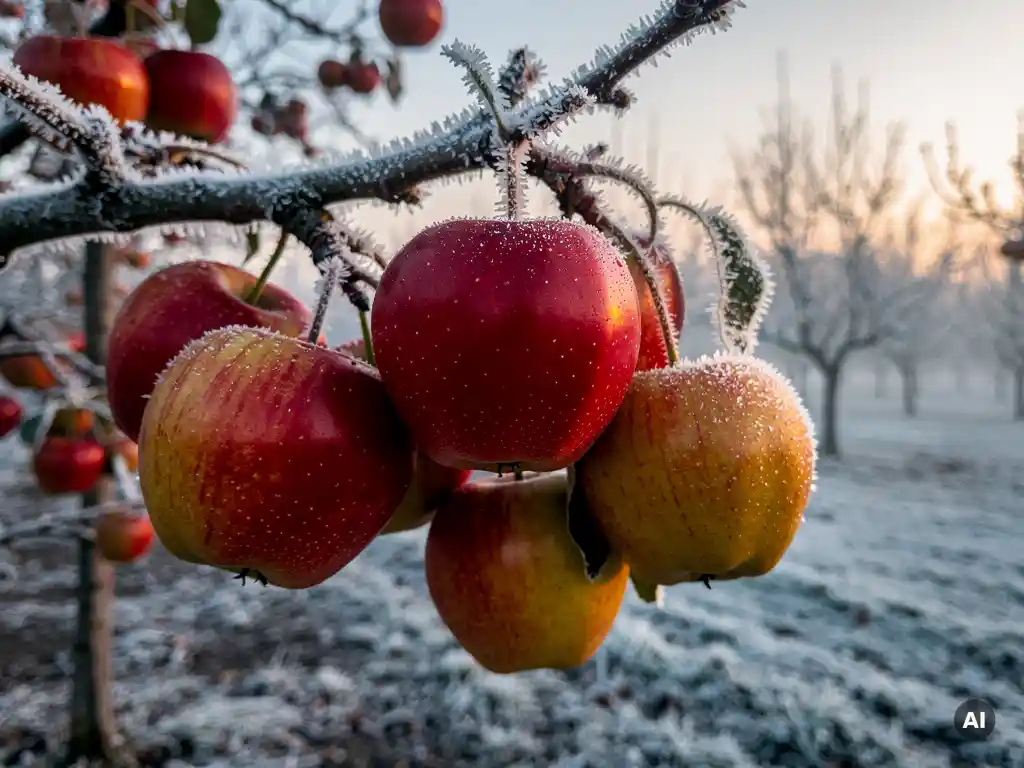
As winters grow milder across many apple-growing regions, varieties that depend on long periods of cold are struggling to perform reliably. Low-chill apple varieties and climate-resilient cultivars are increasingly the practical answer for growers facing warming winters. The questions below unpack the science behind chilling requirements, what breeders are doing about it, and how growers should respond today.
If you want to discuss your specific situation with us directly, feel free to get in touch and we will be happy to help.
Why do apple trees need winter cold to produce fruit?
Apple trees need winter cold to break dormancy, a biological rest period that protects them from premature growth during unpredictable autumn warm spells. Without enough accumulated cold, trees fail to wake up uniformly in spring, leading to poor bud break, irregular flowering, low fruit set, and reduced yields. This cold requirement is measured in chilling hours, typically defined as hours below 7°C (45°F).
During dormancy, apple trees accumulate what is known as a chilling requirement. Each variety has its own threshold, often ranging from around 400 to more than 1,200 chilling hours depending on the cultivar. When that threshold is not met, the physiological signals that trigger uniform bud break simply do not fire correctly. The result is not just a poor harvest in a single season but cumulative stress on the tree that can reduce its productive lifespan.
This dependency on cold is deeply embedded in the genetics of most commercial apple varieties, which were bred over centuries in temperate climates where cold winters were reliable. As those winters become less predictable, the chilling requirement has shifted from a background assumption to a frontline concern for apple cultivation worldwide.
Which apple varieties perform well with fewer chilling hours?
Low-chill apple varieties are those bred or selected to complete dormancy with fewer accumulated cold hours, typically below 600 to 700 chilling hours. Varieties in this category can flower and fruit reliably even in regions where winters are short or mild. Traditional examples include Anna, Dorsett Golden, and Tropic Sweet, though newer breeding programs are expanding the range considerably.
The challenge with many established low-chill varieties is that they were not bred with modern market demands in mind. Taste, texture, shelf life, and disease resistance were often secondary to simply achieving adequate dormancy release. This means growers in warming regions have historically faced a trade-off: accept lower fruit quality or risk crop failure with premium varieties that need more cold.
That trade-off is narrowing. Breeding programs are now producing cultivars that combine genuinely low chilling requirements with the flavour complexity, crunch, and appearance that premium markets expect. Exploring the full range of what is now available is worth doing before committing to a replanting strategy. You can browse our variety portfolio to see what we have developed with exactly these pressures in mind.
How are apple breeders developing climate-resilient varieties?
Apple breeders are developing climate-resilient varieties by combining traditional cross-breeding with molecular marker technology, which allows them to identify and select for traits like reduced chilling requirements, heat tolerance, and disease resistance far earlier in the breeding cycle. This speeds up the development of cultivars that can perform reliably in a broader range of climatic conditions.
At Better3Fruit, we work with over 30,000 new varieties under evaluation at any given time, with 10,000 new seedlings of each crop entering the field every year. This scale matters because climate resilience is not a single trait, it is a combination of genetic factors that must align with taste, texture, yield, and grower practicality. Molecular markers allow us to screen for these combinations without waiting years for each generation to mature and fruit.
Beyond chilling requirements, climate resilience in apple breeding also means addressing the knock-on effects of warming winters: increased disease pressure as mild, wet conditions favour fungal pathogens, greater pest activity, and more variable spring frosts that can damage early-flowering cultivars. A truly climate-resilient apple variety must be robust across all of these dimensions, not just tolerant of reduced cold.
What regions are most affected by declining winter chill?
The regions most affected by declining winter chill are those at the warmer edges of traditional apple-growing zones, including parts of southern Europe, the Mediterranean basin, South Africa, Australia, South America, and the southern United States. In these areas, chilling hour accumulation has already dropped measurably over recent decades, and projections suggest further reductions through 2026 and beyond.
However, the impact is not limited to historically warm growing regions. Temperate zones in central Europe, the Pacific Northwest, and parts of Asia are also experiencing shorter and more variable cold periods. Growers in these areas may not yet be seeing consistent crop failures, but they are noticing irregularities in bud break timing, uneven flowering, and years where yields fall sharply without an obvious weather event to explain it.
The practical implication is that almost no major apple-producing region can treat warming winters as someone else’s problem. Even in cooler climates, the trajectory of change is clear enough that variety selection decisions made today will need to account for conditions that may look quite different in ten or fifteen years.
Should growers switch varieties now or wait for better options?
Growers in regions already experiencing insufficient chilling hours should act now rather than wait, because the cost of repeated poor harvests compounds quickly and replanting takes years to generate returns. Waiting for a perfect variety is rarely the right strategy when reliable options already exist. That said, growers in less severely affected regions have more room to plan carefully and select varieties suited to their specific market and climate trajectory.
The decision depends on a few practical factors:
- Current chilling hour shortfall: If your region is already regularly falling short of the requirements for your planted varieties, switching is urgent.
- Market positioning: Low-chill varieties vary widely in quality and market appeal. Choose a variety that fits your target market, not just your climate.
- Replanting timeline: Apple orchards take three to five years to reach commercial production. The sooner a decision is made, the sooner the new planting pays off.
- Variety pipeline: Breeding programs are releasing new climate-resilient cultivars regularly. Staying informed about what is coming helps growers make better long-term bets.
The risk of waiting too long is that growers find themselves replanting under pressure, with fewer seasons of reliable income to fund the transition. Acting with a clear strategy now, even if it means a phased replanting over several years, is almost always preferable to reacting to consecutive poor harvests.
We work with growers and licensing partners worldwide to match the right variety to the right region and market. If you are ready to explore your options, contact us and we will help you find the best path forward for your orchard.
This content was generated with the help of AI and it may contain mistakes