
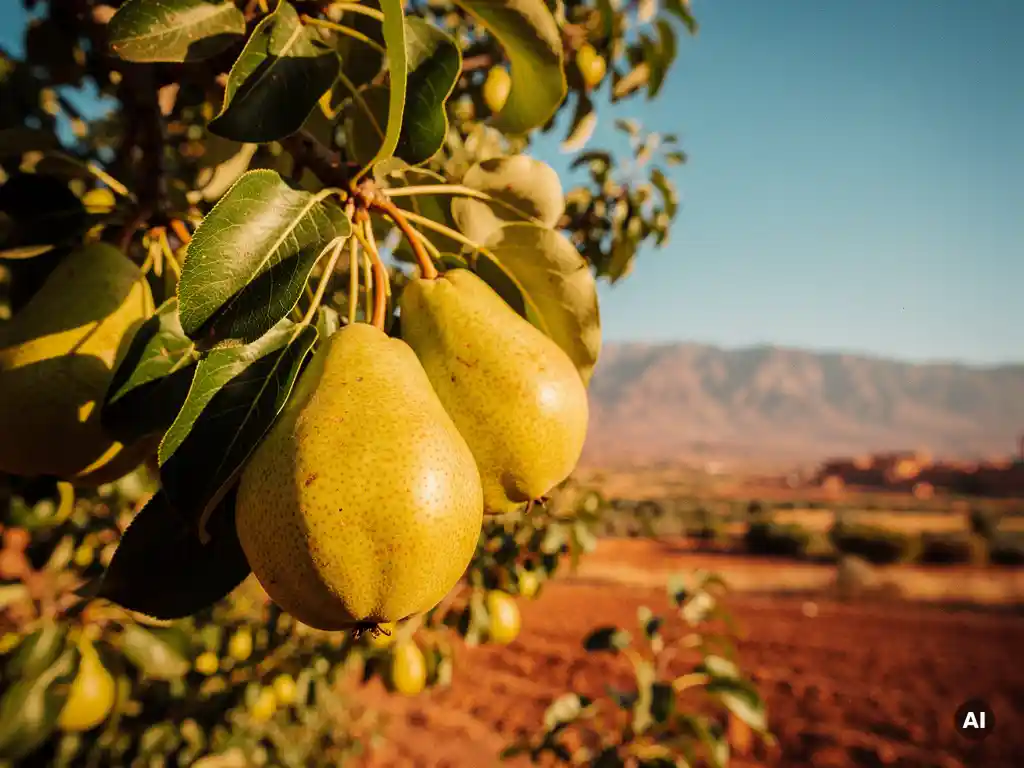
Morocco is well-suited to growing several pear varieties, particularly low-chill cultivars that thrive in warm, semi-arid climates with mild winters. The best options for Moroccan growers include varieties such as Coscia, Spadona, and Moonglow, along with selected Asian pear types that require fewer chilling hours to break dormancy and set fruit reliably. The sections below unpack the key questions every grower should consider before choosing a cultivar. If you want to discuss variety selection with us directly, feel free to get in touch and we will be happy to help.
What climate conditions in Morocco suit pear cultivation?
Morocco’s climate suits pear cultivation in its highland and mountain regions, particularly the Middle Atlas, High Atlas, and Rif areas, where cooler winters provide enough chilling hours for dormancy. Coastal and lowland regions are generally too warm for most European pear varieties but can support low-chill cultivars, especially where irrigation is available during the dry summer months.
Pear trees need a period of winter cold to break dormancy and flower properly. In Morocco, elevations above 800 to 1,000 metres typically deliver enough cold to satisfy most commercial varieties. The Saiss Plain around Fez and Meknes and the Souss Valley have also seen successful pear production, though variety selection in those zones requires more careful thought. Summers in Morocco are hot and dry, which actually benefits fruit quality by concentrating sugars and reducing fungal pressure, provided irrigation is managed well.
Which pear varieties perform best in low-chill environments?
In low-chill environments like Morocco’s warmer lowland and coastal zones, the pear varieties that perform best are Coscia, Spadona, Hood, and Moonglow. These cultivars require fewer than 400 to 500 chilling hours to complete dormancy, making them reliable producers even where winters are short and mild. Asian pear varieties such as Hosui and Shinseiki are also strong performers under low-chill conditions.
Coscia is particularly popular in North African pear farming because it ripens early, handles heat reasonably well, and produces good yields without requiring deep winter cold. Spadona is another long-established choice that adapts to the Mediterranean-style climate found across much of Morocco. For growers looking to differentiate in the market, Moonglow offers attractive fruit size and a pleasant flavour profile while still performing under lower chill accumulation.
It is worth noting that even within low-chill varieties, performance varies considerably depending on rootstock, soil type, and microclimate. Trialling a variety on a small block before committing to large-scale planting is always a sound approach in pear farming in Morocco.
How do chilling hours affect pear variety selection in Morocco?
Chilling hours are the number of hours during winter when temperatures fall between 0°C and 7°C, and they directly determine whether a pear tree will break dormancy uniformly, flower well, and set a consistent crop. In Morocco, chilling hour accumulation varies dramatically by region and altitude, which makes it the single most important factor when selecting pear cultivars for a specific site.
Most European pear varieties require between 800 and 1,200 chilling hours. Morocco’s mountain regions can meet this threshold, but lower-altitude sites often accumulate only 200 to 500 hours. Planting a high-chill variety in a low-chill location results in erratic bud break, poor fruit set, and unreliable harvests year after year. This is why understanding your site’s chilling hour profile before choosing a variety is essential for successful pear production in Morocco.
Growers in transitional zones, where chill accumulation sits between 400 and 700 hours, often do best with mid-chill varieties such as Beurré Hardy or Conference, which offer more flexibility than traditional high-chill European types while still delivering commercially attractive fruit.
What are the differences between European and Asian pear varieties for Moroccan growers?
The key difference between European and Asian pear varieties for Moroccan growers is chilling hour requirement and fruit texture. European pears such as Conference and Williams need more winter cold and produce soft, buttery fruit that ripens off the tree. Asian pears generally require fewer chilling hours and produce crisp, juicy fruit that is eaten fresh directly from the tree, making them better suited to warmer growing zones in Morocco.
European pear varieties
European varieties dominate the commercial pear market globally and typically command strong consumer recognition. However, they are more demanding in terms of climate. In Morocco, they perform reliably only in cooler highland areas. Post-harvest handling is also more complex, as European pears must be cold-stored and then ripened before sale, which adds logistical requirements for Moroccan pear producers.
Asian pear varieties
Asian pears, sometimes called nashi or apple pears, are ready to eat at harvest, which simplifies the supply chain considerably. Their lower chilling requirements make them a practical option for growers in Morocco’s warmer zones. They also tend to have a longer shelf life on the tree, giving growers more flexibility around harvest timing. The trade-off is that consumer familiarity with Asian pears in European export markets is still growing, which can affect pricing and marketing strategy.
Which pear varieties offer the best disease resistance in Morocco?
For Moroccan growers, the pear varieties with the strongest disease resistance include those with natural tolerance to fire blight, the most economically damaging bacterial disease affecting pears in the region. Varieties such as Harrow Sweet, Moonglow, and Magness carry useful fire blight resistance, while some newer breeding selections also show improved tolerance to pear scab and psylla pressure.
Fire blight caused by the bacterium Erwinia amylovora is a serious threat in Morocco’s warmer, wetter spring conditions, particularly in irrigated orchards. Choosing a resistant variety significantly reduces the need for costly chemical interventions and lowers the risk of catastrophic orchard losses. Moonglow, already noted for its low-chill tolerance, doubles up as a sensible choice in Morocco precisely because it combines climate adaptability with meaningful fire blight resistance.
Beyond fire blight, pear scab can be a problem in higher-altitude areas with more rainfall. Varieties with scab tolerance reduce spray programmes and improve sustainability outcomes, which is increasingly important for growers supplying quality-conscious export markets. We place disease and pest tolerance at the core of our breeding strategy, and you can explore our current variety portfolio to see how these traits are built into new cultivars.
When is the best time to plant pear trees in Morocco?
The best time to plant pear trees in Morocco is during the dormant season, typically between November and February. Planting during this window allows the root system to establish before the heat and drought stress of summer arrive. In Morocco’s Mediterranean and semi-arid climate, early establishment is critical to long-term tree vigour and productivity.
Bare-root trees should be planted as early in the dormant period as possible, ideally after the first significant autumn rains have softened the soil. Container-grown trees offer slightly more flexibility and can be planted a little later in the season, but they still benefit from being established well before spring growth begins. Growers in Morocco’s hotter lowland zones should prioritise irrigation infrastructure before planting, as young pear trees are vulnerable to water stress during their first two summers.
Soil preparation, rootstock selection, and spacing decisions should all be finalised before the planting window opens. In Morocco, quince rootstocks are commonly used for European pear varieties because they induce earlier cropping and are well adapted to the heavier clay soils found in many of the country’s productive agricultural valleys.
Selecting the right pear variety for your Moroccan growing conditions is a decision that shapes the profitability and resilience of your orchard for decades. Whether you are farming in the cool highlands or exploring lower-chill options in warmer zones, matching cultivar to climate and market is the foundation of successful pear production in Morocco. Contact us to discuss which varieties might be the right fit for your specific situation, and we will be glad to guide you through the options.
This content was generated with the help of AI and it may contain mistakes