
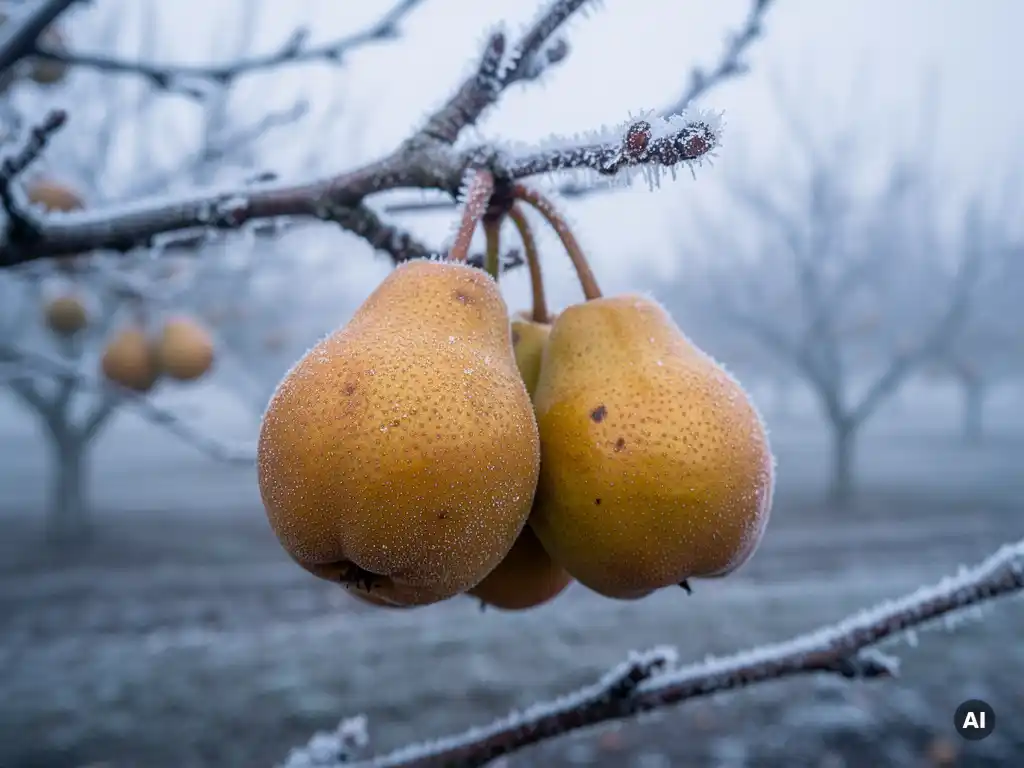
The chill unit requirement is important for pear varieties because it determines whether a tree will break dormancy correctly, flower uniformly, and ultimately produce a commercial crop. Without sufficient chilling, pear trees struggle to wake up from winter dormancy in a coordinated way, leading to erratic flowering, poor fruit set, and reduced yields. The sections below unpack exactly how chilling works, why it varies between varieties, and what it means for growers navigating a changing climate. If you have specific questions about variety selection or pear breeding, feel free to get in touch with us directly.
What happens to pear trees that don’t get enough chilling hours?
Pear trees that fail to accumulate enough chilling hours during winter will not break dormancy properly in spring. The result is delayed, uneven, or incomplete bud break, which means flowers open at different times, pollination becomes inefficient, and fruit set drops sharply. In severe cases, trees may produce almost no crop at all despite appearing otherwise healthy.
Beyond the immediate crop loss, repeated chilling deficits weaken the tree over time. Buds that never fully complete dormancy remain in a kind of physiological limbo, which exhausts carbohydrate reserves and makes the tree more vulnerable to disease and stress. Growers in regions with mild winters often report a gradual decline in orchard productivity when the same variety is grown year after year without adequate cold exposure. This is why matching the chill unit requirement of a pear variety to the local climate is one of the most consequential decisions a grower can make.
How do chill units actually affect fruit development in pears?
Chill units affect fruit development in pears by regulating the hormonal signals that control bud break, flowering, and cell division in the developing fruit. When a pear tree accumulates enough chill units, it releases growth inhibitors built up during dormancy and becomes fully responsive to warming spring temperatures. This synchronized awakening drives uniform flowering, which is the foundation of a well-timed, even fruit set.
The downstream effects on fruit quality are significant. Trees that break dormancy uniformly tend to produce fruit with more consistent size, better colour development, and higher sugar content, because the entire canopy is working in biological sync. When chilling is insufficient, some buds activate earlier than others, creating competition for resources within the tree. This uneven resource allocation often results in smaller fruit, lower dry matter content, and a harvest window that is harder to manage. For commercial pear production, where uniformity drives packout rates and market returns, the chill unit requirement is not a minor technical detail but a central quality driver.
What’s the difference between chill hours and chill units?
Chill hours and chill units both measure winter cold exposure, but they use different models to do so. Chill hours simply count the total number of hours when temperatures fall between 0°C and 7°C. Chill units, by contrast, use a more sophisticated model that assigns different weights to different temperature ranges, recognising that not all cold temperatures are equally effective at satisfying dormancy.
The most widely used chill unit model is the Utah model, which assigns positive values to temperatures in the most effective chilling range (around 6°C to 8°C), smaller positive values to temperatures slightly outside that range, and actually negative values to temperatures that are too warm after a cold period. This means a warm spell in January can partially cancel out chilling already accumulated. A simpler chilling hours count would ignore this effect entirely.
For pear growers in regions with variable winters, using chill units rather than raw chilling hours gives a more accurate picture of whether a variety’s dormancy requirement has genuinely been met. Breeders and researchers typically express variety requirements in chill units precisely because the model better predicts real-world orchard performance across diverse climates.
Why do different pear varieties have different chill unit requirements?
Different pear varieties have different chill unit requirements because dormancy depth is a genetically determined trait that evolved in response to the climate of the region where each variety or its ancestors originated. Varieties developed in cold continental climates tend to have high chill unit requirements, while those bred for or selected in milder regions require far less cold to complete dormancy.
This genetic variation is actually a resource for breeders. By selecting parent lines with lower chill unit requirements, it is possible to develop new pear varieties that perform reliably in regions with mild winters without sacrificing other commercially important traits like taste, texture, or disease resistance. At Better3Fruit, we work with large populations of new seedlings every year, and dormancy characteristics are among the traits we evaluate as part of our broader breeding strategy. Exploring our current pear variety portfolio gives a sense of how these traits translate into commercial releases suited to different growing regions.
The range of chill unit requirements across commercial pear varieties is wide. Some traditional European varieties require well over a thousand chill units, making them poorly suited to Mediterranean or subtropical climates. Newer varieties developed with low-chill objectives can perform adequately with a fraction of that exposure, opening up production regions that were previously unsuitable for pears.
How do growers match pear varieties to their local chill accumulation?
Growers match pear varieties to their local chill accumulation by first calculating the average chill units their site accumulates each winter, then selecting varieties whose published requirements fall comfortably within that range. Using multi-year temperature records rather than a single season’s data is essential, because winter cold varies considerably from year to year.
In practice, growers and advisors use a few key steps:
- Record or obtain local temperature data for multiple recent winters, ideally at least ten years of records to capture variability.
- Apply a chill unit model (such as the Utah model) to calculate accumulated chill units for each season and identify the typical range and the worst recent years.
- Select varieties with requirements below the low end of the local range, not just the average, to ensure reliable performance even in warmer-than-normal winters.
- Consult variety performance data from trials conducted in comparable climates, since published chill unit requirements are often derived from specific testing environments.
Working with breeders and licensing organisations that provide climate-matched variety guidance reduces the risk of planting a variety that performs well in trials but underperforms in a specific orchard’s microclimate. Variety selection is ultimately a long-term investment, and matching chilling requirements precisely at the outset avoids costly replanting decisions later.
Will climate change affect chill unit accumulation for pear growers?
Yes, climate change is already reducing chill unit accumulation in many pear-growing regions, and the trend is expected to continue. Rising winter temperatures mean fewer hours in the optimal chilling range and more frequent warm spells that, under models like the Utah model, can actively negate previously accumulated chilling. Growers in historically marginal chilling regions face the most immediate pressure, but even producers in traditionally cold areas are beginning to notice shifts.
The practical consequences for pear cultivation are significant. Varieties that have been commercially reliable for decades may gradually become unsuitable for regions where winters are warming fastest. This creates urgency around two parallel responses: adapting orchard management and accelerating the development of low-chill pear varieties.
On the management side, some growers are experimenting with evaporative cooling to extend effective chilling periods, or with chemical agents that partially compensate for insufficient dormancy. These are stopgap measures rather than long-term solutions. The more durable response is breeding. Developing new pear varieties with lower chill unit requirements and strong climate resilience is a core part of how the industry will adapt to a warmer world, and it is a direction that shapes our long-term breeding goals at Better3Fruit. Climate is becoming as important a selection criterion in pear cultivation as taste or disease resistance, and the varieties that succeed commercially in the coming decades will need to perform reliably across a wider and more variable range of winter conditions.
If you are evaluating variety options for a changing climate or want to learn more about how chill unit requirements factor into our breeding work, reach out to us to start the conversation.
This content was generated with the help of AI and it may contain mistakes