
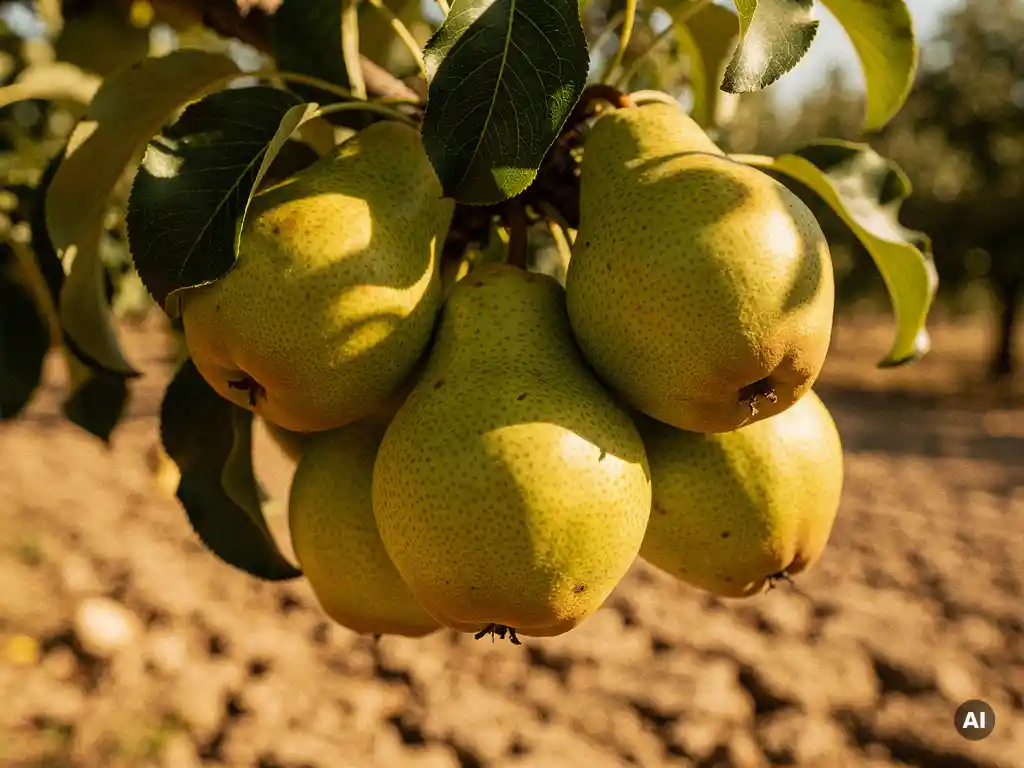
Pear varieties that retain their quality under warm growing conditions are those bred specifically for heat resilience, combining strong skin integrity, firm flesh, and the ability to develop full flavour even when temperatures rise beyond the traditional comfort zone of the crop. Varieties with these traits avoid the most common heat-related defects, russeting, premature softening, and poor colour development, that undermine commercial value in warmer seasons. The sections below explore how heat affects fruit quality, which traits matter most, and how modern breeding programmes are responding. Feel free to get in touch with us if you would like to discuss variety selection directly.
How does heat stress affect pear fruit quality?
Heat stress reduces pear fruit quality by accelerating ripening, weakening cell wall structure, and disrupting the development of sugars, acids, and aromas. When temperatures consistently exceed the optimal range during the growing season, the result is fruit that softens too early, loses its characteristic crunch or buttery texture, and often develops surface russeting or sunburn damage that makes it commercially unacceptable.
The impact of warm growing conditions on pears is more pronounced than in many other tree fruits because pears are particularly sensitive to temperature fluctuations during cell division and the final swell period. High night-time temperatures are especially damaging because they prevent the fruit from recovering from daytime heat load, which speeds up respiration and depletes the carbohydrate reserves needed for flavour development. The result is fruit that looks mature on the outside but lacks the internal quality that consumers and packers expect.
Skin finish is another casualty of heat stress. Many European pear varieties develop russeting or cracking when exposed to high temperatures combined with low humidity, making them difficult to market as premium fresh produce. For growers in warm climates, this is one of the most immediate and visible signs that a variety is not suited to their conditions.
Which pear varieties perform best in warm growing conditions?
Pear varieties that perform best in warm growing conditions are those with genetic tolerance to high temperatures, typically characterised by thicker cuticles, lower susceptibility to russeting, and a ripening pattern that remains stable even when the season runs hotter than average. Varieties bred with climate resilience as a primary trait consistently outperform traditional European varieties in warm-climate trials.
Traditional varieties such as Conference and Doyenné du Comice were selected in cooler northern European climates and often struggle when grown further south or during increasingly warm summers. In contrast, varieties developed through modern breeding programmes, including work carried out by us at Better3Fruit, are evaluated specifically for performance across a range of climatic conditions, including warmer growing environments.
Asian pear types and certain hybrid varieties tend to show stronger heat tolerance at a baseline level, but the most commercially promising options for warm-climate growers are purpose-bred European-style pears that combine heat resilience with the eating quality and shelf life that fresh fruit markets demand. Exploring the full range of Better3Fruit varieties gives growers a clearer picture of what is available for different growing environments.
What traits should a pear variety have to withstand warm climates?
A pear variety suited to warm climates should combine heat-stable ripening, low russeting tendency, strong skin integrity, and the ability to develop adequate flavour complexity without requiring prolonged cool temperatures. These traits work together to ensure that fruit quality is maintained from the orchard through to the consumer, even when growing conditions are far from ideal.
The most important traits to look for include:
- Heat-stable ripening: The variety should ripen on a predictable schedule even when temperatures are elevated, rather than softening unevenly or collapsing internally before it can be harvested.
- Low russeting susceptibility: Varieties prone to russeting become commercially unviable in warm, dry conditions where temperature swings stress the fruit skin early in development.
- Firm flesh retention: Flesh that holds its structure under warm storage and transport conditions is essential for the supply chain to function without excessive loss.
- Flavour development independence: Some varieties require extended cool periods to develop full sugar and acid balance. Warm-climate varieties should reach acceptable eating quality without this requirement.
- Disease and pest tolerance: Warm conditions often intensify pest and disease pressure, so varieties with built-in resistance reduce the risk of quality loss from secondary causes.
No single trait is sufficient on its own. A variety that ripens reliably in heat but russettes heavily is still commercially problematic. Breeding programmes that evaluate varieties across multiple warm-climate environments over several seasons are best placed to identify combinations of these traits that hold up under real growing conditions.
How is climate resilience built into modern pear breeding?
Climate resilience is built into modern pear breeding by using molecular markers to identify and select for specific genetic traits linked to heat tolerance, drought response, and disease resistance, long before a variety ever reaches the orchard. This approach allows breeders to screen thousands of seedlings efficiently and focus field evaluation on the most promising candidates.
At Better3Fruit, we use molecular marker technology as a core part of our breeding process. With over 10,000 new varieties of each crop entering the field every year and more than 30,000 varieties under evaluation at any given time, the scale of our programme allows us to identify climate-resilient traits across a genuinely diverse genetic pool. This is not a marginal consideration in our work: climate resilience and multi-level sustainability are primary long-term goals of our breeding strategy.
Field evaluation across multiple climatic zones is equally important. A variety that performs well in a Belgian trial season may behave differently under the consistent heat of a Mediterranean or Southern Hemisphere growing environment. Exposing varieties to real warm-climate conditions over multiple seasons reveals how traits interact under stress and which combinations hold up commercially. This multi-environment testing is what separates varieties that are genuinely heat resilient from those that simply tolerate one warm season before quality declines.
What’s the difference between heat tolerance and drought tolerance in pears?
Heat tolerance and drought tolerance are related but distinct traits in pears. Heat tolerance refers to a variety’s ability to maintain fruit quality and normal physiological function when air and canopy temperatures are high. Drought tolerance refers to the ability to manage water stress, to continue growing and fruiting productively when soil moisture is limited. A variety can have one without the other.
The distinction matters practically because warm growing conditions do not always come with reduced rainfall. In some regions, growers face high temperatures with adequate irrigation available, making heat tolerance the priority. In others, heat and water scarcity arrive together, requiring varieties that can manage both stresses simultaneously.
How heat tolerance works in pears
Heat-tolerant varieties maintain cell wall integrity and normal ripening processes even when temperatures exceed the crop’s comfort range. The key mechanisms involve stable enzyme activity during fruit development and cuticle characteristics that limit water loss and sunburn damage. These traits are largely independent of how the root system responds to soil moisture levels.
How drought tolerance works in pears
Drought-tolerant varieties manage water use more efficiently through the root system and leaf stomata, reducing the impact of reduced soil moisture on growth and fruit development. However, a drought-tolerant variety grown in high heat without irrigation can still suffer heat-related fruit quality problems if it lacks the specific cellular resilience associated with heat tolerance. For growers in genuinely arid warm climates, both traits need to be present in a variety for it to perform reliably.
Understanding this distinction helps growers ask the right questions when evaluating new varieties for their specific environment, and it guides breeders like us to develop varieties that address the full complexity of what warm-climate growers actually face in the orchard. If you want to explore which variety best fits your growing conditions, contact us and we will help you find the right match.
This content was generated with the help of AI and it may contain mistakes