
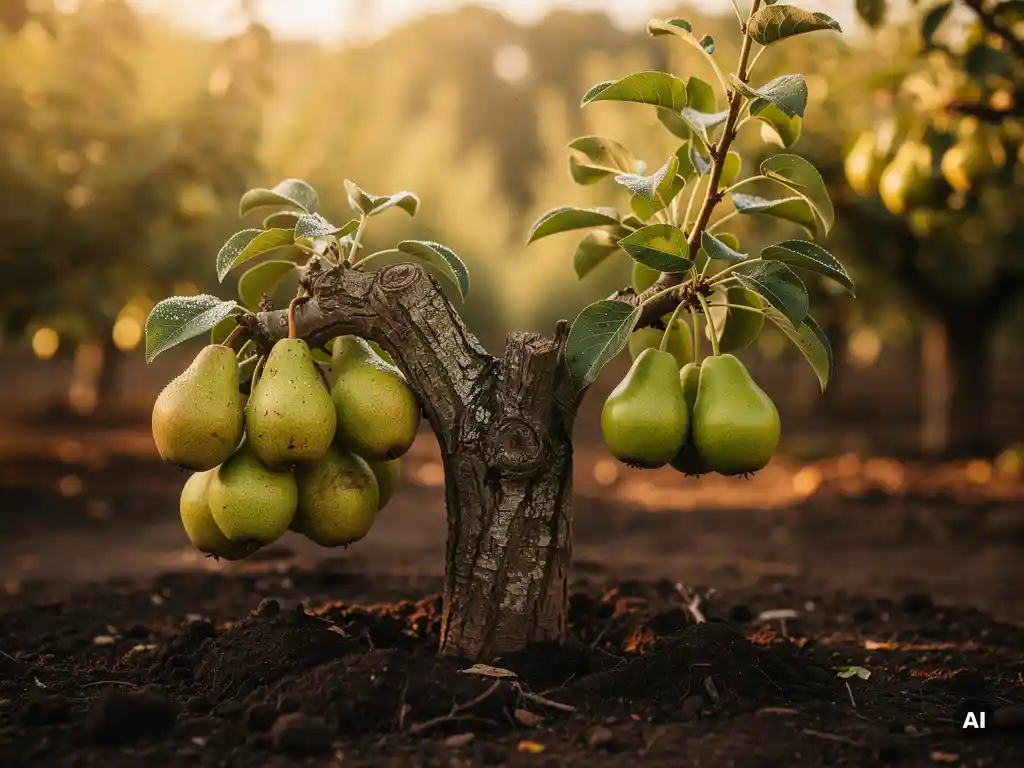
The core difference between traditional and climate-resilient pear varieties lies in how they respond to environmental stress. Traditional varieties were bred for stable, predictable growing conditions and often struggle when temperatures, rainfall patterns, or pest pressures shift. Climate-resilient pear varieties, by contrast, are developed to maintain performance, in yield, fruit quality, and health, even as growing conditions become less predictable. Below, we unpack the key questions growers and industry partners are asking about this shift in pear cultivation. If you’d like to discuss what this means for your operation, feel free to get in touch with us directly.
How do traditional pear varieties struggle with modern climate conditions?
Traditional pear varieties struggle with modern climate conditions because they were selected and developed during periods of relatively stable weather. They perform well within a narrow band of temperature, humidity, and seasonal timing, and when those conditions shift, their yields, fruit quality, and disease resistance can all deteriorate significantly.
Many well-established pear cultivars were bred decades ago, long before climate variability became a defining challenge for fruit growers. As a result, they carry little genetic tolerance for late spring frosts, prolonged summer heat, irregular rainfall, or the expanded range of fungal and bacterial diseases that warmer, wetter winters encourage. For growers, this translates into higher input costs, more unpredictable harvests, and greater reliance on chemical interventions to protect crops that were never designed to cope with today’s conditions.
Pear cultivation is particularly sensitive to climate shifts because pears have specific chilling requirements, a set number of cold hours needed during dormancy to flower and fruit properly. When winters warm, those requirements go unmet, leading to erratic flowering, poor fruit set, and reduced yields. Traditional varieties, optimised for the climates of the twentieth century, are increasingly mismatched with the realities of pear growing in 2026.
What traits make a pear variety climate-resilient?
A climate-resilient pear variety is one that combines tolerance to abiotic stresses, such as heat, drought, and irregular frost, with strong resistance or tolerance to the diseases and pests that thrive under shifting climate conditions. Crucially, these traits must coexist with good fruit quality and acceptable grower yield to be commercially viable.
The most important traits that define climate resilience in pear varieties include:
- Disease and pest tolerance or resistance: Reduced susceptibility to fire blight, scab, and psylla, all of which become more prevalent as climates warm and seasons shift.
- Flexible chilling requirements: The ability to flower and fruit reliably even when winter cold is insufficient or inconsistent.
- Heat and drought tolerance: Maintaining fruit size, skin finish, and internal quality during periods of high temperature or reduced water availability.
- Late-frost resilience: Later or more robust flowering that reduces vulnerability to spring frost events, which are becoming more frequent in many pear-growing regions.
- Strong agronomic performance: Reliable yield and consistent fruit quality across a range of growing conditions, reducing grower risk from season to season.
No single trait defines climate resilience on its own. The real value lies in combining these characteristics so that a variety can adapt across multiple stressors simultaneously, something that only becomes possible through structured, long-term breeding programmes.
How does modern pear breeding develop climate-resilient varieties?
Modern pear breeding develops climate-resilient varieties by combining traditional cross-breeding with advanced tools such as molecular markers, which allow breeders to identify and select for specific genetic traits far earlier and more precisely than conventional methods allow. This speeds up the development cycle and improves the accuracy of trait selection.
At Better3Fruit, we run one of the largest and most innovative apple and pear breeding programmes in the world. Every year, we introduce 10,000 new pear varieties into field evaluation, with more than 30,000 under assessment at any given time. This scale is essential, climate resilience is a complex, multi-trait target, and finding varieties that genuinely deliver across taste, disease resistance, yield, and stress tolerance requires evaluating an enormous genetic pool.
Molecular marker technology plays a central role in our approach. Rather than waiting years for a tree to mature before assessing its traits, we can screen seedlings at an early stage for key genetic markers associated with disease resistance, fruit quality, and climate adaptability. This dramatically reduces the time from cross to commercial release and allows us to pursue ambitious breeding targets, including multi-level sustainability and long-term climate resilience, without sacrificing the fruit quality that growers and consumers expect.
Our breeding strategy deliberately prioritises disease and pest tolerance alongside taste, texture, and grower yield. Climate resilience is not treated as a separate goal, it is woven into every variety we develop, because a variety that cannot perform under real-world growing conditions will never succeed commercially, regardless of how good it tastes.
Do climate-resilient pear varieties compromise on taste or quality?
No, climate-resilient pear varieties do not have to compromise on taste or quality. The assumption that resilience comes at the expense of eating experience is a common misconception, and one that modern breeding programmes are actively disproving. When breeding targets are set correctly, disease resistance, climate adaptability, and exceptional fruit quality can all be achieved in the same variety.
This balance is only possible when taste and texture are treated as non-negotiable alongside agronomic traits. If a breeding programme deprioritises eating quality in favour of resilience, the result may be a robust variety that consumers reject at retail. That is why we evaluate our pear varieties against both field performance and fruit quality standards throughout the entire development process, not as a final check, but as an ongoing filter.
The commercial success of club varieties in the apple category demonstrates that consumers will actively seek out fruit that delivers a superior eating experience. The same principle applies to pears. A climate-resilient variety that also offers outstanding flavour, texture, and appearance has every opportunity to build a strong market position, and that is precisely the kind of variety our breeding programme is designed to produce. You can explore our current variety portfolio to see how these traits come together in practice.
Which pear growing regions benefit most from climate-resilient varieties?
Pear growing regions that face the greatest climate variability stand to benefit most from climate-resilient varieties. This includes areas experiencing warmer, shorter winters that reduce chilling hours, regions with increasing summer heat and drought stress, and zones where fire blight and other climate-sensitive diseases are expanding their range.
In practical terms, this covers a broad and growing share of the world’s pear-producing regions:
- Western Europe: Countries such as Belgium, the Netherlands, and northern France are experiencing milder winters and more variable spring weather, putting traditional Conference and Comice varieties under increasing pressure.
- Southern Europe: Spain, Italy, and Portugal face heat stress and water scarcity that challenge traditional varieties bred for cooler, more humid conditions.
- North America: Pacific Northwest growing regions are seeing more frequent heat events and shifting disease pressure, particularly fire blight.
- Southern Hemisphere: Argentina, South Africa, and Australia are all navigating climate shifts that affect flowering, fruit set, and post-harvest quality in established pear orchards.
That said, the benefits of climate-resilient pear varieties are not limited to regions already under acute stress. Even in areas where conditions remain relatively stable today, planting varieties with built-in resilience is a form of future-proofing, reducing long-term agronomic risk and lowering dependence on chemical inputs across the full growing cycle. As climate variability becomes the norm rather than the exception, the question for growers is less about whether to transition and more about when.
If you are evaluating which pear varieties are best suited to your region and growing conditions, we are happy to help. Contact us to start a conversation about licensing, variety selection, or partnership opportunities with Better3Fruit.
This content was generated with the help of AI and it may contain mistakes