
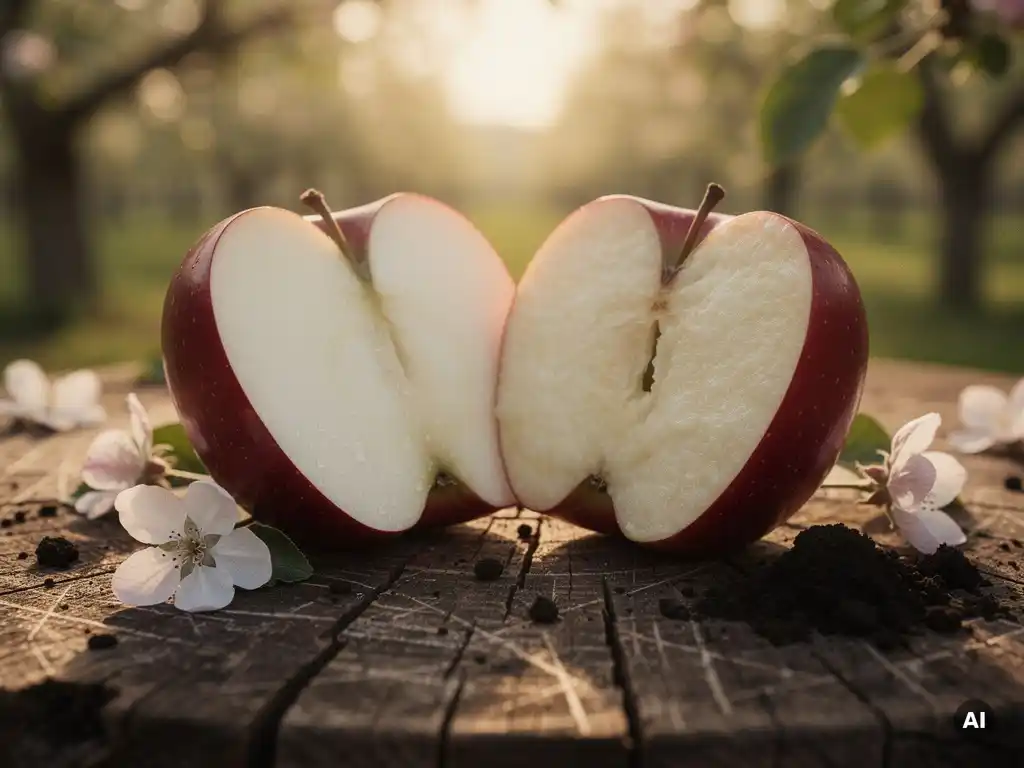
An apple turns mealy when its cell walls break down and the cells separate from each other rather than snapping apart cleanly. This process, called mealiness or flesh softening, is driven primarily by the natural ripening process, specifically the breakdown of pectin, the substance that holds apple cells together. Storage conditions, harvest timing, and variety all play a significant role in how quickly this happens. Below, we answer the most common questions about why apples lose their crunch and what you can do about it. If you want to reach out directly, feel free to get in touch with us.
What causes an apple to become mealy?
An apple becomes mealy when pectin in the cell walls breaks down, causing cells to separate rather than rupture when you bite into the fruit. A crunchy apple snaps because its tightly bonded cells break apart together. A mealy apple has lost that cohesion, so the cells slide apart and the flesh feels grainy or powdery rather than firm and juicy.
The main driver of this breakdown is the natural ripening process, which accelerates after harvest. As an apple ripens, enzymes inside the fruit actively degrade the pectin that binds cells together. Ethylene gas, which apples produce naturally, speeds up this process significantly. The longer an apple is left to ripen beyond its peak, the more pronounced the mealiness becomes. This is why an apple that tastes perfectly crisp one week can feel soft and disappointing the next.
Beyond natural ripening, physical damage and bruising also trigger localized cell breakdown. Even a small knock can initiate the softening process in a concentrated area, which is why handling apples gently during transport and storage matters so much for preserving texture.
Does temperature affect how quickly apples go mealy?
Yes, temperature has a direct and significant effect on how quickly an apple turns mealy. Cold temperatures slow down the enzymatic activity responsible for pectin breakdown, while warmer temperatures accelerate it. An apple stored at room temperature will become mealy far faster than one kept in a refrigerator or cold store.
Most apples keep their texture best when stored between 0°C and 4°C (32°F to 39°F) with high humidity. At these temperatures, the ripening process slows dramatically, preserving both firmness and flavor for weeks or even months, depending on the variety. This is why commercial cold storage is central to the apple supply chain.
There is, however, an important exception worth knowing: some apple varieties are susceptible to a condition called low-temperature breakdown or chilling injury. When stored at temperatures that are too cold for too long, these varieties can develop internal mealiness even without appearing overripe on the outside. This is one reason why variety selection matters as much as storage temperature when you want to keep apples crunchy.
Which apple varieties stay crunchy the longest?
Apple varieties with naturally firm, dense flesh and strong cell wall structure tend to stay crunchy the longest. Varieties bred for high crunchiness and good storage performance consistently outperform older or more delicate cultivars when it comes to maintaining texture over time.
At Better3Fruit, breeding for texture is a core part of what we do. Our apple varieties are developed with traits like firmness, juiciness, and crunch built in from the start. Kanzi®, one of our most established varieties, is well known for its firm, dense flesh that holds up well during storage. More recently, varieties like Morgana® and Giga® have been developed with long-term texture retention as a key breeding goal.
In general, varieties with higher starch content at harvest tend to convert starch to sugar more gradually, which correlates with a slower softening rate. Varieties that have been specifically selected for post-harvest performance, as opposed to simply early-season flavor, will almost always give you a better eating experience weeks after purchase compared to varieties bred primarily for appearance or early yield.
Can a mealy apple be saved or is it best avoided?
A mealy apple cannot be restored to its original crunchy texture. Once the cell walls have broken down and the pectin has degraded, the structural change is irreversible. However, a mealy apple is not necessarily wasted, it simply works better in cooked or processed applications than eaten fresh.
Mealy apples are actually well suited for applesauce, smoothies, baking, and juicing, where texture is less important than flavor. The softened cell structure means the flesh breaks down quickly and evenly when cooked, making it easier to work with than a firm apple in some recipes. So while a mealy apple is disappointing to bite into raw, it can still be put to good use in the kitchen.
For fresh eating, the better approach is prevention. Storing apples correctly from the moment you bring them home, keeping them cold, away from ethylene-producing fruits like bananas, and handling them gently, is the most effective way to avoid mealiness in the first place.
How does the apple’s harvest timing affect texture?
Harvest timing is one of the most important factors in determining an apple’s final texture. An apple picked too early will lack full flavor development, while one harvested too late will already be well along in its ripening process, making it far more prone to mealiness during storage and transport.
Growers use several indicators to judge the right harvest window, including starch-iodine tests, firmness measurements, and Brix readings (a measure of sugar content). The goal is to harvest the apple at a point where it has developed its full flavor potential but still has enough firmness and starch reserves to withstand the journey through the supply chain to the consumer.
Late harvesting is a particularly common cause of mealy apples reaching consumers. When apples are left on the tree beyond their optimal window, the ripening process is already advanced before cold storage even begins. No amount of careful cold storage can fully reverse the texture decline that starts on the tree. This is why precision in harvest timing, guided by objective measurements rather than appearance alone, is essential for delivering consistently crunchy fruit to market.
Breeding programs like ours take harvest timing into account as a key trait. A variety that has a wide, forgiving harvest window is much easier for growers to manage and results in more consistent quality for consumers. If you want to learn more about how we approach variety development, contact us and we would be happy to tell you more.
This content was generated with the help of AI and it may contain mistakes