
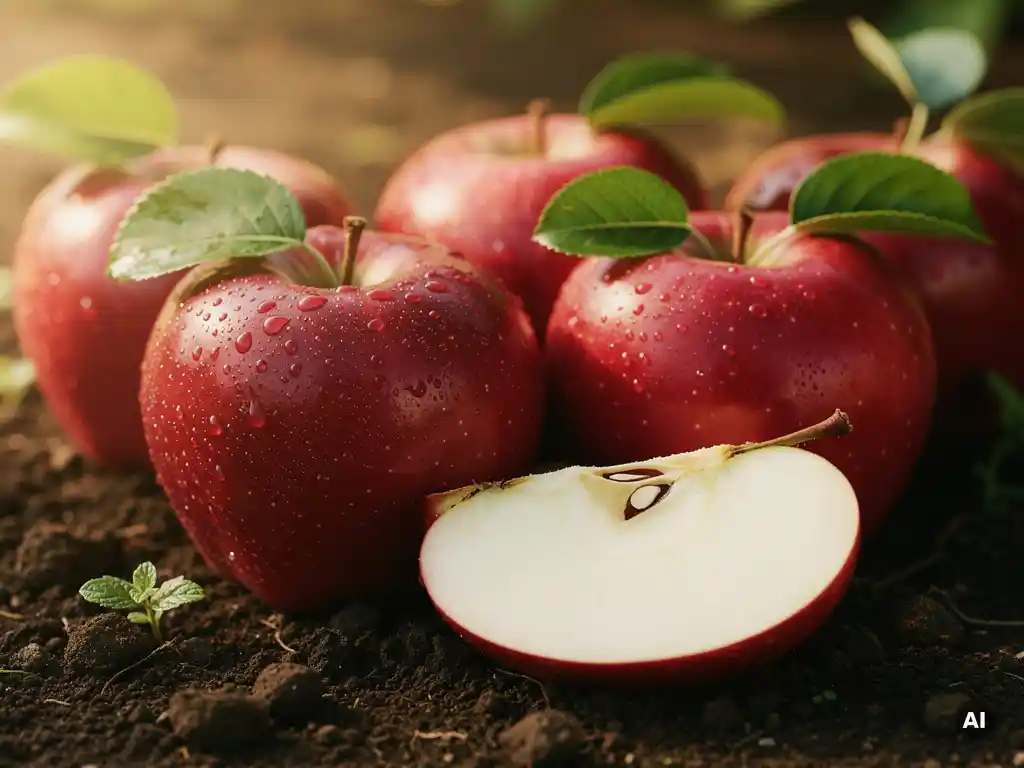
The newest crunchy apple varieties combine exceptional firmness with bold, complex flavour profiles that go far beyond what older cultivars could offer. Advances in apple breeding have made it possible to develop fruit with a satisfying, glass-like snap that holds up well through the supply chain. We focus specifically on this kind of innovation at Better3Fruit, and if you want to learn more or explore licensing opportunities, feel free to get in touch with us directly.
What makes an apple variety crunchy?
An apple variety is crunchy when its flesh cells are large, turgid, and tightly packed, creating high internal pressure that resists biting force and then fractures cleanly. This cell structure, known as turgor pressure, is largely determined by genetics, meaning crunchiness is a heritable trait that breeders can actively select for across generations.
Beyond cell size and pressure, the composition of the cell walls matters enormously. Varieties with firmer, more rigid cell walls tend to produce that satisfying snap rather than a soft, mealy give. Water content also plays a role: apples with higher juice levels tend to feel crisper because the liquid reinforces the internal cell pressure.
At the genetic level, modern breeding programmes use molecular markers to identify which parent varieties carry the genes responsible for superior texture. This allows breeders to stack desirable traits, crunchiness, sweetness, disease resistance, without the trial-and-error approach that traditional breeding required. The result is a new generation of crisp apple cultivars that are far more consistent in texture than older varieties ever managed to be.
What are the newest crunchy apple varieties available today?
Among the newest crunchy apple varieties generating commercial interest in 2026, standout examples include Morgana® and Giga® from our breeding programme at Better3Fruit. Both varieties are characterised by a firm, crisp bite, vibrant appearance, and a flavour complexity that appeals to modern consumers looking beyond the standard supermarket apple.
Morgana® has earned attention for its balanced sweet-tart profile paired with a dense, juicy crunch that holds well after harvest. Giga® lives up to its name with impressive fruit size and an exceptionally firm texture, making it one of the most talked-about new apple varieties in the club apple space right now.
These sit alongside our longer-established Kanzi®, which remains one of the crunchiest and most commercially successful club varieties of the past two decades. Kanzi® set a benchmark for what a modern crisp apple cultivar could achieve, and our newer releases build on that foundation with improvements in disease tolerance and climate resilience. You can explore the full range of our apple varieties to see how each one is positioned in terms of texture, flavour, and growing profile.
How do new crunchy varieties compare to classic crisp apples?
New crunchy apple varieties generally outperform classic crisp apples in texture consistency, disease resistance, and shelf life, while matching or exceeding them in flavour complexity. Older varieties like Braeburn or Jonagold were celebrated for their crunch in their time, but they were bred without the molecular tools that allow modern programmes to target texture traits with precision.
Classic crisp apples often show significant variation in texture between individual fruits, between growing regions, and across seasons. A Braeburn grown in a warm season, for instance, can be noticeably softer than one harvested in a cooler year. Modern cultivars developed using marker-assisted selection are far more genetically stable in this regard, producing a more uniform eating experience batch after batch.
Flavour is where the comparison gets interesting. Some consumers remain loyal to the familiar tang of older varieties, which have decades of brand recognition behind them. However, newer varieties like Morgana® and Giga® have been specifically developed to deliver layered flavour alongside their crunch, rather than treating texture and taste as a trade-off. This is one of the key shifts in modern apple breeding philosophy.
Why do some crunchy apples lose their crunch after harvest?
Crunchy apples lose their crunch after harvest primarily because of cell wall breakdown driven by natural ripening enzymes and moisture loss. Once an apple is separated from the tree, enzymes continue to break down pectin in the cell walls, softening the flesh over time. This process accelerates at room temperature and slows significantly in cold storage.
Moisture loss is the second major factor. As water evaporates through the apple’s skin, internal cell pressure drops, and the apple loses the turgor that makes it feel firm and crisp. This is why controlled-atmosphere cold storage, which regulates both temperature and humidity, is so important for maintaining apple texture through long distribution chains.
Genetics plays a decisive role here too. Some varieties are inherently more resistant to post-harvest softening because their cell walls contain more stable pectin structures that break down more slowly. Breeding for post-harvest firmness is now a core objective in modern apple programmes, because a variety that arrives soft on the supermarket shelf will not succeed commercially, no matter how crunchy it was at harvest. This is why texture at the point of consumption, not just at picking, is a key evaluation criterion in our breeding work.
Where can you find the newest crunchy apple varieties?
The newest crunchy apple varieties are typically available through licensed growers and retail partners connected to club variety programmes. Because modern cultivars like Morgana® and Giga® are protected by intellectual property rights, they are grown exclusively by licensed producers and sold under managed brand programmes rather than being freely available on the open market.
For consumers, this means the best place to find these varieties is in premium supermarkets and specialist fruit retailers that carry club apple brands. Availability varies by country and season, depending on where licensed growers are based and how the supply chain is structured for each variety.
For growers, nurseries, or commercial partners interested in obtaining a licence, the process starts with reaching out directly to the variety owner. We work with partners across the globe and welcome enquiries from anyone interested in bringing new crisp apple cultivars to their market. There are no preferred partners and no prior rights on our varieties, meaning any grower worldwide can apply. Contact us to find out more about licensing opportunities and which varieties might be the right fit for your region and growing conditions.
This content was generated with the help of AI and it may contain mistakes