
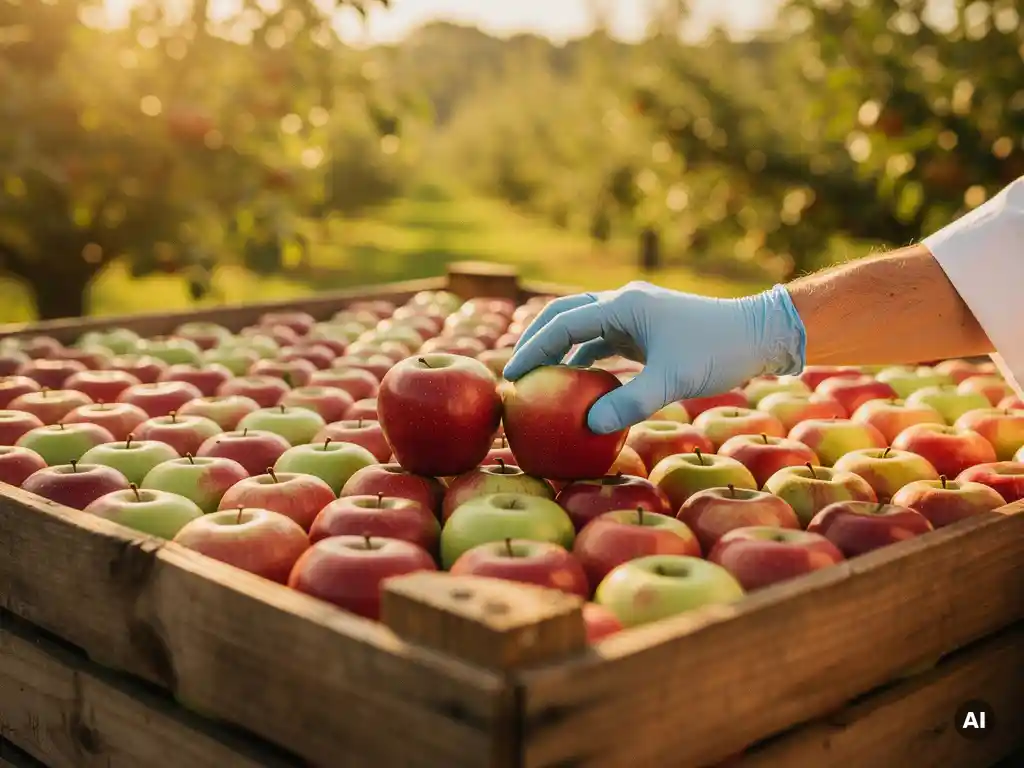
Uniformity is factored into the apple and pear breeding process from the very earliest evaluation stages, long before a seedling ever reaches commercial consideration. Breeders assess consistency in fruit size, shape, colour, and ripening across individual trees and across growing seasons, treating it as a foundational trait rather than an afterthought. If you have questions about how we approach this at Better3Fruit, feel free to get in touch with us directly. The sections below walk through each dimension of how uniformity is measured, selected for, and balanced within our broader breeding goals.
Why does uniformity matter so much in commercial fruit production?
Uniformity matters in commercial fruit production because retailers, packers, and consumers all expect consistent fruit that can be graded, priced, and presented predictably. A variety that produces highly variable fruit in terms of size, colour, or ripening time creates sorting losses, complicates supply chain planning, and undermines the brand value of a cultivar. Without a baseline level of consistency, even a delicious apple struggles to succeed commercially.
From a grower’s perspective, uniformity directly affects profitability. Fruit that ripens unevenly requires multiple harvest passes, which increases labour costs. Fruit that varies significantly in size or appearance leads to a higher proportion of lower-grade product, reducing the return per tree. For club varieties in particular, where a brand promise is central to the marketing strategy, inconsistency at the point of sale can quickly erode consumer trust and demand.
Retailers add another layer of pressure. Supermarket specifications for size, colour coverage, and firmness are often tight, and a variety that meets those specs reliably across seasons and growing regions is far more attractive to a retailer than one that performs beautifully in ideal conditions but varies under real-world growing pressures. Uniformity is, in this sense, a commercial prerequisite as much as it is a quality trait.
How do breeders measure and assess uniformity in new seedlings?
Breeders measure uniformity in new seedlings by evaluating multiple trees of each seedling across several growing seasons, recording variation in fruit size, shape, skin colour, colour coverage, and harvest timing. A single season of data is never sufficient; genuine uniformity must be demonstrated across different weather patterns and growing conditions before a seedling advances in the selection process.
At Better3Fruit, with over 30,000 new varieties under evaluation at any time, systematic observation is essential. Early-stage screening focuses on identifying seedlings with obviously high variation and removing them quickly, so that resources can be concentrated on the most promising candidates. As seedlings advance through the selection pipeline, the assessment becomes more rigorous, including trials in multiple locations and under different orchard management practices.
Harvest window is one of the more telling uniformity indicators. A variety where individual fruits on the same tree ripen across a span of several weeks is inherently more difficult to manage commercially than one with a compact, predictable harvest window. Breeders record this window carefully, alongside measurements of fruit weight distribution and colour development, to build a complete picture of how consistent a seedling truly is.
What role do molecular markers play in selecting for uniform traits?
Molecular markers play a significant role in selecting for uniform traits by allowing breeders to identify the genetic basis of consistency-related characteristics early in a seedling’s life, before the fruit itself can be evaluated. Rather than waiting years for a tree to bear fruit, markers can flag seedlings that carry favourable alleles associated with stable colour development, predictable ripening, or consistent fruit size.
This approach, which we use extensively at Better3Fruit, dramatically accelerates the breeding cycle. Apple and pear trees have long juvenile phases, so any tool that reduces the time between crossing and selection has a major impact on the pace of variety development. Molecular markers allow us to screen thousands of seedlings at the DNA level and discard those unlikely to meet uniformity standards before they ever occupy valuable field space.
Beyond speed, markers improve precision. Traits like background colour uniformity or the tendency for russeting are influenced by specific genetic regions that can be tracked across generations. By combining marker-assisted selection with traditional field observation, we can build a much clearer picture of which crosses are likely to produce the consistent, commercially viable fruit that growers and retailers need. You can explore the varieties we have developed through this approach to see the results in practice.
How is uniformity balanced against other key breeding goals?
Uniformity is balanced against other key breeding goals by treating it as a threshold requirement rather than the sole optimisation target. A seedling must meet a minimum standard of consistency to remain in the programme, but beyond that threshold, breeders weigh uniformity alongside taste, texture, disease tolerance, yield, and climate resilience to find the best overall combination of traits.
In practice, trade-offs do arise. A seedling with outstanding flavour complexity but slightly variable colour coverage might still advance if its other traits are exceptional, with the expectation that further selection or specific growing protocols can manage the variability. Conversely, a highly uniform but flavourless apple has no commercial future regardless of how consistent it is. The goal is always a variety that performs reliably and delivers genuine eating quality.
Disease and pest tolerance add another dimension to this balancing act. Breeding for strong resistance to scab or mildew, for example, involves introducing genetic material that may initially bring some variability in other traits. Managing these interactions requires careful crossing strategies and extended evaluation periods. Our breeding programme at Better3Fruit treats climate resilience and multi-level sustainability as long-term primary goals, which means uniformity must be achieved alongside these broader objectives rather than at their expense.
Does uniformity differ between apple and pear breeding programmes?
Yes, uniformity challenges differ meaningfully between apple and pear breeding programmes, primarily because pears are more sensitive to growing conditions and post-harvest handling, which makes achieving consistent quality across regions and seasons inherently more complex. Pears also have narrower harvest and ripening windows, where small deviations in timing can significantly affect texture and eating quality at the consumer level.
In apple breeding, colour uniformity is often a central focus because retailers and consumers respond strongly to visual consistency. Achieving even, well-distributed colour coverage across a crop is a trait that breeders actively select for, and it is one where molecular markers have proven particularly useful. Apples also tend to have more robust post-harvest characteristics, giving the supply chain more flexibility to manage minor variability in ripening.
Pear breeding presents different uniformity priorities. Because pears ripen from the inside out and can move from perfect to overripe quickly, consistency in the ripening process itself is critical. Breeders working on pear varieties must pay close attention to how uniformly fruit responds to cold storage and ethylene treatment, since these post-harvest steps are central to delivering consistent quality to the consumer. The underlying principle, that consistency must be demonstrated across seasons and locations, is the same in both programmes, but the specific traits that define uniformity differ between the two crops.
Uniformity is never a single checkbox in the breeding process; it is an ongoing evaluation that runs through every stage of variety development, from early seedling screening to multi-site trials and commercial rollout. If you want to learn more about how we approach fruit variety development at Better3Fruit, or if you are interested in discussing a potential licensing partnership, contact us and we will be happy to talk you through our programme in more detail.
This content was generated with the help of AI and it may contain mistakes