
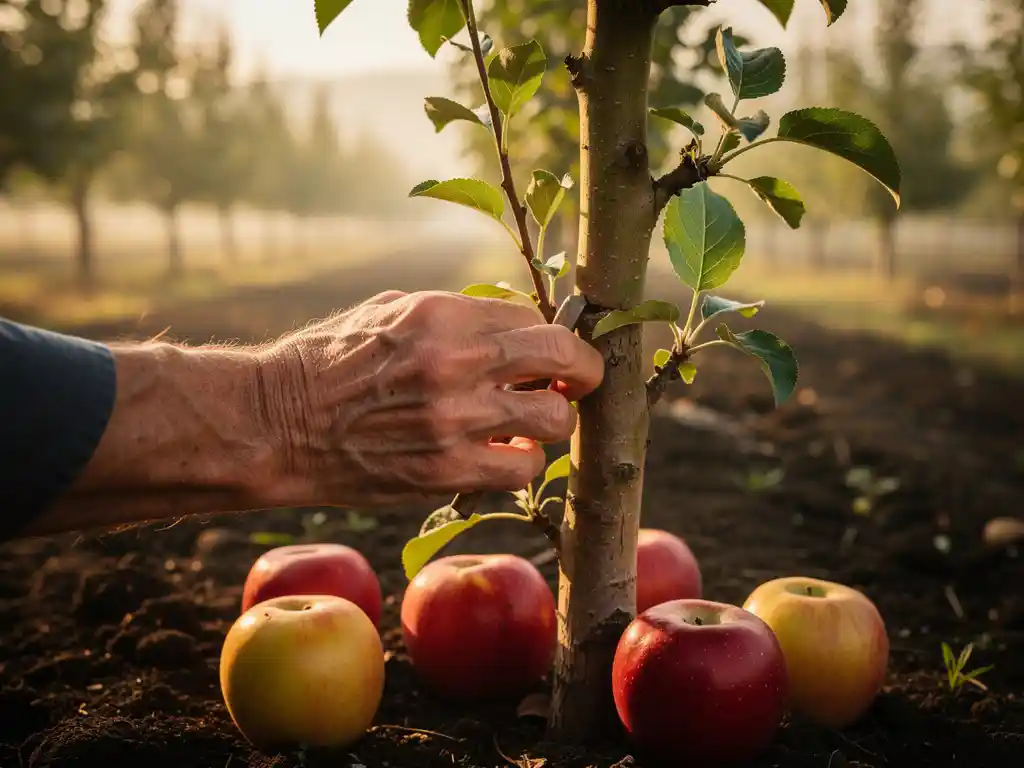
Switching apple varieties is one of the most significant decisions a grower can make. The investment in new trees, the years before a full crop, and the uncertainty of market reception all combine to make it a genuinely complex choice. If you want to talk through your options before diving in, feel free to get in touch with us, and we will be happy to help you find the right direction.
The good news is that the risk involved in variety transitions is manageable when you understand what drives it and how to plan around it. This article walks through the most common questions growers ask when considering a move to new apple varieties, so you can make a confident, well-informed decision.
Why is switching apple varieties considered risky?
Switching apple varieties carries risk primarily because of the long production timeline involved. Apple orchards take several years to reach full commercial yield after planting, meaning a poor variety choice does not reveal itself quickly. By the time a grower recognises a problem with market fit, disease performance, or consumer demand, significant time and capital have already been committed.
Several factors compound this risk. Consumer preferences shift, retailer requirements evolve, and competing varieties can enter the market during the years between planting and peak production. A variety that looks promising at planting may face a crowded or changed market by the time volumes are commercially significant. On top of this, growers must manage the operational disruption of replanting, including lost income from removed trees and the cost of new plant material, training systems, and labour.
Understanding these risk factors is the first step toward managing them. The following questions address each dimension of the decision in turn.
What makes a new apple variety worth the switch?
A new apple variety is worth switching to when it offers a combination of clear consumer appeal, grower-friendly performance, and a credible route to market. No single trait is enough on its own. The variety needs to solve a real problem or fill a genuine gap, whether that is better taste, stronger disease tolerance, improved storability, or higher packout rates.
From a commercial standpoint, the variety should have backing from a serious breeding program with documented performance data across multiple growing regions. Varieties that have been through rigorous multi-stage selection, including evaluation of appearance, texture, productivity, and disease response, carry far more evidence behind them than novelties with limited trial history.
Grower yield and consistency matter just as much as consumer appeal. A variety that produces exceptional fruit in ideal conditions but underperforms in variable weather or under commercial management pressure is a liability, not an asset. Look for varieties that demonstrate stability across seasons and locations before committing to a significant planting.
What’s the difference between a club variety and an open variety?
A club variety is one for which production and marketing rights are restricted to a licensed group of growers, packers, and retailers, creating a controlled supply chain. An open variety, by contrast, is available to any grower without licensing restrictions and is typically sold under a generic or widely available name.
Club varieties generally offer growers stronger price protection because supply is managed to match demand. When a variety is grown by anyone and sold everywhere, prices tend to erode over time as supply outpaces market development. Club structures prevent this by coordinating volume and ensuring consistent quality standards across all participants.
The trade-off is that joining a club variety program requires meeting specific quality, volume, and marketing commitments. Growers give up some independence in exchange for market stability and brand support. For growers who can meet the requirements, this structure typically delivers better long-term returns. You can explore the range of apple varieties we have developed to see how different commercial structures apply across our portfolio.
How do breeding programs reduce the risk of new varieties?
Breeding programs reduce variety risk by filtering out weak performers long before a variety reaches commercial release. Through multi-stage selection over many years, only varieties that demonstrate consistent performance across a wide range of traits and growing conditions advance toward commercialisation. This means growers receive varieties that have already survived rigorous evaluation, not experimental material.
Modern breeding tools such as molecular markers allow breeders to identify desirable traits at the seedling stage, dramatically increasing the precision and efficiency of selection. Rather than waiting years to observe whether a tree carries disease resistance or a particular flavour profile, molecular screening provides early confirmation. This reduces the number of weak candidates that advance through the pipeline and improves the overall quality of what eventually reaches growers.
We evaluate over 10,000 new variety selections each year, with more than 30,000 under evaluation at any given time. This scale means that only the most consistently strong performers across taste, texture, storability, disease tolerance, and productivity reach the stage of commercial consideration. For growers, this translates directly into lower variety risk because the hard work of elimination has already been done.
When is the right time to transition to a new apple variety?
The right time to transition to a new apple variety is when your current variety shows signs of declining market value, when a superior alternative has demonstrated reliable commercial performance, and when your operation is in a position to absorb the transition costs without overextending. Timing driven by market signals rather than novelty leads to better outcomes.
Watch for warning signs in your current variety: narrowing margins, increasing retailer pressure on price, rising pest and disease management costs, or consumer feedback pointing toward declining appeal. These signals suggest the variety is approaching the end of its commercial prime, and waiting too long to act only deepens the transition cost.
On the other side, a new variety should have at least several years of commercial trial data before you commit significant acreage. Early adopters can gain a competitive advantage in club variety programs, but entering too early, before supply chains and market demand are established, carries its own risks. A phased approach, starting with a trial block before scaling up, gives you firsthand performance data from your own site and conditions.
How can growers protect themselves when adopting a new cultivar?
Growers can protect themselves when adopting a new cultivar by diversifying plantings, demanding transparent performance data, and choosing varieties backed by structured commercial programs. No single action eliminates risk entirely, but combining these approaches significantly reduces exposure.
- Start with trial blocks. Plant a manageable area first and evaluate the variety under your specific soil, climate, and management conditions before scaling up.
- Request multi-site performance data. Ask the breeding program or licensor for trial results from regions comparable to your own. Variety performance can vary significantly by location.
- Understand the commercial structure. Know whether you are entering a club program, what the licensing terms are, and how supply is managed relative to demand.
- Assess disease and climate resilience. Varieties with built-in tolerance to key diseases reduce ongoing management costs and provide a buffer against adverse seasons.
- Align with a credible breeding partner. Working with a breeding program that has a long track record, independent IP ownership, and no preferred commercial partners gives you more flexibility and confidence in the variety’s long-term support.
Ultimately, the growers who navigate variety transitions most successfully are those who treat the decision as a strategic investment rather than a reactive one. Taking time to gather evidence, build relationships with the right partners, and plan the transition in stages makes a significant difference to the outcome.
If you are weighing up a variety change and want to discuss what the right fit might look like for your operation, reach out to us directly and let us help you make the most informed decision possible.
Frequently Asked Questions
How many acres should I plant in a trial block before committing to a full variety transition?
There is no universal rule, but most experienced growers start with a trial block of 1–5 acres, large enough to generate meaningful yield and quality data without overexposing the operation to risk. The goal is to observe real performance under your specific soil, microclimate, and management system across at least two or three seasons before scaling up. If you are entering a club variety program, check whether the licensor has minimum planting requirements, as some programs require a committed volume to qualify for market access.
What financial costs should I budget for when transitioning to a new apple variety?
The main cost categories to plan for are plant material (including royalties for licensed varieties), site preparation and replanting, new training systems or infrastructure if required, and lost income during the non-bearing years before the new planting reaches commercial yield. Depending on your region and system, establishment costs can range from several thousand to tens of thousands of dollars per acre, so building a realistic multi-year cash flow model before committing is essential. Factor in the ongoing income from your remaining productive blocks to ensure the transition does not create a cash shortfall during the establishment period.
Can I grow both a club variety and open varieties on the same property?
Yes, in most cases growers can manage club and open varieties side by side, and many successful operations do exactly that as a way of balancing price stability with flexibility. However, club variety agreements typically require strict separation of fruit at harvest, packing, and storage to maintain brand integrity and traceability. Review the specific terms of any club program you are considering carefully, as some agreements include volume commitments or exclusivity clauses that could affect how you allocate land across your property.
How do I evaluate whether a breeding program's disease resistance claims are credible?
Look for published or independently verified trial data that shows disease performance across multiple sites and seasons, not just results from the breeding program's own controlled environment. Credible programs will be transparent about which specific diseases the variety tolerates, the mechanism of resistance (whether it is genetic or management-dependent), and any known limitations or vulnerabilities. It is also worth asking whether the resistance has held up over time in commercial orchards, as some disease pressures can evolve to overcome varietal tolerance after several years of widespread planting.
What happens if consumer demand for my new variety drops before I reach full production?
This is one of the core risks of variety transitions, and it is why choosing varieties backed by structured club programs and active market development provides an important layer of protection. Club programs actively manage supply relative to demand and invest in building consumer recognition, which helps sustain pricing over the long term compared to open varieties that are vulnerable to commodity pricing. For additional protection, diversifying across two or three varieties with different market profiles reduces your exposure to a single demand shift affecting your entire operation.
How long does it typically take for a new apple variety to go from breeding selection to commercial availability?
From initial cross to commercial release, the development of a new apple variety typically takes 15–25 years when full multi-stage evaluation is carried out responsibly. This includes seedling screening, preliminary selection, multi-site trials, consumer taste testing, and commercial-scale evaluation before a variety is released with confidence. Modern tools such as molecular marker screening have accelerated the early stages of this process, but the field evaluation phases still require real seasons and real growing conditions that cannot be compressed, which is why varieties backed by long-running breeding programs carry stronger evidence than recently introduced novelties.
Is it better to be an early adopter of a new variety or to wait until it is more established?
Both approaches carry trade-offs, and the right answer depends on your operation's risk tolerance and commercial goals. Early adopters in club variety programs can secure preferential licensing terms, stronger market positioning, and a head start on building volume before supply becomes widely available — but they also bear more uncertainty about how the variety will perform commercially at scale. Waiting until a variety has several years of commercial data behind it reduces variety risk significantly, but the best licensing opportunities and market positions may already be taken. A middle path — entering a program after initial commercial proof points are established but before the variety reaches full market saturation — often offers the best balance of evidence and opportunity.