
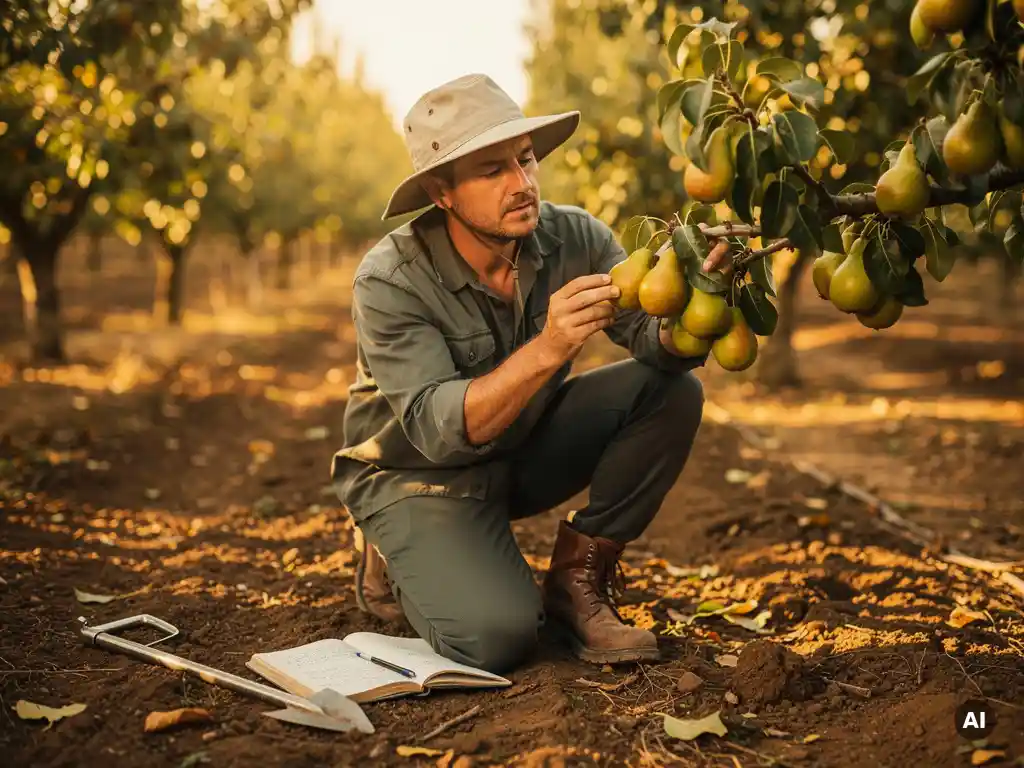
To test whether a pear variety suits your region, start small-scale trial plantings in representative conditions, collect performance data over several seasons, and compare results against established benchmarks. Regional suitability depends on how well a variety’s climate requirements, disease tolerance, and fruit quality align with your specific growing environment. The questions below walk through exactly how to structure that process, from setting up trials to knowing when you have enough data to make a confident decision. If you want guidance before committing to a trial, feel free to get in touch with us and we will be happy to help you think it through.
What factors determine whether a pear variety suits a region?
A pear variety suits a region when its climate requirements, soil preferences, disease pressure, tolerance, and phenological timing align with local conditions. The most critical factors are winter chilling hours, spring frost risk, summer heat accumulation, and the prevalence of diseases such as fire blight or pear scab in your area. Rootstock compatibility with local soils also plays a significant role in long-term performance.
Beyond climate, growers should consider how a variety’s flowering time fits the local pollination window and whether harvest timing matches available labour and storage capacity. A variety that ripens beautifully in one region may arrive too early or too late in another, creating logistical problems that undermine its commercial potential. Pest and disease pressure varies significantly between growing regions, so a variety with strong resistance to one pathogen may still struggle if a different threat dominates locally.
Soil type, altitude, and local microclimate all add further layers of complexity. A valley site prone to late frosts will stress an early-flowering variety in ways a hillside site never would. This is why pear variety regional suitability cannot be assessed from catalogue data alone; it must be validated through on-site observation.
How do official variety trials work for pear?
Official pear variety trials are structured experiments run by research stations, universities, or grower associations to evaluate new cultivars under controlled, documented conditions. Candidate varieties are planted alongside reference cultivars at representative sites, and trained evaluators record data on yield, fruit quality, disease incidence, and tree vigour over multiple seasons according to standardised protocols.
Many European countries have national or regional trial networks coordinated through horticultural research institutes. These networks use common evaluation criteria so results are comparable across sites and years. Participation typically requires a formal agreement with the trial organiser, and varieties under intellectual property protection, such as club varieties, may require a licence before they can be included.
For growers, official trial data is valuable precisely because it is collected systematically and peer-reviewed. It removes much of the guesswork from pear variety selection and provides a defensible basis for investment decisions. That said, official trials rarely cover every microclimate, so on-farm validation remains important even after a variety has performed well in a nearby trial.
What performance data should you collect during a pear trial?
During a pear trial, you should collect data on fruit yield per tree, fruit size and uniformity, internal and external quality at harvest, post-harvest storage behaviour, tree vigour and health, disease and pest incidence, and the timing of key phenological stages such as flowering and harvest. Collecting this data consistently across seasons is what turns a planting into a genuine trial.
Fruit quality and yield metrics
Record fruit weight, colour development, firmness at harvest, soluble solids content, and the proportion of fruit meeting commercial grade thresholds. These numbers tell you whether the variety can produce marketable fruit in your conditions, not just whether the tree survives. Yield per tree across multiple years reveals consistency, which matters as much as peak performance.
Tree health and adaptability indicators
Track disease incidence for locally relevant pathogens, note any signs of biotic or abiotic stress, and assess how the tree responds to your pruning and training system. Rootstock performance under your soil conditions is worth monitoring separately, since the same scion on different rootstocks can behave very differently. Phenological records, bud break, full bloom, and harvest date, help you understand climate adaptation and frost risk year on year.
How long does it take to know if a pear variety is regionally suited?
A reliable assessment of pear variety regional suitability typically requires a minimum of four to six years of data after the trees reach full bearing, which usually means seven to ten years from planting. This timeframe captures enough seasonal variation, including late frosts, drought years, and high disease pressure seasons, to distinguish genuine adaptation from a run of favourable weather.
Early signals can emerge sooner. Tree establishment, first-year disease response, and initial fruit quality give useful directional information within the first three years. But these early results should be treated as indicators rather than conclusions. A single warm, dry season can make a frost-sensitive or scab-susceptible variety look far better than it actually is in your region over the long term.
Patience is genuinely important here. Committing to a commercial planting on the basis of two or three seasons of trial data is one of the most common and costly mistakes in pear variety testing. The extra years of observation are an investment that protects the much larger investment of a full commercial block.
Should you trial a new pear variety alone or alongside existing varieties?
You should always trial a new pear variety alongside existing, well-understood varieties used as reference cultivars. Trialling in isolation gives you no benchmark against which to interpret your results; a yield figure or disease score only becomes meaningful when you can compare it to a variety you already know performs acceptably or well in your conditions.
Reference varieties anchor your data to reality. If a known variety underperforms in an unusual season, you can account for that when interpreting the trial variety’s results. If both perform poorly, the problem is likely environmental rather than variety-specific. If the trial variety consistently outperforms the reference on key metrics over multiple seasons, you have a strong, evidence-based case for wider adoption.
From a practical standpoint, including at least two reference varieties, one strong commercial performer and one that represents average regional performance, gives you a meaningful range. This structure is standard in formal trial design and makes your results far more credible to other growers, advisors, and potential commercial partners.
Where can you find regionally tested pear varieties to start with?
Regionally tested pear varieties can be found through national horticultural research institutes, regional grower associations, extension services, and specialist breeding companies that publish trial results. These sources provide documented performance data from multiple sites and seasons, giving you a starting point that is grounded in evidence rather than marketing material.
At Better3Fruit, we develop apple and pear varieties through one of the most extensive breeding programmes in the world, with a focus on disease and pest tolerance, taste, and climate resilience. Our variety portfolio includes cultivars that have been evaluated across diverse growing environments, and we work with regional partners to build the kind of performance data that helps growers make informed decisions. Because we license our varieties openly, with no preferred partners, growers anywhere in the world can access our material and test it in their own conditions.
When exploring new varieties, prioritise those with documented trial results from climates similar to yours, and always verify that the variety is available for licensing in your country. Starting with a variety that already has a regional track record significantly reduces the risk of your own trial planting, even if you still need to validate it in your specific microclimate. Ready to explore which pear varieties might suit your region? Contact us and we will help you find the right starting point for your situation.
This content was generated with the help of AI and it may contain mistakes