
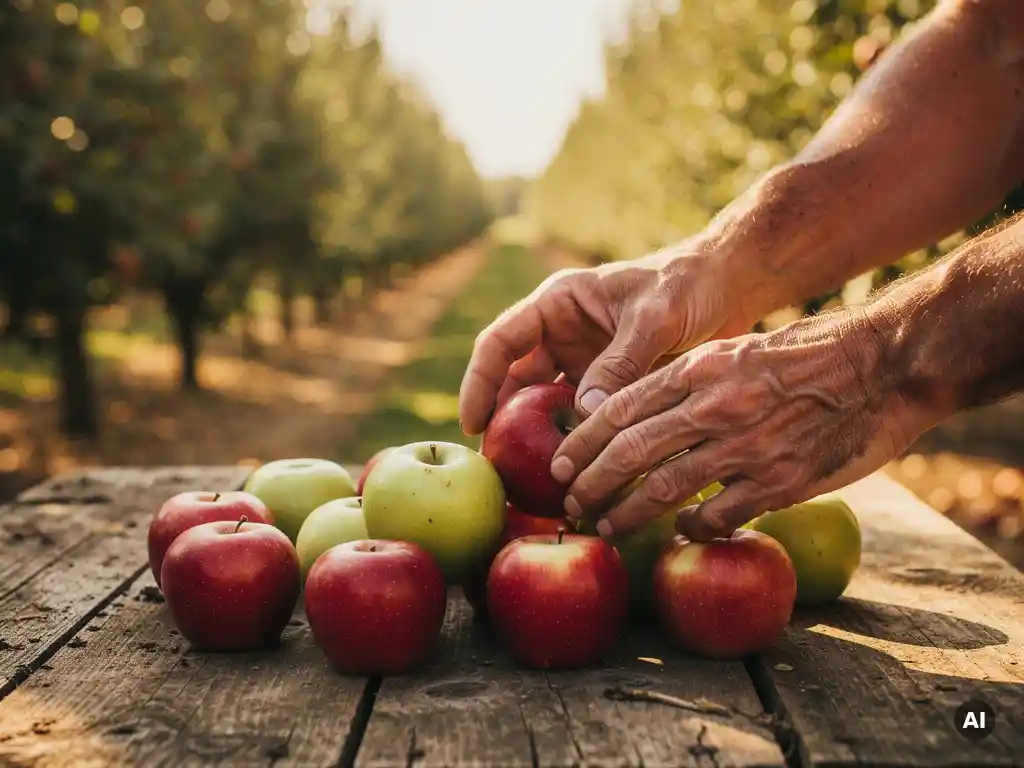
Orchard management has a direct and significant impact on fruit uniformity. The way growers handle crop load, canopy light, irrigation, and nutrition determines whether fruit develops evenly in size, colour, and maturity across the orchard. For apple and pear growers aiming to meet commercial grading standards, uniformity is not a lucky outcome – it is the result of deliberate, well-timed management decisions. Below, we answer the most common questions growers and industry partners ask about achieving consistent, high-quality crops. If you want to discuss variety selection or licensing, feel free to get in touch with us.
What orchard practices have the biggest impact on fruit uniformity?
The orchard practices with the greatest influence on fruit uniformity are crop load management, canopy light distribution, irrigation scheduling, and nutrient supply. When any one of these is poorly managed, the result is uneven fruit size, inconsistent colour development, or staggered maturity – all of which increase waste and reduce packout grades.
Uniformity is rarely the product of a single intervention. It emerges from the interaction of multiple practices carried out at the right time. Thinning done too late, for example, cannot fully compensate for an overloaded tree, even if irrigation and nutrition are well managed. Similarly, perfect crop load control will not deliver consistent colour if the canopy blocks sunlight from reaching the lower and inner fruit. Successful growers treat these practices as a system rather than a checklist.
How does crop load management affect fruit size consistency?
Crop load management is one of the most powerful tools for achieving fruit size uniformity. When too many fruitlets compete for the same pool of carbohydrates and nutrients, the tree cannot supply each fruit equally – the result is a wide spread of sizes at harvest. Thinning to the correct crop load allows the tree to direct resources more evenly, producing fruit that grades into a narrower size band.
Timing is critical. Chemical thinning applied during the cell division phase, typically within the first four to six weeks after full bloom, has the greatest effect on final fruit cell number and therefore size potential. Hand thinning carried out later can still reduce competition, but its effect on uniformity is more limited because size differentiation has already begun. For apple varieties in particular, the relationship between crop load and size is well established – a lighter crop consistently produces larger, more uniform fruit, but the ideal balance must be calibrated to the variety and the market specification.
Why does light distribution in the canopy matter for uniformity?
Light distribution in the canopy matters because photosynthesis drives sugar production, and sugar drives both fruit size and colour development. Fruit growing in shaded parts of the canopy receives less direct light, produces fewer carbohydrates, and develops less anthocyanin – the pigment responsible for red colouration in many apple varieties. The result is fruit that is smaller, paler, and less mature than fruit growing in well-lit positions.
Modern high-density orchard systems with slender spindle or tall spindle training are designed specifically to maximise light interception across the entire canopy. Summer pruning to open the canopy, combined with reflective mulch on the orchard floor, can meaningfully improve light exposure for fruit in lower positions. For varieties where colour is a primary commercial driver – as it is in many club apple programmes – light management is not optional. It is a core part of achieving the consistent appearance that retailers and consumers expect.
How does irrigation and nutrient management influence fruit uniformity?
Irrigation and nutrient management influence fruit uniformity by ensuring a steady, balanced supply of water and minerals throughout the growing season. Water stress at any point during cell expansion causes fruit to stop growing temporarily – and because stress does not affect all fruit on the tree equally, the result is a wider spread of sizes at harvest. Inconsistent nutrient supply has a similar effect, particularly nitrogen and calcium, which influence both cell growth and fruit firmness.
Irrigation timing and fruit development
Deficit irrigation during the cell expansion phase, which runs from shortly after thinning through to the final weeks before harvest, is particularly damaging to size uniformity. Drip irrigation systems that deliver water directly to the root zone allow growers to maintain consistent soil moisture levels and respond quickly to heat stress events. Soil moisture monitoring tools have made precision irrigation more accessible, and their use correlates with more consistent fruit sizing across the orchard block.
Nutrient balance and fruit consistency
Calcium is especially important for apple and pear uniformity because it strengthens cell walls and reduces the risk of disorders such as bitter pit, which causes uneven breakdown in the fruit flesh. Foliar calcium applications during the growing season, combined with a balanced base nutrition programme, help ensure that fruit develops with consistent internal quality as well as external size. Excessive nitrogen, on the other hand, promotes vegetative growth at the expense of fruit development and can lead to softer, less uniform fruit with shorter storage life.
Does apple or pear variety choice affect how uniform the crop is?
Yes, variety choice has a meaningful effect on how uniform the crop is. Different apple and pear varieties vary in their natural tendency to set evenly, respond to thinning, and maintain consistent size and colour across the tree. Some varieties are inherently more sensitive to crop load fluctuations, producing a wider size range when thinning is imprecise, while others are more forgiving and grade more consistently even under variable conditions.
At Better3Fruit, variety development considers not just taste and disease tolerance but also the practical performance of a variety in commercial orchard conditions. A variety that is difficult to thin accurately or that produces highly variable colour without intensive management creates real commercial challenges for growers and packers. Exploring our apple and pear varieties gives a clear picture of how breeding decisions translate into orchard performance. Matching variety characteristics to local climate, training system, and target market is one of the most effective ways to build a naturally uniform crop from the ground up.
What’s the difference between fruit uniformity and fruit quality?
Fruit uniformity and fruit quality are related but distinct concepts. Fruit quality refers to the intrinsic attributes of individual fruit – taste, texture, sugar content, acidity, firmness, and nutritional value. Fruit uniformity refers to the consistency of those attributes across the entire crop – how similar each fruit is to the next in size, colour, maturity, and appearance. A crop can have excellent individual fruit quality but poor uniformity if the fruit varies widely in size or ripeness at harvest.
From a commercial perspective, uniformity is often as important as quality because it determines packout efficiency and the ability to meet retail specifications. Supermarkets and export buyers typically purchase fruit within defined size and colour ranges, meaning that even high-quality fruit that falls outside the specification window is downgraded or rejected. For growers, improving uniformity directly improves the proportion of the crop that achieves premium prices – which makes orchard management practices that support uniformity a sound economic investment, not just an agronomic preference.
Understanding the relationship between these two concepts also matters at the breeding level. We design varieties that deliver both intrinsic eating quality and the consistency that commercial supply chains demand – because a great-tasting apple that cannot be packed and sold reliably has limited value to the industry. If you want to learn more about how our breeding programme approaches these challenges, get in touch with us and we would be happy to talk it through.
This content was generated with the help of AI and it may contain mistakes