
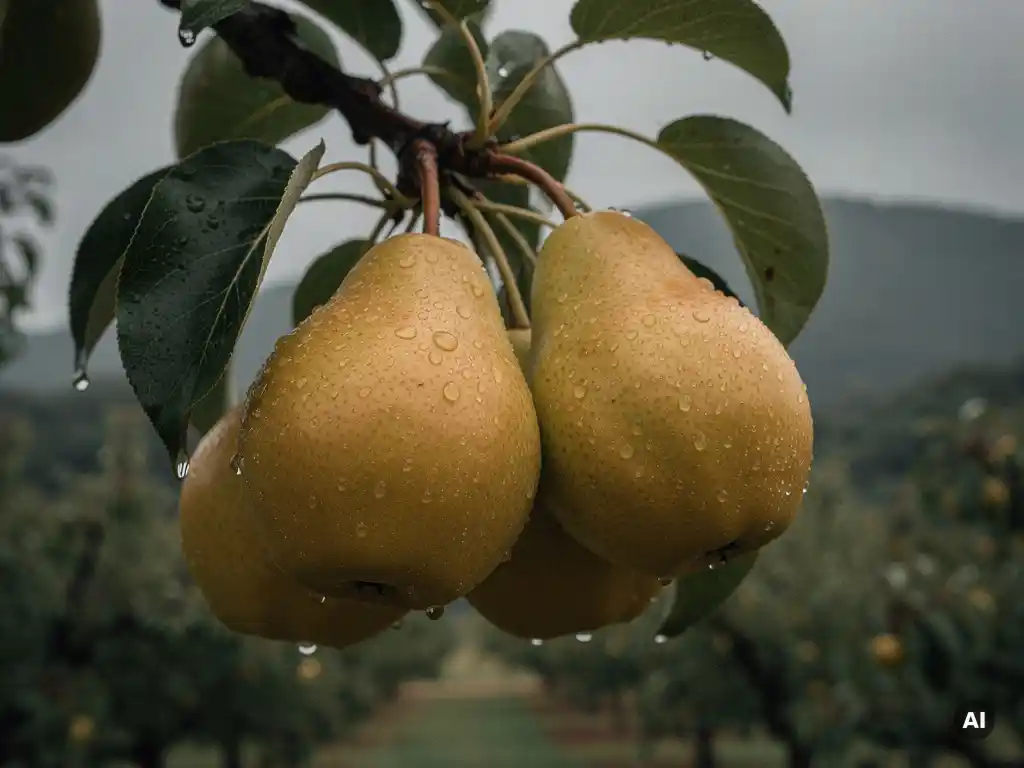
New climate-resilient pear varieties from breeders are cultivars specifically developed to tolerate shifting weather conditions, including drought stress, temperature extremes, and irregular rainfall patterns, while still delivering consistent fruit quality and yield. Breeding programs combine traditional selection methods with modern tools like molecular markers to bring together the traits growers need most. We at Better3Fruit are actively working on pear breeding that addresses these long-term climate challenges, and if you want to learn more about our work, feel free to get in touch with us. Below, we unpack the key questions growers and industry partners ask most about climate-adapted pear varieties.
How do breeders develop climate-resilient pear varieties?
Breeders develop climate-resilient pear varieties by crossing parent plants that carry desirable traits, then using selection tools to identify offspring with the right combination of climate tolerance, disease resistance, and fruit quality. Modern programs use molecular markers to screen thousands of seedlings at an early stage, dramatically accelerating the time it takes to bring a strong variety to market.
At Better3Fruit, we introduce around 10,000 new pear varieties into field evaluation every year, with more than 30,000 under assessment at any given time. That scale matters because climate resilience is a complex trait. No single gene controls it. Instead, breeders look for combinations of characteristics, such as the ability to flower reliably under warmer spring conditions, root systems that manage water stress, and fruit that develops well even when temperatures deviate from historical averages. Molecular markers allow us to link these observable traits to specific genetic signals, making the selection process faster and more precise than purely visual field observation.
Pear breeding programs also rely on long-term trial networks, planting candidate varieties across different climatic zones to observe how they perform under real-world variation. A variety that thrives in Belgium may behave differently in southern Spain or northern Germany, so multi-location testing is essential before any commercial release.
What traits define a climate-resilient pear variety?
A climate-resilient pear variety is defined by its ability to maintain stable yield and fruit quality across a range of environmental conditions, including heat stress, late frosts, irregular rainfall, and drought periods. The most important traits include late or flexible flowering to avoid frost damage, efficient water use, strong root development, and the capacity to ripen well under variable summer temperatures.
Beyond the environmental side, climate resilience in pear cultivars is closely linked to overall plant vigor and health. A variety that is already stressed by disease pressure is far less likely to cope well with weather extremes. This is why our breeding strategy treats climate resilience and disease tolerance as interconnected goals rather than separate targets.
Texture and taste are never sacrificed in this process. A variety that survives a difficult season but produces poor-quality fruit has no commercial future. The challenge for breeders is finding the combinations where agronomic strength and consumer appeal genuinely coexist, which is exactly where large-scale evaluation programs provide a real advantage.
Which diseases are new pear varieties bred to resist?
New pear varieties are bred to resist a range of fungal, bacterial, and pest-related threats, with fire blight, scab, and psylla among the most commercially significant. Fire blight, caused by the bacterium Erwinia amylovora, is particularly damaging in warmer and wetter conditions, making resistance to it increasingly important as climate patterns shift.
Pear scab, caused by the fungus Venturia pirina, affects fruit appearance and storability, reducing marketable yield. Breeding for scab resistance reduces the need for repeated fungicide applications, which benefits both grower economics and environmental sustainability. Psylla, a sap-sucking insect pest, is harder to address through genetics alone, but tolerance to its effects is increasingly part of the selection criteria in advanced programs.
The connection between disease resistance and climate resilience is direct. Warmer winters and wetter springs create conditions where pathogens spread more aggressively. Varieties that carry durable resistance are therefore better equipped to remain productive as growing conditions become less predictable. Our breeding program at Better3Fruit treats multi-level sustainability, including reduced reliance on chemical inputs, as a primary long-term goal across both apple and pear development.
How are new pear varieties licensed and made available to growers?
New pear varieties developed by breeding companies are made available to growers through licensing agreements that grant the right to propagate and grow a protected cultivar. Intellectual property protection, typically through plant variety rights or patents, ensures that breeders can fund continued research through royalties while growers gain access to well-supported, commercially developed varieties.
At Better3Fruit, we operate as an independent, privately funded company with no preferred partners and no prior rights obligations. This means any grower or nursery, anywhere in the world, can apply for a license for one of our varieties. Licensing terms vary depending on whether a variety is released as a club variety or an open variety, which has a significant impact on how it reaches the market.
You can explore the range of pear and apple cultivars we currently offer through our variety portfolio, which gives a clear overview of what is available for licensing at different stages of commercial development.
What’s the difference between a club variety and an open pear variety?
A club variety is a pear cultivar released under a controlled licensing model, where production, marketing, and quality standards are managed by a selected group of partners. An open variety, by contrast, is available to any grower who meets the basic licensing conditions, with fewer restrictions on who can grow it or where it can be sold.
Club varieties: controlled growth and brand development
Club varieties are designed to build a strong, recognizable brand in the market. By limiting the number of licensed growers and coordinating marketing through a single structure, the variety’s name and quality promise can be managed consistently. This approach tends to generate higher returns per kilogram for growers who are inside the club, but it requires careful partner selection and long-term commitment from all parties. Our Kanzi apple is one of the best-known examples of a successful club variety model, and we apply similar thinking to our pear development work.
Open varieties: broad access and grower flexibility
Open pear varieties give growers more freedom. Any licensed nursery or producer can access the cultivar without being part of a coordinated marketing group. This model suits varieties where broad market penetration is the goal, or where the variety’s qualities speak for themselves without requiring a branded sales structure. Open varieties typically reach a wider geographic footprint more quickly, though they may face more price competition at the retail level.
Choosing the right model depends on the variety’s market potential, the strength of its differentiating traits, and the strategic goals of the breeding program. For climate-resilient pear cultivars with strong disease resistance and distinct eating quality, a club structure often makes sense because it protects the investment growers make in establishing a new variety. If you are considering a license for one of our pear varieties and want to understand which model fits your situation, contact us directly and we will be happy to guide you through the options.
This content was generated with the help of AI and it may contain mistakes