
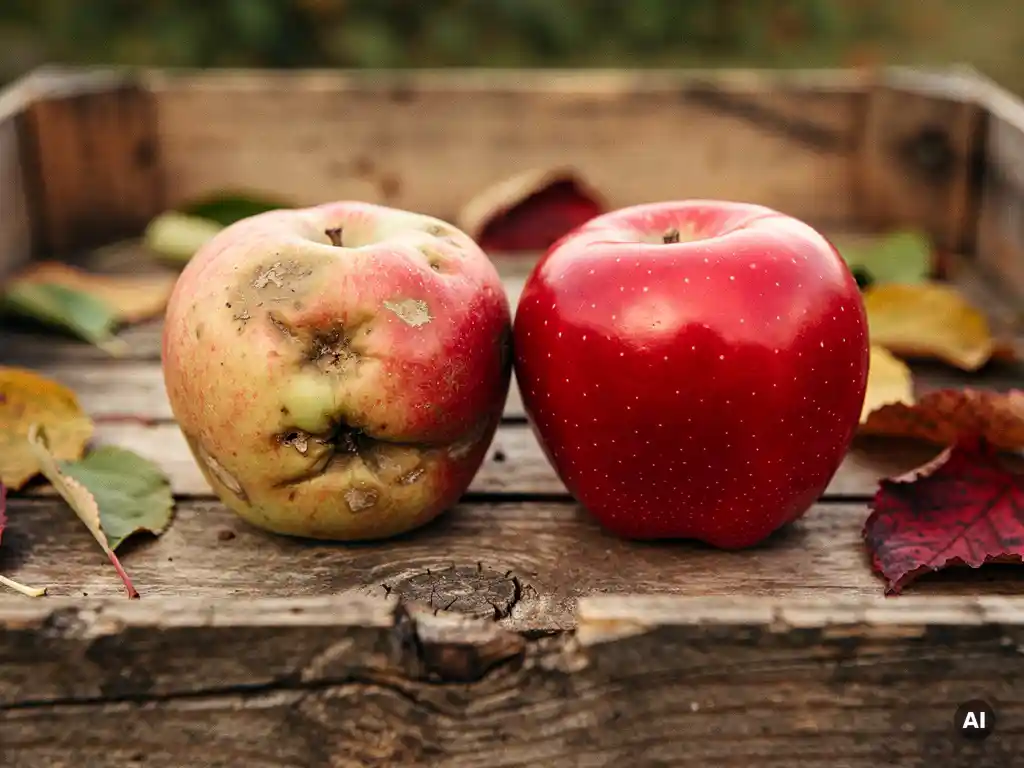
Non-uniform fruit varieties expose growers to serious commercial, financial, and logistical risks. When apples or pears within the same variety produce inconsistent size, colour, texture, or flavour across a harvest, a significant proportion of the crop fails to meet retailer and market specifications, reducing the volume of fruit that can actually be sold at premium prices. The sections below unpack the specific risks in detail, from marketability to supply chain reliability and the role of modern breeding in reducing them. If you have questions about variety selection, feel free to get in touch with us; we are happy to help.
How does non-uniformity in fruit varieties affect marketability?
Non-uniformity in fruit varieties directly reduces marketability because retailers, packers, and supermarket chains purchase to strict grade specifications. When a variety consistently delivers mixed results in size, colour, or shape, a large share of the harvest is downgraded or rejected outright. Fruit that cannot be sold in the premium fresh market is redirected to processing at a fraction of the value, or discarded entirely.
Retailers operate on tight quality standards. A consistent, visually appealing product is not just a preference; it is a contractual requirement for most major supply agreements. Growers supplying non-uniform fruit variety batches risk losing their preferred supplier status, damaging long-term commercial relationships that took years to build.
Beyond individual sales, fruit quality consistency shapes consumer trust. Shoppers who buy an apple variety and receive a different eating experience each time are unlikely to seek it out again. Variety loyalty, the kind that builds a strong brand and drives repeat purchases, depends entirely on delivering a predictable, high-quality product every single time.
What causes fruit varieties to produce non-uniform results?
Fruit variety non-uniformity is caused by a combination of genetic instability, environmental sensitivity, and agronomic variability. Some varieties carry genetic traits that express differently depending on growing conditions, meaning that even well-managed orchards can produce inconsistent results. Climate variation, soil differences, and rootstock interactions all compound the problem.
The primary drivers include:
- Genetic variability within the variety: Varieties that have not been rigorously selected for stable trait expression will behave differently across sites and seasons.
- Climate sensitivity: Temperature fluctuations during fruit development directly affect colour development, sugar accumulation, and firmness, all key quality parameters.
- Rootstock compatibility: Poorly matched rootstocks can lead to irregular fruit sizing and uneven ripening across the same orchard block.
- Pest and disease pressure: Varieties without adequate disease tolerance are more vulnerable to scab, mildew, and other pathogens that cause surface blemishing and internal quality defects.
- Orchard management variation: Differences in pruning, thinning, and irrigation, even between neighbouring farms, can amplify latent inconsistencies in a variety’s genetics.
Understanding these causes is important because it clarifies that non-uniformity is not purely a management problem. The variety itself must be genetically predisposed to perform consistently before any orchard management practice can deliver reliable results.
How does fruit non-uniformity impact a grower’s financial returns?
Fruit non-uniformity directly reduces a grower’s financial returns by shrinking the proportion of the harvest that qualifies for premium market prices. When a significant share of production is downgraded to the processing or juice market, the revenue per hectare falls sharply, often making the difference between a profitable season and a loss.
The financial impact operates on several levels. First, there is the direct loss of premium price per kilogram. Second, growers absorb the cost of harvesting, packing, and sorting fruit that ultimately earns a fraction of its potential value. Third, repeated non-uniform harvests can lead to contract penalties, volume shortfalls, or the loss of supply agreements, all of which have long-term revenue consequences that extend well beyond a single season.
Apple variety risks related to inconsistency also affect planning. Growers investing in orchard establishment, irrigation infrastructure, and labour expect a predictable return over a ten-to-twenty-year production cycle. A variety that performs inconsistently makes accurate financial forecasting nearly impossible, increasing the grower’s exposure to seasonal risk and complicating access to financing.
What are the supply chain risks of non-uniform apple and pear varieties?
Non-uniform apple and pear varieties create supply chain risks by making it difficult to guarantee consistent volume and quality across the season. Packers, retailers, and export customers plan their purchasing and logistics around predictable supply. When a variety delivers irregular harvests, the entire downstream supply chain is disrupted, from storage scheduling to shelf-space allocation.
Key supply chain risks include:
- Volume unpredictability: Inconsistent variety performance makes it difficult to commit to supply contracts with confidence, creating gaps that competitors can exploit.
- Storage and logistics complications: Non-uniform ripening means fruit does not come out of controlled-atmosphere storage at the same quality level, complicating release scheduling and shelf-life management.
- Brand and programme risk: For club varieties and branded programmes, non-uniformity undermines the entire value proposition; a branded apple must deliver the same experience regardless of origin or season.
- Export market vulnerability: International buyers require guaranteed specifications. Non-uniform batches are frequently rejected at destination, leading to costly returns or disposal.
For growers participating in coordinated marketing programmes or club variety arrangements, the reputational damage of supplying non-uniform fruit can result in exclusion from the programme entirely, a significant loss given the premium pricing these arrangements typically offer.
How do modern breeding programmes reduce non-uniformity risks?
Modern apple breeding programmes reduce non-uniformity risks by using advanced selection tools, particularly molecular markers, to identify and retain only those seedlings that carry stable, consistent trait expression across multiple environments. This means that genetic variability is screened out at an early stage, long before a variety reaches commercial evaluation.
At Better3Fruit, we evaluate more than 30,000 new varieties at any given time, with 10,000 new seedlings of each crop entering the field every year. This scale allows us to apply rigorous multi-site and multi-season selection pressure, ensuring that only varieties demonstrating genuine consistency in taste, texture, colour, size, and disease tolerance progress towards commercial release. Molecular marker technology accelerates this process by allowing us to screen for key traits at the DNA level, reducing the time and cost of identifying stable candidates.
Our breeding strategy also prioritises disease and pest tolerance as foundational traits. Varieties with strong built-in resistance are less susceptible to the environmental triggers that cause quality inconsistency, meaning growers face fewer surprises across different seasons and growing regions. Climate resilience is an increasingly important part of this work, as the ability to perform consistently under shifting weather patterns is becoming a defining requirement for any commercially viable variety.
Should growers prioritise variety uniformity when choosing what to plant?
Yes, fruit variety uniformity should be a primary criterion when growers select what to plant, not a secondary consideration. A variety that delivers consistent size, colour, flavour, and yield across seasons and sites reduces commercial risk, supports reliable supply agreements, and protects long-term profitability. Uniformity is the foundation on which successful grower-retailer relationships are built.
That said, uniformity alone is not sufficient. Growers should evaluate varieties across several interconnected criteria:
- Genetic stability: Has the variety demonstrated consistent performance across multiple growing regions and seasons in independent trials?
- Disease and pest tolerance: Varieties with strong built-in tolerance are inherently more consistent because they are less exposed to quality-disrupting pressures.
- Market fit: Uniformity must be matched to the right market channel; the specifications that matter for a supermarket programme differ from those for a farmers’ market or processing contract.
- Supply chain integration: Varieties supported by coordinated marketing programmes, quality control systems, and demand-matched supply are more likely to deliver consistent commercial returns.
- Climate resilience: As growing conditions become less predictable, varieties that maintain consistent performance under stress will increasingly outperform those that do not.
Choosing a variety is one of the most consequential decisions a grower makes, one that shapes financial outcomes for a decade or more. Prioritising fruit production risks at the selection stage, rather than managing them reactively in the orchard, is the most effective way to protect both yield and income. Explore our apple and pear varieties to see how we approach consistent, commercially proven breeding. If you are ready to discuss which variety suits your growing situation, get in touch with us; we would be glad to guide you through the options.
This content was generated with the help of AI and it may contain mistakes