
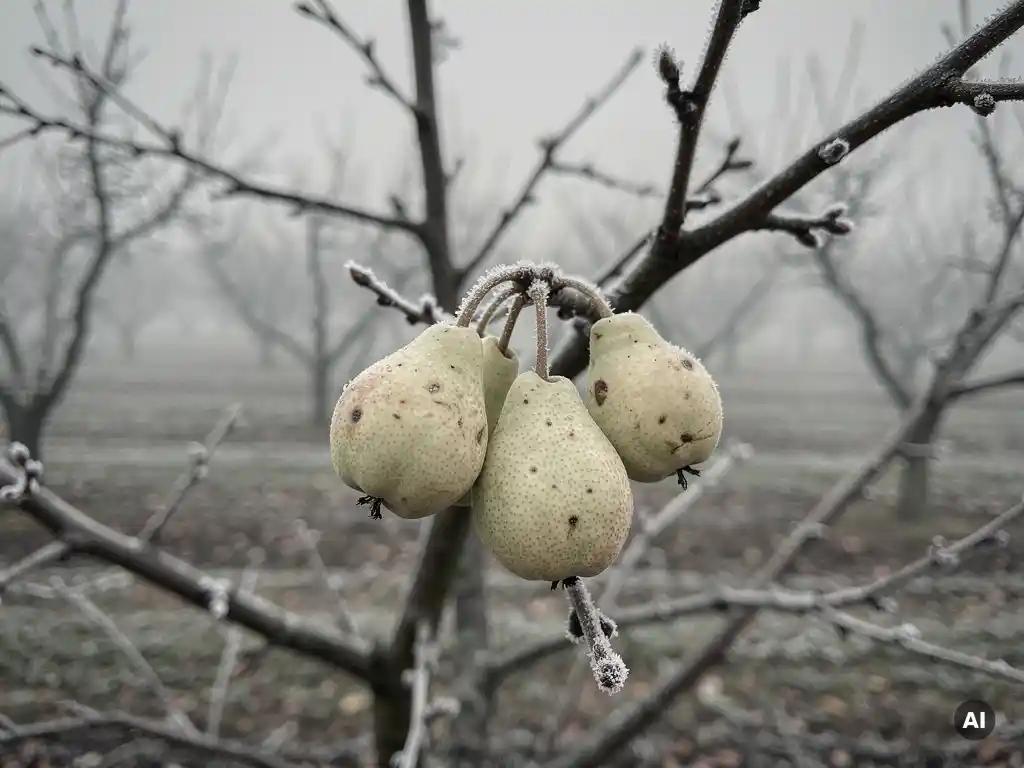
Insufficient winter cold causes pear trees to struggle with breaking dormancy properly in spring, leading to delayed, uneven, or incomplete budbreak. Without enough chilling hours, trees may produce fewer flowers, set less fruit, and deliver a significantly reduced harvest. This problem is becoming more common as winters grow milder in many traditional pear-growing regions, and it is one of the most pressing challenges facing growers today. Below, we unpack the key questions around winter chill and pears, from how dormancy works to what growers can do when temperatures simply do not cooperate. If you want to discuss how variety choice can help your operation adapt, feel free to reach out to us directly.
How do pears use winter cold to prepare for spring?
Pear trees use winter cold to complete a biological process called dormancy, during which they accumulate a set number of chilling hours, typically defined as hours spent at temperatures between roughly 0°C and 7°C (32°F to 45°F). This cold exposure triggers hormonal changes inside the tree that release it from dormancy and allow buds to break evenly and vigorously when temperatures rise in spring.
During the growing season, pear trees build up natural growth inhibitors that essentially put the tree to sleep as days shorten and temperatures drop in autumn. Winter cold gradually neutralizes these inhibitors. Once the tree has accumulated enough chilling hours, it becomes responsive to warmer spring temperatures and begins the process of budbreak, flowering, and fruit set.
Think of chilling hours as a biological debt the tree needs to pay before it can grow again. If that debt is not fully settled, the tree wakes up in spring in a disorganized, weakened state, with consequences that ripple through the entire growing season.
What happens to pear trees when chilling hours fall short?
When pear trees do not receive sufficient chilling hours during winter, dormancy is not properly completed, and the tree enters spring in a state of confusion. The most visible signs are delayed and uneven budbreak, patchy flowering, and reduced fruit set. In severe cases, trees may produce very few flowers at all, making a commercial harvest essentially impossible.
Beyond the obvious yield losses, insufficient winter chill for pears creates a cascade of secondary problems:
- Uneven flowering windows: Buds on the same tree open at different times, making pollination difficult and fruit development inconsistent.
- Reduced fruit size and quality: Even fruit that does set may be smaller, misshapen, or lower in sugar content.
- Weakened tree health: Repeated years of inadequate chilling can stress trees cumulatively, reducing their productive lifespan.
- Increased susceptibility to pests and disease: Stressed trees with disrupted growth cycles are more vulnerable to opportunistic pathogens and insects.
Growers in regions where insufficient winter cold for pears is becoming a recurring pattern report that the problem compounds over time. A single mild winter is manageable; several consecutive ones can fundamentally undermine an orchard’s viability.
Which pear varieties need the most winter cold?
Traditional European pear varieties generally have the highest chilling hour requirements, often needing between 800 and 1,500 hours of cold exposure to break dormancy fully. Well-known commercial varieties like Conference, Doyenné du Comice, and Williams (Bartlett) fall into this high-requirement category, making them particularly vulnerable in regions experiencing warmer winters.
Asian pear varieties tend to sit in a middle range, while a smaller group of specifically bred low-chill varieties can complete dormancy with fewer than 400 chilling hours. The practical implication for growers is straightforward: variety selection is one of the most powerful tools available when managing pear cultivation in areas where cold winters can no longer be taken for granted.
Breeding programs focused on developing varieties with lower chilling requirements without sacrificing fruit quality are increasingly important. At Better3Fruit, our apple and pear varieties are developed with long-term climate resilience as a primary breeding goal, meaning we actively work to bring strong agronomic performance together with adaptability to shifting growing conditions.
How is climate change affecting winter chill for pear growers?
Climate change is reducing the number of reliable chilling hours in many traditional pear-growing regions across Europe, North America, and beyond. As average winter temperatures rise, the periods of sustained cold that pear trees depend on are becoming shorter, less consistent, and, in some years, simply insufficient to meet the requirements of established varieties.
The challenge is not just about average temperatures. Warmer winters also bring more temperature fluctuation, with cold spells interrupted by unseasonably warm periods. This irregular pattern can actually reverse some of the chilling progress a tree has already accumulated, a phenomenon known as chill negation, which makes the effective chilling received even lower than raw temperature records might suggest.
In 2026, growers across southern Europe and parts of the Southern Hemisphere are already managing this as a present-day operational reality rather than a future risk. Regions that historically delivered reliable winter chill for pears are seeing that reliability erode, pushing growers to rethink both variety selection and orchard management practices. Climate projections consistently indicate this trend will intensify, meaning the pressure on traditional high-chill varieties will only increase in the decades ahead.
What can growers do when winter cold is not enough?
When chilling hours fall short, growers have several practical strategies to mitigate the impact on pear dormancy and protect yield. No single approach is a complete solution, but combining the right tools can meaningfully reduce the damage from a mild winter and help maintain orchard productivity.
Chemical dormancy-breaking agents
Products such as hydrogen cyanamide and mineral oils can be applied to stimulate budbreak in trees that have not received adequate chilling. These agents essentially mimic some of the hormonal effects of cold exposure, encouraging more uniform budbreak even when the chilling debt has not been fully paid. Timing and application rates are critical, and the products must be used carefully within local regulatory frameworks.
Variety replacement and rootstock selection
Over the medium to long term, transitioning to varieties with lower chilling hour requirements is the most sustainable response. This may involve gradual replanting programs, trialing newer low-chill varieties alongside established ones, and working with breeders and licensing partners to identify options suited to the local climate. Rootstock selection also plays a role, as some rootstocks can influence how efficiently a tree uses available chilling.
Orchard site and microclimate management
Cold air drainage, elevation, and orchard orientation all influence the microclimate a tree experiences. Growers managing pear cultivation in marginal chill environments can sometimes optimize site selection and orchard design to maximize the cold hours their trees receive, even when regional averages are declining.
Addressing insufficient winter cold in pears requires a combination of short-term management tactics and longer-term strategic thinking about which varieties will remain viable in a warming climate. We are committed to developing pear varieties that meet these evolving needs, and we would be glad to discuss what options might suit your region and operation. Contact us to start the conversation.
This content was generated with the help of AI and it may contain mistakes