
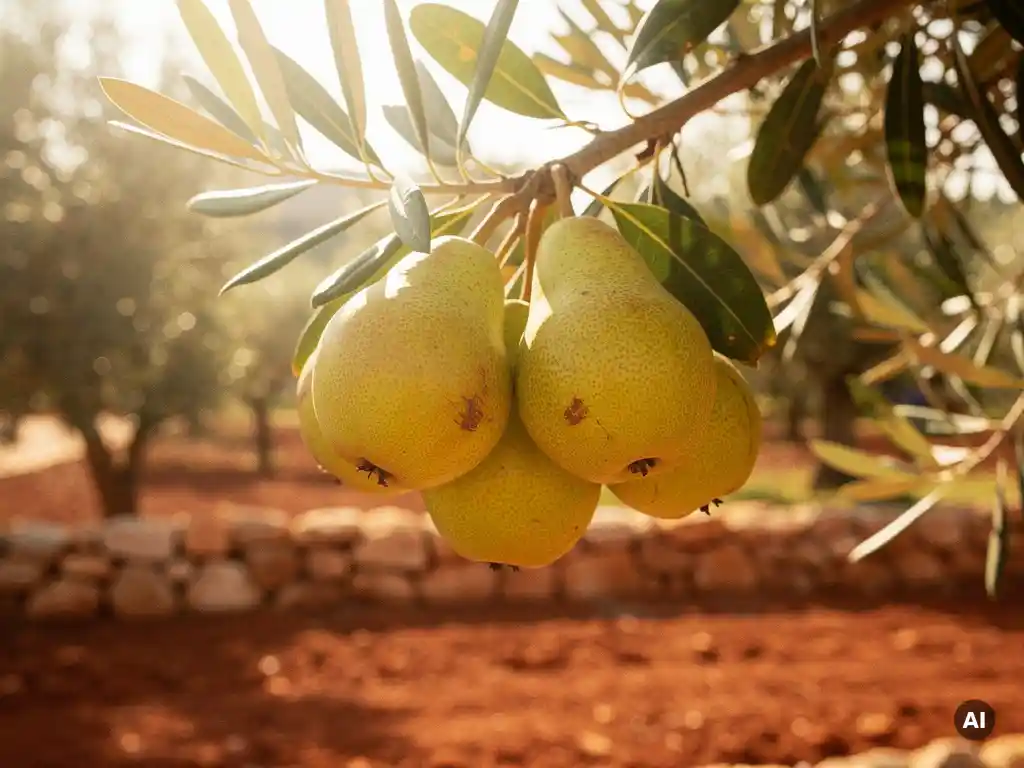
The best pear varieties for Mediterranean climates are those that combine low chill hour requirements with strong heat tolerance and reliable fruit quality under dry summer conditions. Varieties such as Coscia, Spadona, and newer bred selections adapted to warm winters consistently outperform traditional European cultivars in these regions. Below, we answer the most common questions growers ask about pear cultivation in Mediterranean conditions, and if you want to discuss variety selection for your specific situation, feel free to get in touch with us.
Which pear varieties perform best in hot, dry summers?
Pear varieties that perform best in hot, dry Mediterranean summers are those with moderate to low chill hour requirements, good drought tolerance, and the ability to size and ripen fruit without excessive irrigation. Coscia, Spadona, and Williams Bon Chrétien (also known as Bartlett) are among the most widely grown in Mediterranean regions, though their performance varies by elevation and microclimate.
Heat-tolerant pear varieties tend to share a few key traits: they ripen earlier in the season before peak summer heat arrives, they have thinner skin that does not crack under temperature fluctuation, and they maintain acceptable sugar development even when water availability is limited. In higher-altitude Mediterranean zones, varieties with slightly higher chill requirements can also succeed, provided winter temperatures are cool enough at elevation.
Growers in warmer coastal areas often find that early-ripening varieties are the most practical choice, as they complete fruit development before the most stressful period of summer. Late-ripening European varieties, by contrast, often struggle to finish properly under intense heat without significant irrigation input.
What is a low-chill pear variety and why does it matter in Mediterranean regions?
A low-chill pear variety is one that requires fewer hours of winter temperatures below approximately 7°C (45°F) to break dormancy and flower normally in spring. In Mediterranean climates, where winters are mild and chill hours are often insufficient for traditional European pear varieties, selecting low-chill cultivars is essential for consistent cropping and reliable fruit set.
Most standard European pear varieties were developed in cooler northern climates and require between 800 and 1,200 chill hours to perform well. In many Mediterranean growing regions, growers may accumulate only 400 to 700 hours in a given winter, and that figure is declining as climate patterns shift. When a variety does not receive adequate chilling, it may flower unevenly, set fruit poorly, or produce undersized and misshapen fruit even in otherwise favorable conditions.
Low-chill pear varieties address this directly by completing their dormancy requirement within the chill hours realistically available in warm-winter regions. This makes them far more reliable for growers in southern Spain, Italy, Greece, North Africa, and similar climates where Mediterranean conditions define the growing season.
How does disease pressure differ for pears grown in Mediterranean climates?
Pears grown in Mediterranean climates face a different disease pressure profile compared to those grown in cooler, wetter northern European regions. The dry, warm summers characteristic of Mediterranean growing significantly reduce the risk of fungal diseases like scab and fire blight during the growing season, but spring conditions can still create infection windows that growers must manage carefully.
Spring infection risk
Fire blight (Erwinia amylovora) remains a serious concern in Mediterranean pear cultivation, particularly during flowering when warm, humid spring weather creates ideal conditions for bacterial spread. Even in otherwise dry climates, the short but critical flowering window can coincide with rainfall or irrigation-driven humidity, making resistant or tolerant varieties a meaningful advantage.
Summer and storage diseases
During the dry Mediterranean summer, foliar fungal diseases are generally less severe than in Atlantic or continental climates. However, post-harvest storage rots and skin blemishes caused by heat stress or sunburn can affect fruit quality significantly. Variety selection plays a role here too, as some cultivars have tougher skin and better heat tolerance that reduces surface damage and extends storage life after harvest.
What’s the difference between European and Asian pear varieties for Mediterranean growing?
The key difference between European and Asian pear varieties for Mediterranean growing is their fruit texture, chill hour requirements, and how they respond to heat during ripening. European pears (Pyrus communis) produce buttery, soft flesh and typically require more chill hours, while Asian pears (Pyrus pyrifolia and related species) offer crisp, apple-like texture and often tolerate warmer winters more readily.
European pear varieties
European pears are the dominant type in Mediterranean commercial orchards and include well-known cultivars such as Williams, Abate Fetel, and Conference. They are valued for their rich flavor and soft texture when ripe, but many require careful management of chill hours and are sensitive to heat during the final stages of fruit development. In Mediterranean pear cultivation, growers often select early-ripening European types to avoid the worst of the summer heat.
Asian pear varieties
Asian pears are gaining interest in some Mediterranean markets due to their lower chill requirements and their ability to ripen on the tree without becoming mealy in the heat. Their crisp texture and longer shelf life make them attractive for fresh markets and export. However, consumer familiarity with Asian pears remains lower in many traditional European markets, which can affect commercial viability depending on the target region.
When should pears be harvested in a Mediterranean climate?
In Mediterranean climates, pears are typically harvested earlier in the season than in cooler northern European regions, with most varieties ready between late June and August depending on the cultivar and location. Harvesting at the correct maturity stage is critical because Mediterranean heat accelerates post-harvest ripening and reduces the window for transport and storage.
The key indicator for harvest timing is not visual color alone but a combination of factors: firmness measured with a penetrometer, starch-iodine pattern, and days from full bloom. In hot climates, relying on color as the primary harvest cue often leads to over-maturity at picking, which shortens shelf life significantly.
Early-ripening varieties such as Coscia and Spadona are typically harvested in late June to July across Mediterranean regions. Mid-season varieties like Williams follow in July to August. Growers at higher elevations may harvest slightly later as cooler nighttime temperatures slow the ripening process and can actually improve flavor development compared to lower-altitude sites.
How does pear variety breeding address Mediterranean climate challenges?
Modern pear variety breeding addresses Mediterranean climate challenges by combining low chill hour adaptation, heat tolerance, disease resistance, and consistent fruit quality into single cultivars that perform reliably without compromising flavor or grower profitability. Traditional breeding alone is slow, but the use of molecular markers and genomic tools has accelerated the identification of traits suited to warm-climate growing.
At Better3Fruit, we run one of the world’s largest apple and pear breeding programs, and Mediterranean adaptability is increasingly central to how we think about new variety development. With climate resilience and multi-level sustainability among our primary long-term goals, we evaluate tens of thousands of new selections every year, looking for combinations of traits that make commercial sense for growers in warm, water-limited environments.
Breeding for Mediterranean conditions means selecting not just for low chill requirements but also for varieties that maintain eating quality under heat stress, resist fire blight during warm springs, and produce commercially acceptable yields without excessive irrigation. You can explore the varieties we have developed and currently offer on our variety overview page. These represent years of selection work aimed at bringing together the traits that matter most to growers and the supply chain.
As Mediterranean growing regions face increasing pressure from shifting climate patterns, the role of purpose-bred varieties becomes more important. Growers who select varieties designed with these conditions in mind are better positioned to maintain productivity and quality as summers grow longer and winters warmer. Contact us to find out which of our varieties may be the right fit for your orchard and climate.
This content was generated with the help of AI and it may contain mistakes