
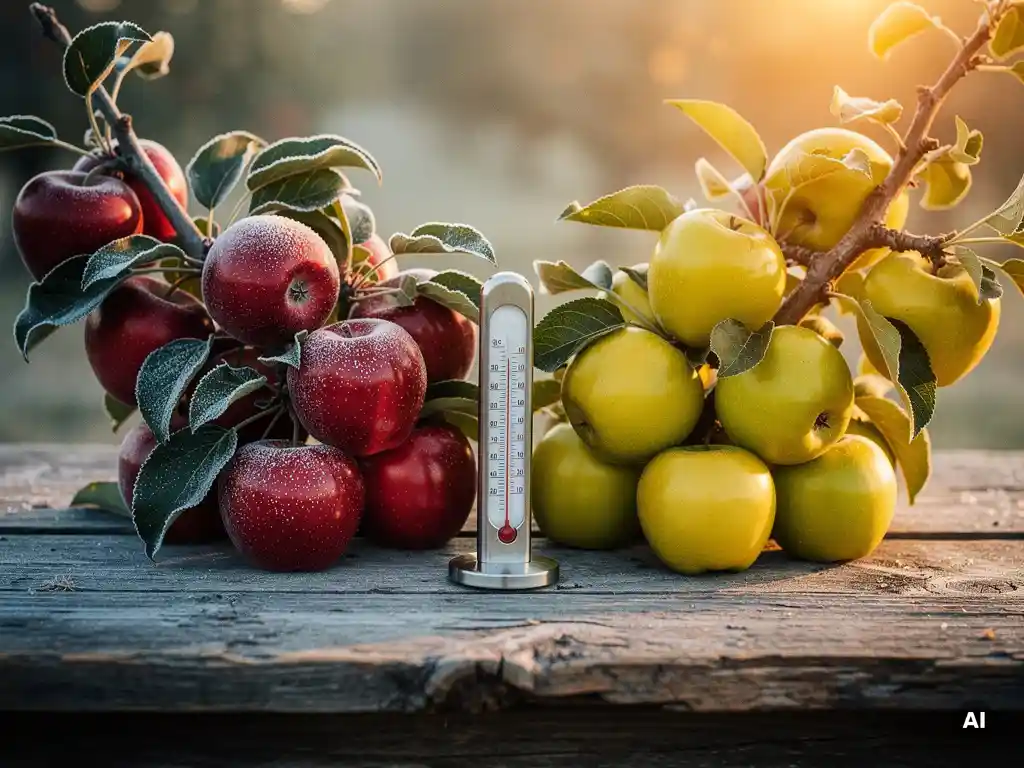
The difference between high-chill and low-chill apple varieties comes down to how much cold winter weather each type needs to break dormancy and produce fruit reliably. High-chill varieties require long periods of temperatures between roughly 0°C and 7°C, while low-chill varieties have been bred or selected to fruit successfully with far less winter cold. Understanding this distinction is essential for growers choosing varieties suited to their local climate, and it matters more than ever as growing regions warm. The sections below unpack the science, the numbers, and the practical choices involved, and if you have questions along the way, feel free to get in touch with us.
Why do apple trees need cold temperatures to fruit?
Apple trees need cold temperatures because they enter a state of dormancy in autumn to protect themselves from winter damage, and they require sufficient chilling to release that dormancy properly in spring. Without adequate cold, the hormonal signals that trigger budbreak, flowering, and fruit set remain blocked, and the tree cannot complete its annual growth cycle.
This mechanism evolved in temperate climates where cold winters reliably precede warm growing seasons. During dormancy, apple trees accumulate the physiological changes needed to respond to rising spring temperatures. If the chilling requirement is not met, the tree may produce erratic, delayed, or patchy flowering, or fail to flower at all. Even if some blossoms do appear, fruit set is often poor and the resulting crop uneven. The chilling requirement is therefore not a quirk of apple biology but a fundamental part of how the tree times its growth to match seasonal conditions.
What counts as a chill hour for apple trees?
A chill hour is traditionally defined as one hour of air temperature at or below 7°C (45°F). Under the simplest model, the Utah model or its basic predecessor, growers count every hour within the effective chilling range during autumn and winter to determine whether a variety’s requirement has been met before spring warmth arrives.
In practice, the calculation is more nuanced than a simple count of cold hours. Several models have been developed to better reflect how trees actually respond to temperature variation:
- The basic chill hour model counts all hours at or below 7°C, which works reasonably well in consistently cold climates.
- The Utah model assigns positive and negative weights to different temperature ranges, recognising that temperatures above 15°C can cancel out previously accumulated chill.
- The Dynamic model is considered the most accurate for warm or variable climates, as it accounts for the irreversible nature of certain chilling processes within the tree.
For practical variety selection, most breeders and nurseries still express chilling requirements in chill hours or chill portions, with the Dynamic model increasingly preferred in warmer growing regions where temperature swings are common.
How many chill hours do high-chill vs. low-chill apple varieties need?
High-chill apple varieties typically require between 800 and 1,200 or more chill hours per season, while low-chill apple varieties are bred to fruit reliably with fewer than 400 to 500 chill hours. Some ultra-low-chill selections can perform with as few as 100 to 200 chill hours, making them suitable for subtropical growing conditions.
Most traditional commercial apple varieties, including many of the classic European cultivars that dominate global markets, fall into the high-chill category. These varieties were developed in temperate climates with reliably cold winters, and their chilling requirements reflect that heritage. Low-chill varieties, by contrast, have either been selected from naturally occurring low-chill seedlings or deliberately bred using parents with reduced chilling needs. At Better3Fruit, our breeding programme evaluates tens of thousands of new seedlings every year, and chilling adaptability is increasingly a trait we assess alongside taste, texture, disease tolerance, and grower performance.
Which apple varieties grow best in warm or mild climates?
Apple varieties with low chill requirements grow best in warm or mild climates, including Mediterranean regions, parts of South Africa, Australia, Chile, California, and areas of the Middle East and Southeast Asia where winters are short and mild. These varieties are specifically selected or bred to complete their chilling requirement during the limited cold spells these regions experience.
Among well-known low-chill options, varieties such as Anna, Dorsett Golden, and Tropic Sweet have been widely planted in warm regions for decades. Breeding programmes are now developing a new generation of low-chill varieties that also meet modern market expectations for flavour, appearance, and shelf life, areas where older low-chill cultivars have sometimes fallen short.
For growers in mild climates looking for commercially viable options, exploring our variety portfolio is a useful starting point to understand what traits are now achievable in varieties suited to lower chill accumulation. The combination of strong eating quality with climate adaptability is precisely the challenge that modern apple breeding is working to solve.
What happens if you plant a high-chill apple variety in a warm climate?
Planting a high-chill apple variety in a warm climate where insufficient chill hours accumulate leads to a range of serious problems: delayed or absent budbreak, sparse and irregular flowering, poor fruit set, reduced fruit size and quality, and overall tree decline over time. The tree essentially cannot complete its biological reset and enters the growing season in a compromised state.
In mild winters, a high-chill variety may produce some blossom, but the flowering period is typically extended and staggered rather than concentrated, making pollination unreliable and harvest management difficult. Repeated years of insufficient chilling weaken the tree progressively, as it cannot properly restore the energy reserves and hormonal balance needed for healthy growth. Growers sometimes attempt to compensate using hydrogen cyanamide or other chemical dormancy-breaking treatments, but these are management tools rather than solutions: they partially substitute for natural chilling but cannot fully replicate it, and their effectiveness diminishes as the chilling deficit grows larger.
The practical lesson is straightforward: matching variety to climate is not optional. Planting a high-chill variety in a low-chill environment is a long-term commercial risk, regardless of how attractive the variety may be in terms of fruit quality or market demand.
How is climate change affecting apple chill hour requirements?
Climate change is reducing the number of chill hours accumulating across many traditional apple-growing regions, meaning that varieties with high chilling requirements are increasingly at risk of underperformance even in areas where they have historically thrived. Warmer winters, earlier springs, and more variable autumn temperatures are all compressing the effective chilling window.
Research across apple-growing regions in Europe, North America, and the Southern Hemisphere consistently points in the same direction: growers who relied on predictable winter cold are now experiencing year-to-year variability that makes long-term planning around high-chill varieties more difficult. In some established production areas, average chill hour accumulation has already shifted enough to affect the performance of standard commercial cultivars.
This shift is reshaping breeding priorities. Climate resilience is now a primary long-term goal in our breeding strategy at Better3Fruit, sitting alongside disease and pest tolerance, taste, texture, and grower yield. Developing varieties that perform well across a broader range of chilling conditions, rather than being tightly calibrated to a single climate profile, is increasingly central to what a competitive apple variety needs to offer. The apple industry’s future depends not just on great fruit, but on varieties that can deliver that fruit reliably as growing conditions continue to shift.
If you are evaluating variety options for your specific climate or want to understand how chilling requirements factor into variety selection for your region, we are happy to help. Contact us to discuss your situation and explore what might work best for your growing conditions.
This content was generated with the help of AI and it may contain mistakes