
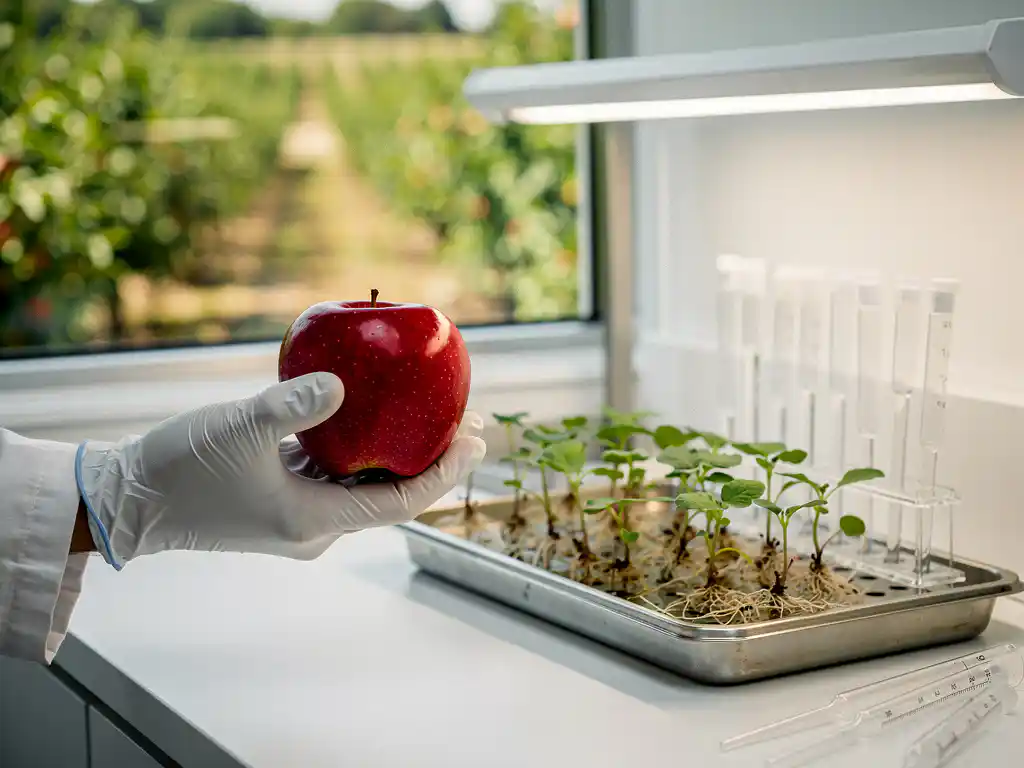
Modern apple breeding has come a long way from the days of simply planting seeds and waiting years to see what grows. Today, tools like molecular markers allow breeders to work smarter, faster, and with far greater precision when developing new apple varieties. At Better3Fruit, we use molecular markers as a core part of our breeding program, alongside traditional crossing and selection methods. If you want to learn more about our work or get in touch directly, feel free to contact us at any time.
This article walks through the key questions surrounding molecular markers in apple breeding—from what they are and how they work to what they mean for the future of horticulture. Whether you are a grower, a commercial partner, or simply curious about how new apple varieties come to life, the answers below offer a clear and practical overview.
What are molecular markers in apple breeding?
Molecular markers are specific, identifiable sequences in a plant’s DNA that are associated with particular traits or characteristics. In apple breeding, they act as genetic signposts, allowing breeders to detect the presence or absence of desirable traits at the DNA level long before a tree produces its first fruit.
Think of the apple genome as an enormous instruction manual. Molecular markers are like bookmarks placed at known locations within that manual, each one pointing to a chapter that describes a specific trait, such as disease resistance, fruit color, or flavor. By reading those bookmarks early in a seedling’s life, breeders can make informed decisions about which plants are worth developing further.
There are several types of molecular markers used in plant science, including SSRs (simple sequence repeats) and SNPs (single nucleotide polymorphisms). Each type offers a slightly different resolution of genetic information, but all serve the same fundamental purpose: translating complex genetic data into actionable breeding decisions.
Why do molecular markers matter for developing new apple varieties?
Molecular markers matter because they dramatically reduce the time, cost, and uncertainty involved in developing new apple varieties. Traditional apple breeding requires years of observation before a breeder can assess whether a seedling carries a desired trait. Molecular markers shift that assessment to the very beginning of the process.
Apple trees have a long juvenile phase, meaning a seedling may take five to ten years to bear fruit under conventional conditions. Without molecular tools, breeders must maintain large populations of plants throughout that entire period, investing significant resources in trees that may ultimately be discarded. By screening seedlings at the DNA level within the first year of life, breeders can eliminate unsuitable candidates early, concentrating resources on the most promising material.
For us at Better3Fruit, this efficiency is essential. With more than 10,000 new variety selections entering evaluation every year and more than 30,000 under assessment at any given time, molecular markers help ensure that our breeding program remains both rigorous and manageable. The result is a faster pipeline from initial cross to commercial release, which ultimately benefits growers and the wider fruit industry.
How does marker-assisted selection work in fruit breeding?
Marker-assisted selection (MAS) is the process of using molecular markers to guide breeding decisions. In practice, it means screening young seedlings for specific DNA markers linked to target traits, then selecting only those plants that carry the desired genetic profile for further development.
The process typically follows these steps:
- Two parent varieties are crossed through manual pollination to create a new generation of seedlings.
- DNA is extracted from young leaf tissue from each seedling, often within the first few months of growth.
- The DNA is screened for markers associated with the target traits, such as scab resistance or specific flavor compounds.
- Seedlings that carry the desired markers are retained; those that do not are removed from the program.
- Selected seedlings continue through multi-stage field and quality evaluations before any variety is considered for commercial release.
Importantly, marker-assisted selection does not replace field evaluation; it works alongside it. A seedling that passes the molecular screen still needs to prove itself in the orchard and on the palate. MAS simply ensures that the plants entering those later, more expensive stages of evaluation already have the right genetic foundation.
What traits can molecular markers identify in apple varieties?
Molecular markers can identify a wide range of traits in apple varieties, including disease resistance, pest tolerance, fruit color, texture, flavor profile, storability, and tree architecture. The key requirement is that the trait must have a known genetic basis and a validated marker linked to it.
Disease resistance is one of the most well-established areas for marker use. Resistance to apple scab, caused by the fungus Venturia inaequalis, is a prime example. Several resistance genes have been mapped in the apple genome, and markers linked to those genes are now routinely used in breeding programs worldwide. Similar work has been done on resistance to powdery mildew and fire blight.
Beyond disease tolerance, markers are increasingly being validated for quality traits. Firmness, acidity, sugar content, and even the presence of specific aromatic compounds all have genetic components that researchers are progressively mapping. As the apple genome becomes better understood, the range of traits accessible through molecular screening continues to expand, giving breeders like us more tools to bring together the full combination of characteristics that a successful commercial variety demands.
How do molecular markers compare to traditional apple breeding methods?
Molecular markers and traditional apple breeding methods are complementary rather than competing approaches. Traditional breeding relies on crossing parent varieties and observing the offspring over many years; molecular markers accelerate and refine that process by providing genetic information that would otherwise only become visible much later in a plant’s development.
Traditional breeding has produced extraordinary results over centuries, including many of the classic apple varieties still grown and loved today. However, it is inherently slow. The combination of long juvenile periods, large population sizes, and unpredictable trait expression means that bringing a new variety from initial cross to commercial release can take fifteen to twenty years using conventional methods alone.
Molecular markers do not eliminate the need for field observation, taste evaluation, or agronomic assessment. What they do is front-load the selection process, removing clearly unsuitable candidates before resources are spent on growing them for years. The outcome is a more efficient pipeline that still depends on the deep horticultural knowledge and sensory judgment that have always defined quality apple breeding. At Better3Fruit, we see the two approaches as inseparable parts of a single, integrated strategy.
What does the future of molecular marker technology look like in horticulture?
The future of molecular marker technology in horticulture points toward greater precision, broader trait coverage, and faster turnaround times. Advances in genomic sequencing and data analysis are making it possible to screen for an increasing number of traits simultaneously, moving the field from single-gene markers toward whole-genome approaches.
Genomic selection, which uses dense marker data across the entire genome to predict the overall performance of a seedling, represents the next frontier. Rather than targeting individual genes one at a time, genomic selection builds a statistical model based on the genetic profiles of many evaluated plants, then uses that model to predict how a new seedling is likely to perform across multiple traits at once. This approach holds particular promise for complex traits like flavor and climate resilience, which are influenced by many genes working together.
Climate resilience is a growing priority across the fruit industry. As weather patterns become less predictable and growing conditions shift, breeders need varieties that can perform reliably across a wider range of environments. Molecular tools that help identify the genetic basis of resilience traits will play an increasingly important role in ensuring that the apple varieties of tomorrow are as robust as they are delicious. For us, developing varieties that are not only commercially successful but also sustainable and adaptable is at the heart of our long-term breeding vision.
Molecular markers have already transformed apple breeding, and their role will only grow as the science advances. If you are interested in learning more about our breeding program or exploring partnership opportunities, we invite you to get in touch with our team and start a conversation.
This content was generated with the help of AI and it may contain mistakes