
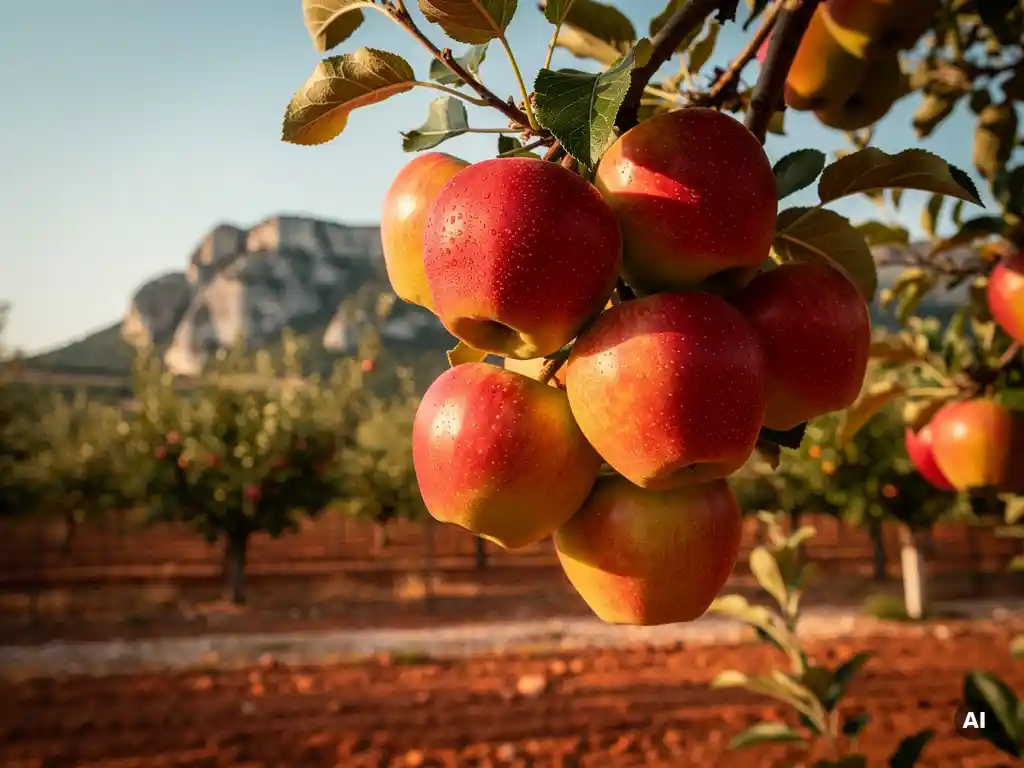
Several apple varieties are well-suited to growing in southern France, including heat-tolerant cultivars with lower chilling requirements such as Gala, Golden Delicious, and newer club varieties bred for warm, dry conditions. The key is matching the variety’s chilling requirement and disease tolerance profile to the specific microclimate of your orchard. Whether you are an established grower or exploring new plantings, the sections below walk through the most important questions to consider, and if you want to talk through options with a specialist, feel free to get in touch with us directly.
What climate conditions do apple trees need to thrive in southern France?
Apple trees need a period of winter cold, known as chilling hours, to break dormancy and flower reliably in spring. In southern France, the Mediterranean climate delivers hot, dry summers and mild winters, which means chilling hours are significantly lower than in northern growing regions. Most traditional apple varieties require between 800 and 1,200 chilling hours, while southern France typically accumulates between 400 and 700 hours depending on elevation and proximity to the coast.
Beyond chilling, apple trees in southern France face intense summer heat, low humidity, and periods of drought stress. These conditions affect fruit set, fruit size, colour development, and overall tree vigour. Varieties that struggle to colour properly without cool autumn nights, or that drop fruit prematurely under heat stress, are poor candidates for the region. Growers at higher altitudes in the Pyrénées foothills or the Massif Central have more options, as elevation compensates for some of the chilling deficit and moderates summer temperatures.
Irrigation infrastructure is essentially non-negotiable in southern France. Even varieties with good drought tolerance will need supplemental water during fruit development to achieve marketable size and quality.
Which apple varieties grow best in hot, dry conditions?
Apple varieties that perform best in hot, dry conditions are those with moderate chilling requirements, strong heat tolerance during fruit development, and the ability to produce good colour without relying on cool autumn temperatures. Varieties in the Gala family, Golden Delicious, and certain Fuji selections have a long track record in warm Mediterranean climates. Newer varieties bred with specific heat resilience traits are increasingly relevant for southern French growers.
Gala and its many strains remain among the most widely planted choices because they have relatively low chilling requirements and colour well even under warm conditions. Golden Delicious has historically been a staple of the Limousin and Dordogne regions, but it also adapts reasonably well further south. Fuji requires careful site selection in the south due to its higher chilling needs, though early-ripening Fuji strains perform better in warmer zones.
At Better3Fruit, our breeding programme specifically targets traits like disease tolerance and climate resilience, which are increasingly relevant as summers across southern France grow hotter and drier. Our variety portfolio includes cultivars that have been evaluated across a range of warm-climate growing conditions, making them worth considering alongside the established names.
What are low-chill apple varieties and why do they matter in southern France?
Low-chill apple varieties are cultivars that require fewer than 600 chilling hours to break dormancy and flower reliably. They matter in southern France because the region’s mild winters frequently fail to provide the chilling accumulation that traditional high-chill varieties need. When a variety does not receive enough winter cold, it may flower erratically, produce poor fruit set, or fail to break dormancy uniformly across the tree.
The practical consequence of planting a high-chill variety in a low-chill environment is unpredictable production. Some years the tree performs acceptably; in warmer winters it may produce almost nothing. For a commercial orchard, this variability is economically damaging. Low-chill varieties eliminate much of this risk by performing consistently even when winter temperatures stay mild.
It is worth noting that “low-chill” does not automatically mean “suitable for southern France.” A variety must also handle summer heat, resist the disease pressures common in the region, and produce fruit of commercial quality. Chilling requirement is one filter among several, not the only criterion.
How does disease pressure differ in southern France compared to northern growing regions?
Disease pressure in southern France differs from northern regions primarily because the warm, dry Mediterranean climate suppresses some fungal diseases that are severe in wetter, cooler areas, while creating conditions that favour other pathogens and pests. Scab, caused by Venturia inaequalis, is generally less aggressive in the dry south than in Normandy or the Loire Valley, where spring rainfall drives infection cycles. However, powdery mildew thrives in warm, dry conditions and is a persistent challenge across southern orchards.
Fire blight, caused by the bacterium Erwinia amylovora, is a growing concern in southern France. Warm spring temperatures combined with flowering periods create ideal conditions for infection. Choosing varieties with strong fire blight resistance is increasingly important for growers in the region, particularly as climate change extends warm weather into the early growing season.
Codling moth and other insect pests are also more active in warm climates, requiring careful integrated pest management. The net effect is that southern French growers face a different but not necessarily lighter disease and pest burden than their northern counterparts; it simply requires a different management strategy and variety selection focused on the specific threats present in the Mediterranean growing environment.
Should growers in southern France choose club varieties or open varieties?
Whether to choose a club variety or an open variety depends on the grower’s commercial ambitions, willingness to meet quality standards, and appetite for market coordination. Club varieties offer access to established brands, coordinated marketing, and often premium pricing, but they come with production requirements and royalty obligations. Open varieties give growers more freedom but require them to compete in commodity markets where margins are thinner.
For growers in southern France with strong production capacity and the infrastructure to meet quality specifications consistently, a club variety can provide a meaningful commercial advantage. The brand recognition and demand-building that comes with a well-managed club programme reduces the uncertainty of selling into open markets.
That said, not every grower is in a position to meet the requirements of a club programme, and open varieties remain a solid foundation for many operations. The most important thing is that the variety, club or open, is genuinely suited to the southern French climate. A well-performing open variety will always outperform a struggling club variety, regardless of the marketing support behind it.
We work with both models at Better3Fruit. Our approach is to find the right partner for each variety and build critical mass in the market, but we place no restrictions on who can apply for a licence: any grower worldwide can explore our varieties regardless of scale or existing partnerships.
What should growers consider when selecting a new apple variety for southern France?
When selecting a new apple variety for southern France, growers should evaluate chilling requirement, heat and drought tolerance, disease resistance profile, fruit quality under warm conditions, and commercial market fit. No single factor is sufficient on its own: a variety that ticks every agronomic box but has no market demand is not a viable investment, and a commercially exciting variety that struggles in the local climate will underperform regardless of its reputation elsewhere.
- Chilling requirement: Confirm the variety’s chilling hours match what your specific site reliably accumulates in winter, accounting for year-to-year variability.
- Heat tolerance: Assess whether the variety maintains fruit quality, size, and colour under the high summer temperatures typical of the region.
- Disease and pest resistance: Prioritise resistance or tolerance to powdery mildew and fire blight, which are the most relevant threats in southern French orchards.
- Fruit quality under local conditions: Taste, texture, and appearance can shift significantly when a variety is grown outside its original breeding environment. Trial data from comparable climates is far more reliable than results from cooler northern regions.
- Market and commercial structure: Understand whether the variety is open or club-licensed, what the royalty structure looks like, and whether there is active market development support in place.
- Long-term climate resilience: With summer temperatures in southern France trending warmer, selecting varieties that are bred with climate resilience as a core trait, rather than an afterthought, will matter increasingly over the lifetime of an orchard.
Taking the time to trial new varieties on a small block before committing to a full planting is always worthwhile. Variety performance data from similar Mediterranean climates, whether from Spain, Italy, or southern France itself, gives a much more reliable picture than trials conducted in cooler northern European conditions. If you are ready to explore what variety options might suit your orchard, contact us to start the conversation: we are happy to help you find the right fit.
This content was generated with the help of AI and it may contain mistakes