
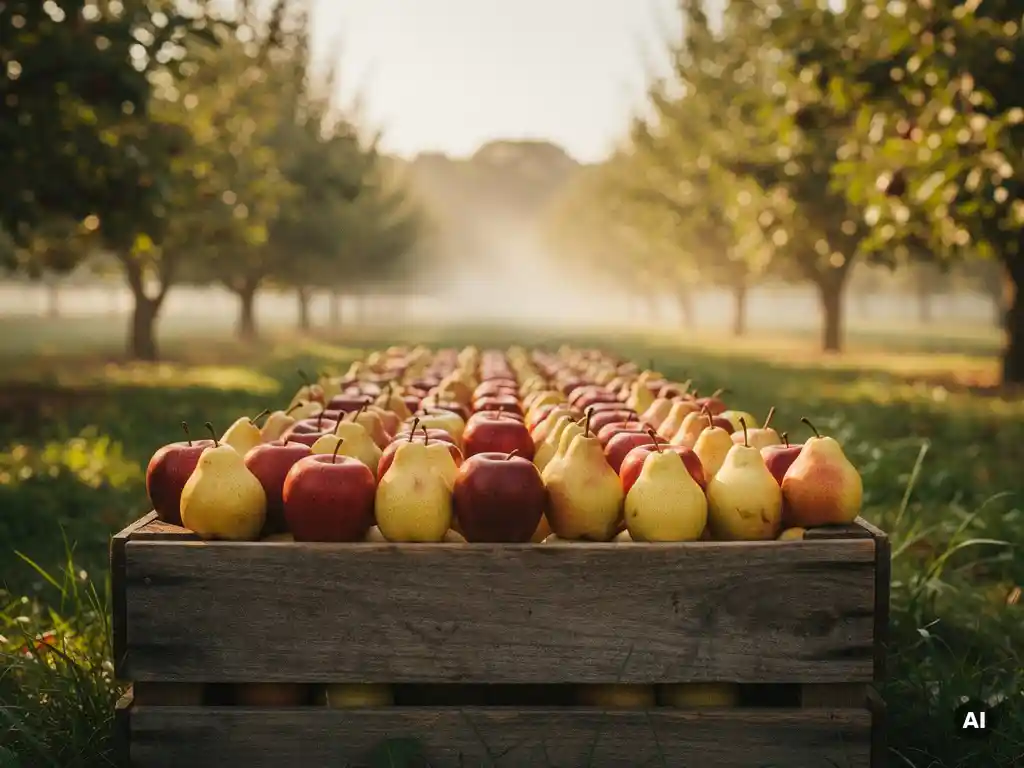
The fruit varieties that score best on consistency worldwide are those bred for stable performance across diverse climates, soils, and growing conditions, not just those that taste great in one region. Varieties like Kanzi® and Morgana® have demonstrated that combining strong genetics, disease tolerance, and structured licensing can deliver reliable quality from orchard to shelf, season after season. Below, we unpack the key questions growers, retailers, and licensing partners ask most about fruit variety consistency, and if you want to talk through any of it directly, feel free to get in touch with us.
What makes a fruit variety truly consistent across different regions?
A fruit variety is truly consistent across different regions when its core quality traits, flavour, texture, appearance, and shelf life, remain stable regardless of where it is grown. This stability comes from a combination of genetic robustness, adaptability to varying climates and soil types, and strong agronomic support that ensures growers can meet the same quality standard wherever they are in the world.
Consistency is not just about taste. It encompasses how a variety performs across an entire growing season, how it responds to different pruning and crop load management practices, and how reliably it meets retail specifications year after year. A variety that delivers exceptional results in one country but underperforms in another is not truly consistent, it is simply well-matched to one set of conditions.
Genetic stability is the foundation. Varieties developed through modern breeding programmes, using tools like molecular markers, can be selected specifically for traits that hold up across a wide range of environments. This means breeders can identify which seedlings carry the right combination of flavour, disease tolerance, and climate resilience before they ever reach commercial scale, dramatically increasing the likelihood that the variety will perform consistently for growers worldwide.
Which apple and pear varieties are known for global consistency?
Among apple varieties, Kanzi® stands out as one of the most globally consistent club varieties of the past two decades, combining a distinctive sweet-sharp flavour profile with strong commercial performance across European, American, and Southern Hemisphere markets. More recently, Morgana® and Giga® have emerged as varieties with strong consistency credentials, bred with the same focus on stable quality traits.
For pear varieties, global consistency is harder to achieve due to the crop’s sensitivity to climate and soil variation, but well-managed breeding programmes are making meaningful progress in developing pear cultivars that hold their quality across different growing regions.
What these varieties share is a breeding origin that prioritised multi-environment performance from the outset. They were not selected purely for peak performance in ideal conditions, they were evaluated across many growing environments before commercial release. You can explore our full range of apple and pear varieties to see how each one is positioned for global performance.
How does apple breeding affect long-term variety consistency?
Apple breeding directly shapes long-term variety consistency by determining which genetic traits are locked into a cultivar at the point of selection. Varieties bred using modern molecular marker technology carry a precisely defined set of traits, flavour compounds, texture characteristics, colour development, and disease tolerance, that remain stable across generations of propagation, giving growers and retailers a reliable baseline to work from year after year.
Traditional breeding relied heavily on field observation over many seasons, which meant that inconsistencies were often only discovered after commercial release. Modern programmes, like ours at Better3Fruit, evaluate thousands of new seedlings annually using genetic screening, meaning varieties that reach commercial release have already been validated for trait stability across a wide range of conditions.
Long-term consistency also depends on how a variety is managed post-release. Breeding programmes that maintain close involvement with licensed growers, providing technical guidance on orchard management, harvest timing, and storage protocols, help ensure that the genetic potential of a variety is actually realised in practice. A well-bred variety can still underperform if the agronomic support around it is weak.
Why do club varieties tend to outperform open varieties in consistency?
Club varieties tend to outperform open varieties in consistency because they are managed under a coordinated licensing structure that controls who grows them, how they are grown, and how they reach the market. This structured approach means that every apple or pear sold under a club variety brand has met a defined quality standard, something that open varieties, available to any grower without restriction, cannot guarantee.
With open varieties, quality varies widely depending on the grower’s location, practices, and investment in post-harvest handling. A consumer buying an open variety apple in one country may have a completely different experience from a consumer buying the same variety in another country. Club varieties eliminate much of this variation by setting minimum standards for colour, size, sugar content, and firmness, and by removing fruit from the supply chain that does not meet those standards.
The commercial result is a more predictable product for retailers and a more reliable experience for consumers. This is why club variety brands can command premium positioning in retail, the brand itself is a quality signal, not just a name. For growers, club membership also typically means access to marketing support, demand forecasting, and a more stable price structure, all of which incentivise the investment needed to maintain high and consistent quality.
What role does disease resistance play in fruit consistency?
Disease resistance plays a central role in fruit consistency because it directly protects the uniformity of a crop from season to season. When a variety is susceptible to common diseases like scab, mildew, or fire blight, the quality and quantity of fruit that reaches harvest can vary dramatically depending on disease pressure in a given year, making it nearly impossible to guarantee consistent supply and appearance to retail partners.
Varieties with strong disease tolerance or resistance reduce this variability significantly. Growers can apply fewer protective sprays, which lowers the risk of residue-related quality issues and makes the crop more predictable to manage. Consistent disease management translates directly into more uniform fruit size, colour, and skin finish, the visible quality attributes that consumers and retailers judge most immediately.
Disease resistance also supports consistency across regions. A variety that performs well in a wet, disease-prone climate in northern Europe but also holds its quality in the drier conditions of South Africa or Chile has a much broader commercial footprint. This is why our breeding strategy at Better3Fruit places disease and pest tolerance at the heart of every new variety development, not as an add-on, but as a primary selection criterion alongside taste and texture.
As climate patterns shift and growing conditions become less predictable, disease resilience is becoming an even more important driver of long-term fruit variety consistency. Varieties built with this resilience from the ground up are far better positioned to deliver reliable quality for growers and consumers well into the future. If you want to learn more about how we approach variety development, reach out to us and we would be happy to discuss it.
This content was generated with the help of AI and it may contain mistakes