
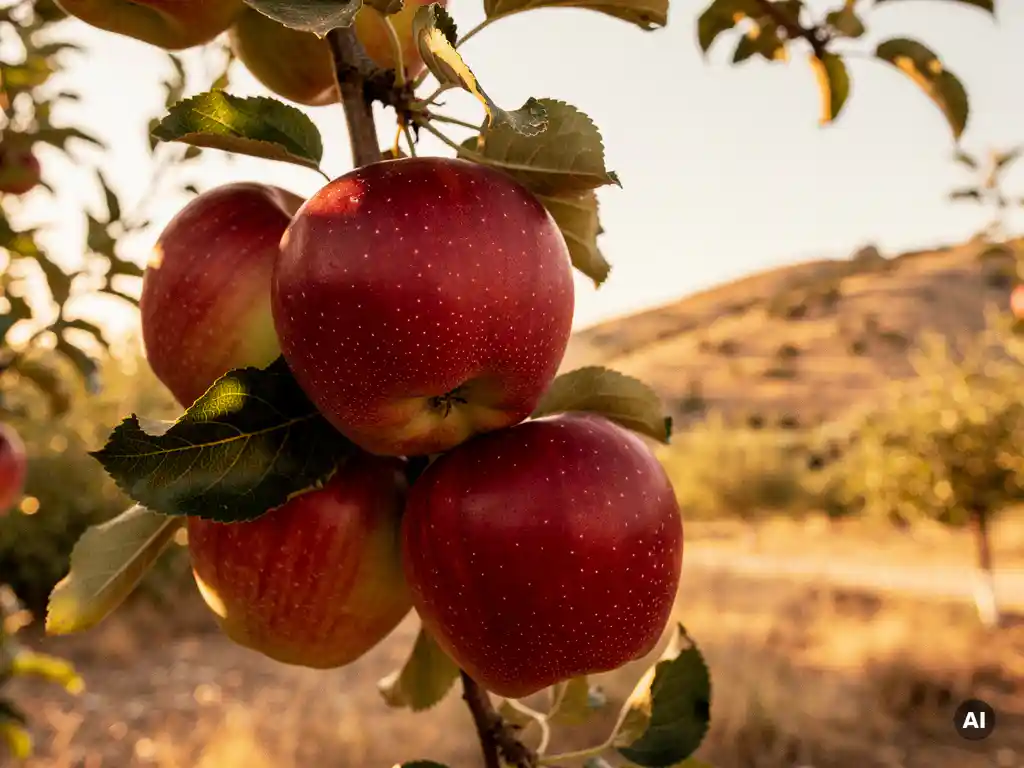
Several apple varieties combine good color development with low chill requirements, making them viable options for warm-climate production. Varieties such as Anna, Dorsett Golden, and Tropic Sweet are well-established examples, while newer breeding programs are steadily expanding the options available to growers in subtropical and mild-winter regions. If you want to explore what modern breeding has to offer, feel free to get in touch with us, and we are happy to help. Below, we unpack the key questions growers and industry partners ask most often about low-chill apples and color.
What makes an apple variety ‘low chill’ and why is it hard to get good color?
A low-chill apple variety is one that requires fewer accumulated hours of cold temperatures (typically below 7°C) during dormancy in order to break bud, flower, and set fruit normally. Most commercial apple cultivars need between 800 and 1,200 chill hours, while low-chill varieties can complete their dormancy cycle with fewer than 400 hours, making them suited to warm climates, subtropical zones, and regions with mild winters.
The challenge with color is rooted in the same climate conditions that make low-chill varieties possible. Red and bicolor pigmentation in apples is driven primarily by anthocyanin production, which is triggered by a combination of high light exposure, cool night temperatures, and a significant day-to-night temperature differential in the weeks before harvest. In warm regions where low-chill varieties thrive, those cool autumn nights and sharp temperature swings are often absent. The result is fruit that matures on schedule but fails to develop the deep, uniform red coloring that retailers and consumers expect.
This creates a genuine breeding dilemma: the genetic traits that reduce chill requirements and the environmental signals that promote strong color are, to a degree, working against each other. Selecting varieties that perform well on both fronts requires deliberate breeding work rather than simply adapting existing high-chill cultivars to warmer conditions.
Which apple varieties are known for combining color and low chill?
The apple varieties most recognized for combining acceptable color with low-chill requirements include Anna, Dorsett Golden, Tropical Beauty, and Ein Shemer. Among these, Anna is notable for producing a red blush over a yellow-green background with a chill requirement of roughly 200 to 300 hours. Tropical Beauty, developed in South Africa, shows reasonable red coloring under warm conditions and has gained traction in subtropical markets.
More recently, breeding programs around the world have been releasing selections with improved color profiles alongside reduced chill needs. These newer cultivars tend to perform better commercially than the older generation of low-chill varieties, which were often accepted more for their adaptability than for their eating or visual quality. The gap between what warm-climate growers can produce and what modern retail demands in terms of appearance is narrowing, but it remains a genuine challenge.
It is worth noting that “good color” is relative to the market. In some regions and retail channels, a lighter blush or a predominantly yellow fruit is commercially acceptable, which opens the door to a broader range of low-chill cultivars. In markets that demand deep red coverage, the options remain more limited, and variety selection becomes even more critical.
How do breeders select for both color and low chill in the same apple?
Breeders select for color and low chill simultaneously by using molecular markers to identify and combine the genetic traits responsible for each characteristic early in the breeding process, long before a seedling ever produces fruit. This marker-assisted selection dramatically reduces the time and resources needed compared to traditional field evaluation, allowing breeders to screen thousands of seedlings and discard those unlikely to carry both target traits.
At Better3Fruit, we work with over 10,000 new seedlings per crop entering the field each year, with more than 30,000 varieties under evaluation at any given time. This scale is essential when selecting for multiple complex traits at once. Color development and chill requirement are both influenced by multiple genes, meaning the probability of finding a seedling that scores well on both traits by chance alone is low. High-volume breeding programs increase the odds of identifying those rare combinations.
Beyond genetics, breeders also evaluate how candidate varieties respond to different growing environments. A variety may show promising color in one trial location but perform poorly in another. Multi-site testing across warm-climate regions is therefore a standard part of the selection process, ensuring that varieties released for low-chill markets genuinely deliver consistent color under the conditions growers will actually face.
What growing conditions help low chill apples develop better color?
Low-chill apples develop better color when growers maximize light exposure, manage canopy density carefully, and take advantage of any natural temperature variation available in their region. Even in warm climates, choosing sites with cooler nights, higher altitude, or reliable sea breezes can meaningfully improve anthocyanin development and the resulting red pigmentation in the fruit.
Orchard management practices play a significant role as well. Pruning to open the canopy allows more direct sunlight to reach individual fruit, which is one of the most effective ways to improve color in any apple variety. Reflective mulches placed on the orchard floor can redirect light upward onto the shaded sides of fruit, helping to achieve more uniform coverage. Thinning fruit loads also concentrates the plant’s resources, often resulting in larger, better-colored apples.
Timing of harvest matters too. Picking slightly later, when the fruit has had more time to accumulate color under favorable conditions, can improve appearance without significantly compromising storage life or eating quality. However, this requires careful monitoring, as delayed harvest in warm conditions can also lead to quality loss if not managed precisely. Growers working with newer low-chill cultivars should consult variety-specific guidance, as optimal harvest windows can differ significantly from traditional high-chill varieties.
Are low chill apple varieties suitable for commercial production?
Yes, low-chill apple varieties are suitable for commercial production, particularly in warm-climate regions where traditional high-chill cultivars simply cannot be grown reliably. Markets across the Middle East, South Africa, parts of Australia, South America, and Southeast Asia have demonstrated that commercially viable apple production is achievable with the right variety choices and management practices. The key constraint is matching variety selection to both the local climate and the target market’s quality expectations.
Commercially, the main challenges for low-chill varieties have historically been yield consistency, fruit size, and color uniformity compared to the benchmark set by leading European or North American cultivars. Newer breeding work is progressively closing this gap. As breeding programs invest more specifically in warm-climate performance, the commercial viability of low-chill apples continues to improve.
Licensing and intellectual property structures also matter for commercial growers. Working with a breeder that offers open, non-exclusive licensing gives growers and packers more flexibility to build their business without being locked into a single supply chain. Our apple and pear varieties are available for licensing worldwide, with no preferred partners, so growers in warm-climate regions can access the same breeding advances as those in traditional apple-growing zones.
Low-chill apple production is not a compromise for growers who have no other option. Increasingly, it is a genuine commercial opportunity for regions that can supply fresh apples during windows when northern hemisphere production is limited. With the right variety, the right site, and sound orchard management, commercial success is well within reach. If you are evaluating options for your region or looking to discuss variety suitability for a specific market, contact us, and we will be glad to explore the possibilities with you.
This content was generated with the help of AI and it may contain mistakes