
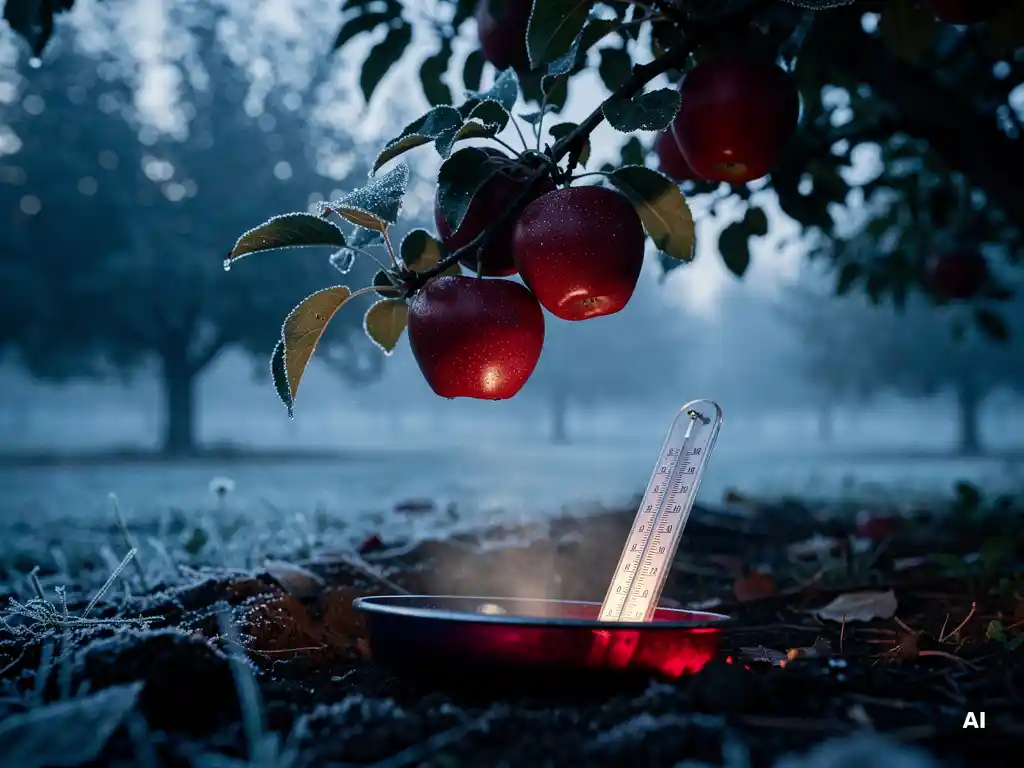
Cool nights trigger red color in apples by stimulating the production of anthocyanins, the pigments responsible for red and pink hues in apple skin. When temperatures drop below roughly 10°C (50°F) at night, the enzymatic pathways that synthesize anthocyanins become significantly more active, while warm nights suppress that process. The sections below unpack exactly how this works, which varieties respond best, and what it means for growers and breeders navigating a warming climate. If you want to discuss any of this with our team directly, feel free to get in touch with us.
How do cool nights actually trigger red color in apples?
Cool nights trigger red color in apples by activating the biosynthesis of anthocyanins, the flavonoid pigments that give apple skin its red, pink, and purple tones. Low nighttime temperatures slow cellular respiration, which preserves the sugars that serve as precursors to anthocyanin synthesis. At the same time, cooler temperatures upregulate the expression of genes encoding key enzymes in the anthocyanin pathway, most notably MYB transcription factors that act as master switches for pigment production.
During the day, sunlight provides the energy needed to drive photosynthesis and accumulate sugars. But it is the cool night that locks those sugars into the skin rather than allowing them to be consumed through respiration. The combination of high daytime light exposure and low nighttime temperature creates the ideal biochemical environment for deep, even red color development across the fruit surface.
This is why regions with a strong diurnal temperature variation, meaning a large gap between daytime highs and nighttime lows, consistently produce the most visually striking apples. The temperature swing is not incidental to apple color; it is a primary driver of the apple skin pigmentation process.
What temperature range produces the best apple color?
The optimal nighttime temperature range for apple color development is between 4°C and 10°C (39°F to 50°F). Within this range, anthocyanin synthesis is strongly stimulated without the fruit suffering cold damage. Daytime temperatures in the range of 20°C to 25°C (68°F to 77°F), paired with these cool nights, produce the most intense and uniform red coloring.
Below 4°C, the enzymatic reactions involved in anthocyanin production begin to slow, and the risk of frost damage to the fruit increases. Above 10°C at night, the temperature effect on apple color weakens considerably, and warm nights above 15°C can almost entirely suppress anthocyanin accumulation even when daytime light conditions are excellent.
The critical window for this temperature effect is the four to six weeks before harvest, when the fruit is sizing up and the skin is most responsive to environmental cues. Growers who can manage orchard conditions during this period, whether through site selection, canopy management to improve light penetration, or reflective mulches to amplify light, can meaningfully improve color outcomes even when nighttime temperatures are not ideal.
Why do apples in some regions color better than others?
Apples color better in regions with a continental or high-altitude climate because those environments naturally deliver the large diurnal temperature swings that drive anthocyanin production. Growing areas in the mountains of South Tyrol, the high valleys of Washington State, or the elevated orchards of New Zealand’s Central Otago produce deeply colored fruit precisely because their autumn nights cool rapidly while days remain warm and sunny.
In contrast, maritime climates, where the ocean moderates temperatures and keeps nights relatively mild, often struggle to achieve the same depth of color. Coastal growing regions in northern Europe, for example, may produce fruit with excellent flavor and texture but with less saturated red color, simply because the nighttime temperatures rarely drop low enough during the pre-harvest window to fully activate the anthocyanin pathways.
Latitude and elevation both play a role. Higher altitudes bring cooler nights earlier in the season and more intense UV radiation, which also independently stimulates anthocyanin production. This is why mountain-grown apples are often used as benchmarks for color quality in international markets, and why growers in warmer lowland regions face a structural disadvantage when competing on visual appearance alone.
Does apple variety affect how it responds to night temperatures?
Yes, apple variety has a significant effect on how strongly a fruit responds to cool nights. Some cultivars are genetically predisposed to produce high levels of anthocyanins and will develop strong red color with only moderate temperature drops, while others require prolonged cool nights to achieve acceptable coloring. This variation is rooted in the genetic architecture of each cultivar’s anthocyanin biosynthesis pathway.
Varieties with a high baseline expression of MYB10 or related transcription factors tend to be highly responsive to cool nights and can achieve full red coverage even in marginally cool conditions. Varieties with lower baseline expression need more pronounced or prolonged temperature drops to reach the same result. This is one reason why breeders pay close attention to the color genetics of new seedlings long before those seedlings ever reach commercial evaluation.
Our breeding program at Better3Fruit screens new apple and pear varieties for color performance across a range of growing environments. Varieties in our portfolio, from the well-established Kanzi® to newer releases like Morgana® and Giga®, have been selected in part for their ability to develop strong, commercially attractive color. You can explore our apple and pear varieties to see how color performance fits into the broader profile of each cultivar.
What happens to apple color when autumn nights stay warm?
When autumn nights stay warm, apple color development is suppressed because the enzymatic pathways responsible for anthocyanin synthesis remain downregulated. Fruit may remain green or develop only a pale, uneven blush rather than the deep, uniform red that markets demand. This is one of the most direct and commercially damaging consequences of warm autumn temperatures for apple growers.
The effect is not just cosmetic. In many markets, particularly in Europe and Asia, red color is a primary purchase driver. Fruit that fails to color adequately is downgraded, sold at lower prices, or rejected entirely by retailers. For growers in regions experiencing warmer autumns due to shifting climate patterns, this is an increasingly serious economic concern.
Some growers attempt to compensate for warm nights using post-harvest techniques or by applying ethylene-based treatments to accelerate ripening and color development. However, these approaches have limitations and cannot fully replicate the quality of color achieved through natural cool-night conditions. The fruit’s internal sugar balance and the evenness of pigment distribution are both affected when color is forced rather than developed naturally.
How are breeders developing apples that color without cold nights?
Breeders are developing apples that color without cold nights by selecting for genetic variants that produce high levels of anthocyanins under warm conditions. This involves identifying and crossing cultivars that carry favorable alleles of the transcription factors controlling pigment synthesis, so that the resulting offspring can activate their color pathways with less dependence on low nighttime temperatures.
Molecular marker technology plays a central role in this work. Rather than waiting years for a seedling to fruit and then evaluating its color performance in the field, breeders can now screen young plants for the presence of favorable color-related alleles early in the breeding cycle. This dramatically accelerates the identification of promising candidates and reduces the cost of evaluating large populations.
At Better3Fruit, we use molecular markers as a core tool in our breeding program, allowing us to bring together multiple desirable traits, including warm-night coloring ability, disease tolerance, taste, and texture, without having to compromise on any single characteristic. As climate resilience becomes an increasingly central goal in apple breeding, the ability to develop varieties that perform well across a broader range of autumn temperature conditions is a genuine competitive priority. If you want to learn more about our approach to variety development or explore licensing opportunities, reach out to our team to start the conversation.
This content was generated with the help of AI and it may contain mistakes