
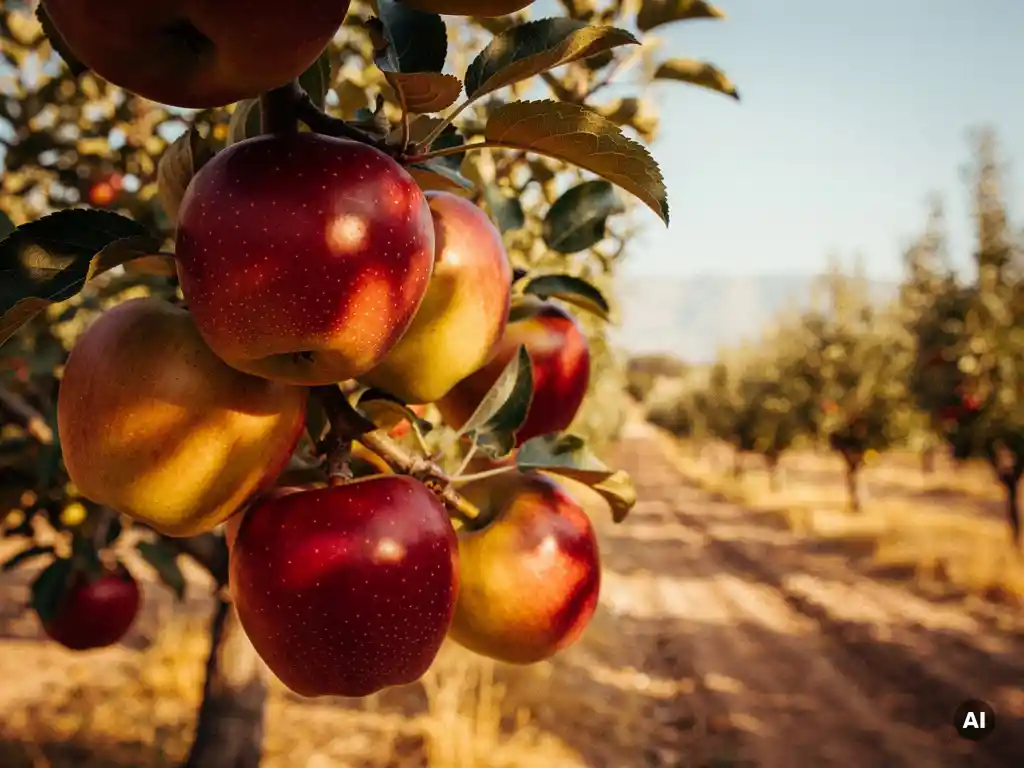
Several apple varieties have been tested and are actively trialled in warm growing regions around the world, including parts of southern Europe, South Africa, Chile, Australia, and the Middle East. Varieties with lower chilling requirements, stronger heat tolerance, and resistance to warm-weather pests and diseases tend to perform best. If you want to explore which varieties might suit your specific region, feel free to get in touch with us, we are happy to help.
Which apple varieties perform best in warm climates?
Apple varieties that perform best in warm climates are those bred or selected for low chilling requirements, heat tolerance during bloom and fruit development, and resistance to diseases that thrive in humid or hot conditions. Varieties with these traits can produce commercially viable yields in regions where traditional cultivars struggle to set fruit or maintain quality.
In practice, this means growers in warm regions often look beyond classic northern European cultivars such as Gala or Fuji in their standard forms and instead seek out selections or entirely new varieties developed with warmer conditions in mind. Traits like early maturity, firm texture under heat stress, and attractive colouring without requiring cold nights for anthocyanin development are particularly valued.
Our breeding program at Better3Fruit evaluates tens of thousands of new seedlings every year, and climate adaptability is increasingly a central filter in that process. Varieties from our portfolio, including the well-established Kanzi® and the fast-emerging Morgana® and Giga®, have been assessed across a wide range of growing environments. You can explore our current commercial variety portfolio to see which cultivars are available for licensing.
What makes an apple variety suitable for warm growing conditions?
An apple variety is suitable for warm growing conditions when it can complete its dormancy cycle with fewer cold hours, maintain fruit quality under elevated temperatures, and resist the pest and disease pressures that intensify in warmer climates. These traits together determine whether a variety can be commercially productive outside traditional temperate apple-growing zones.
The most critical factor is the chilling requirement, the number of hours below a certain temperature threshold that a tree needs to break dormancy properly. Varieties with high chilling requirements planted in warm regions often bloom erratically, set poor crops, or fail to develop adequate fruit size. Selecting or breeding for lower chilling requirements is therefore a foundational step.
Beyond dormancy, heat tolerance during the growing season matters enormously. High temperatures around bloom can reduce pollination success, and sustained heat during fruit development can cause sunburn, soft texture, and poor flavour. Varieties with thicker cuticles, compact canopy architecture, or naturally earlier maturity windows can sidestep the worst of summer heat. Disease resistance is equally important, as warmer and often more humid conditions favour pathogens such as apple scab and powdery mildew.
How does apple breeding account for climate variability?
Apple breeding accounts for climate variability by deliberately selecting parent varieties with traits suited to a range of temperature regimes, then evaluating offspring across multiple locations with differing climates over many years. This multi-environment testing reveals which seedlings are genuinely adaptable versus those that only perform well under narrow conditions.
At Better3Fruit, we use molecular markers as part of our breeding toolkit, which allows us to identify genetic traits associated with climate resilience at an early stage rather than waiting years for trees to mature and fruit. This speeds up the process of identifying candidates with genuine potential in warmer or more variable environments.
Climate resilience and multi-level sustainability are primary long-term goals in our breeding strategy. This means we are not simply selecting for high yield under ideal conditions, we are actively working to develop varieties that remain productive and high-quality as growing conditions shift. Disease and pest tolerance, drought adaptability, and reduced input requirements are all part of this broader picture, making new varieties more viable across a wider geographic range.
Which warm growing regions are actively trialling new apple varieties?
Warm growing regions actively trialling new apple varieties include South Africa, Chile, parts of Australia, Spain, Italy, Turkey, and several countries across the Middle East and North Africa. These regions have established apple industries or are developing them, and growers and research stations there are evaluating new cultivars for commercial potential under local conditions.
South Africa and Chile are particularly active, as both countries have sophisticated export-oriented fruit industries and the infrastructure to run structured variety trials. They are consistently among the first regions outside Europe to evaluate new club varieties and assess performance data over multiple seasons. Australia, particularly in warmer inland growing areas, is also investing significantly in variety trialling as growers seek alternatives to cultivars that underperform in hotter summers.
In the Mediterranean basin, regions in Spain and southern Italy have long grown apples in conditions warmer than the traditional Alpine or northern European zones. Growers there are increasingly interested in varieties that colour well without requiring cold nights and that ripen earlier in the season to avoid peak summer heat. Turkey and parts of the Middle East represent emerging markets where apple cultivation is expanding and variety selection is a critical early decision for new orchards.
What challenges do growers face when planting apples in warm regions?
Growers planting apples in warm regions face several interconnected challenges: insufficient chilling hours to break dormancy reliably, heat stress during bloom and fruit fill, increased pressure from pests and diseases favoured by warm conditions, and the difficulty of achieving the fruit colour and quality that export markets demand without the cool nights that trigger colouring in many traditional varieties.
Dormancy failure is often the most immediate problem. When trees do not receive enough cold hours during winter, they may leaf out unevenly, produce scattered bloom, or set very few fruit. Growers sometimes manage this with chemical dormancy-breaking agents, but these are a workaround rather than a solution, and their effectiveness varies by variety and season.
Fruit quality under heat is another persistent challenge. Sunburn damage, soft flesh, and poor flavour development all become more likely as temperatures rise during the growing season. Growers invest in protective netting, evaporative cooling, and careful irrigation management, but these measures add cost and complexity. Ultimately, the most sustainable path is selecting varieties that are inherently better suited to warm conditions, which is precisely why investment in targeted apple breeding for warm climates is growing worldwide.
If you are a grower or industry partner exploring apple cultivation in a warm region and want to understand which varieties might be the right fit, contact us to start the conversation. We work with partners across the globe and welcome enquiries from any region.
This content was generated with the help of AI and it may contain mistakes