
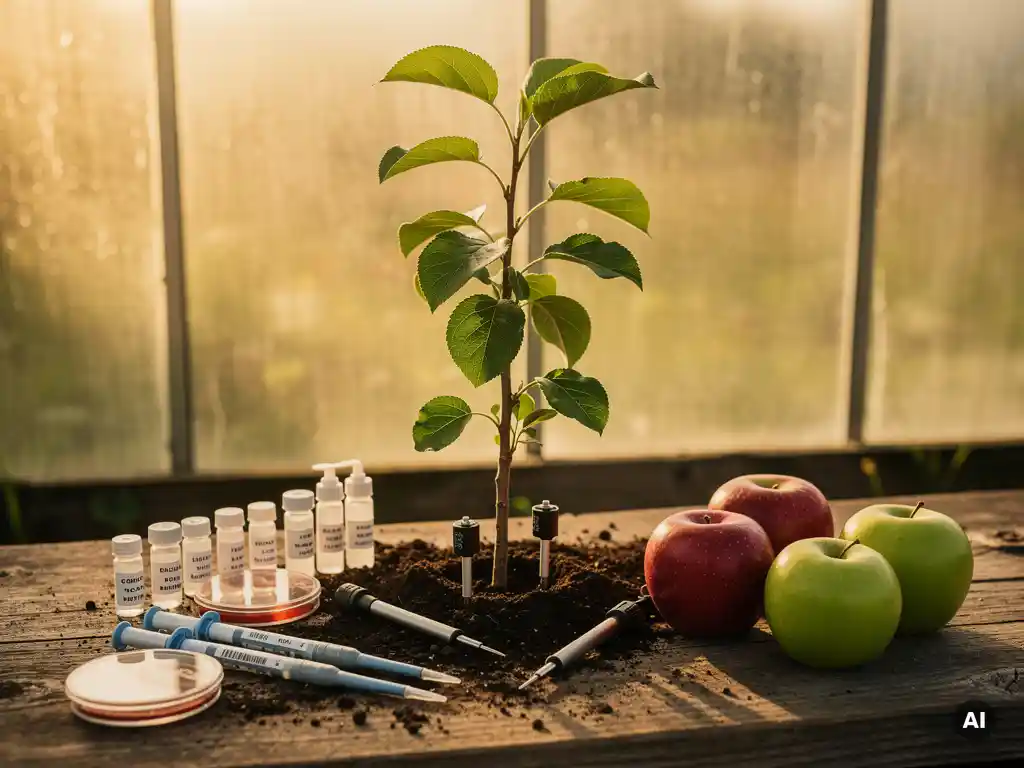
The latest developments in climate-resilient apple breeding centre on combining disease and pest resistance with improved tolerance to temperature extremes, irregular rainfall, and shifting seasonal patterns. Breeders are increasingly using molecular marker technology to accelerate selection, allowing them to identify promising traits in seedlings years before a tree would ever bear fruit in the field. The sections below unpack the key questions driving this field forward, from the traits that matter most to the timeline from breeding programme to supermarket shelf. If you want to learn more about our work or ask a specific question, feel free to get in touch with us directly.
How are breeders developing apples that withstand climate change?
Breeders are developing climate-resilient apple varieties by deliberately crossing parent trees that carry traits suited to warmer winters, hotter summers, and more unpredictable growing conditions. Rather than waiting for nature to produce a useful mutation, modern apple breeding programmes evaluate tens of thousands of seedlings each year, screening for the combinations of traits most likely to perform well as climates shift.
At Better3Fruit, we introduce around 10,000 new varieties of each crop into field evaluation every single year, with over 30,000 varieties under assessment at any given time. This scale allows us to cast a genuinely wide genetic net. The goal is not simply to find an apple that survives stress, but one that continues to deliver on taste, texture, and yield even when growing conditions are far from ideal. Climate resilience is embedded as a primary long-term goal alongside grower profitability and consumer appeal, because a variety that only performs in perfect conditions has a shrinking future.
What traits make an apple variety climate-resilient?
A climate-resilient apple variety typically combines tolerance to temperature fluctuations, reduced chilling requirements for dormancy break, drought tolerance, and the ability to maintain fruit quality under heat stress. No single trait defines climate resilience, it is the combination of multiple characteristics that allows a variety to remain productive across a range of environmental conditions.
Some of the most practically important traits include:
- Reduced chilling requirements: Many traditional varieties need long cold winters to break dormancy correctly. As winters warm, varieties that require less chilling are better positioned to flower and set fruit reliably.
- Heat tolerance during fruit development: High temperatures during the growing season can cause sunburn, russeting, and poor colour development. Varieties with natural tolerance to heat stress maintain better fruit appearance and eating quality.
- Drought tolerance: Irregular rainfall and longer dry periods put pressure on orchards. Varieties with deeper root systems or more efficient water use can sustain yields without excessive irrigation.
- Late or staggered flowering: Late spring frosts remain a serious risk even as average temperatures rise. Varieties that flower later, or whose flowering is spread over a longer window, reduce the risk of total crop loss from a single frost event.
Taste, texture, and nutritional quality are non-negotiable alongside these resilience traits. A variety that survives climate stress but produces unappealing fruit will not succeed commercially, which is why our breeding strategy always holds quality as a parallel priority.
How does disease and pest resistance factor into climate-resilient breeding?
Disease and pest resistance are a central pillar of climate-resilient apple breeding because changing climates are expanding the range and season of many pathogens and pests. Warmer, wetter autumns favour fungal diseases like apple scab and fire blight, while milder winters allow pest populations to overwinter more successfully. A variety that requires heavy chemical intervention to stay healthy is not truly resilient.
Building resistance directly into the genetics of a new variety reduces dependence on pesticides, lowers production costs for growers, and supports the kind of multi-level sustainability that the apple industry increasingly needs to demonstrate. Our breeding programme at Better3Fruit places disease and pest tolerance at the core of variety development, not as an add-on, but as a foundational selection criterion alongside taste and yield.
Importantly, resistance traits and climate resilience traits often need to be combined in the same seedling. A variety might have excellent scab resistance but poor heat tolerance, or strong drought resistance but susceptibility to fire blight. The breeding challenge is assembling the right combination, which is exactly where modern tools like molecular markers become indispensable.
What role do molecular markers play in modern apple breeding?
Molecular markers play a transformative role in modern apple breeding by allowing breeders to identify which seedlings carry desirable traits at the genetic level, long before those traits become visible in the field. Instead of waiting years for a tree to mature and bear fruit, breeders can screen thousands of young seedlings in a laboratory and select only those with the right genetic profile for further development.
In practical terms, this dramatically accelerates the breeding cycle. Traditional apple breeding relied entirely on growing trees to maturity, observing their performance over multiple seasons, and then crossing the best performers. With molecular markers, we can eliminate the majority of unsuitable seedlings at the earliest possible stage, concentrating resources on the candidates most likely to become successful varieties. This is especially valuable when breeding for complex traits like climate resilience, which are controlled by multiple genes rather than a single identifiable marker.
Molecular markers also improve precision. When a breeder wants to combine disease resistance from one parent with drought tolerance from another and excellent flavour from a third, markers help confirm that all three contributions are present in a given seedling, reducing the element of chance that has historically made apple breeding such a slow process.
How long does it take to bring a climate-resilient apple variety to market?
Bringing a new apple variety from initial cross to commercial market typically takes between 15 and 25 years. Apple trees are perennial crops with long juvenile periods, and even with modern tools like molecular markers significantly compressing the early selection stages, the evaluation, trialling, and commercialisation process remains inherently time-intensive.
The process broadly unfolds in several stages:
- Crossing and seedling selection (years 1 to 5): Parent trees are crossed, seeds are grown into seedlings, and molecular markers are used to identify the most promising candidates early. Tens of thousands of seedlings may be created to find a handful worth advancing.
- Field evaluation (years 5 to 12): Selected seedlings are grown on to assess real-world performance: fruit quality, yield, disease resistance, and climate behaviour across multiple seasons and locations.
- Advanced trialling and IP protection (years 12 to 18): The most promising selections are trialled more extensively, intellectual property rights are secured, and the variety is assessed for commercial viability.
- Licensing and market development (years 18 onwards): The variety is licensed to growers and marketing partners, orchards are planted, and the variety gradually builds volume and consumer recognition.
Our own experience reflects this timeline. Kanzi®, our first major commercial success, was released in 2002, and the work that produced it began years before that. Newer varieties in our portfolio like Morgana® and Giga® represent years of sustained breeding effort, now entering their commercial growth phase.
What does the future of climate-resilient apple breeding look like?
The future of climate-resilient apple breeding will be defined by greater genetic diversity, faster selection tools, and a sharper focus on multi-trait combinations that address both grower needs and environmental pressures simultaneously. As climate change accelerates, the varieties entering commercial production in the 2030s and 2040s will need to have been designed for conditions that do not yet fully exist today.
Several directions are shaping where the field is heading:
- Broader genetic exploration: Wild apple relatives and underutilised heritage varieties carry traits, drought tolerance, unusual disease resistance, adaptation to temperature extremes, that have barely been tapped by commercial breeding. Accessing this diversity is a growing priority.
- More precise marker-assisted selection: As genomic databases expand and our understanding of apple genetics deepens, molecular markers will become even more powerful, allowing breeders to predict complex multi-gene traits with greater confidence.
- Sustainability as a commercial requirement: Consumer demand, retailer commitments, and regulatory pressure are all moving in the same direction, varieties that require fewer inputs, produce less waste, and perform reliably in a changing climate will have a structural commercial advantage.
- Coordinated global licensing: Climate resilience is a global challenge, and varieties need to be trialled and deployed across diverse geographies. Strategic licensing partnerships that build critical mass in key markets will be essential to turning breeding advances into real-world impact.
At Better3Fruit, we are already breeding for the climate conditions of future decades, not just the present. Our independence as a privately funded company means we can set long-term goals without short-term commercial pressure distorting our priorities. If you want to explore what our apple breeding programme could mean for your business, contact us and let’s start the conversation.
This content was generated with the help of AI and it may contain mistakes