
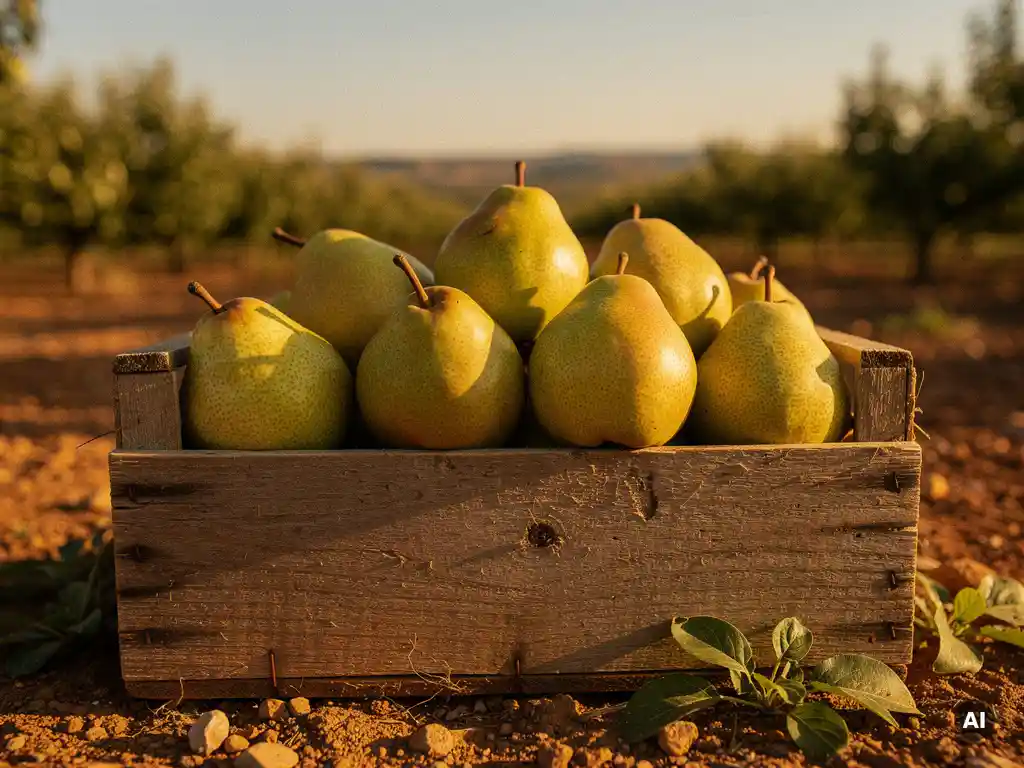
South Africa’s best pear varieties include Forelle, Packham’s Triumph, Beurré Bosc, and Rosemarie, European cultivars that have thrived in the Western Cape’s Mediterranean-style climate for decades. These varieties suit South Africa’s cool winters and warm, dry summers particularly well, making the country one of the Southern Hemisphere’s leading pear producers. Below, we answer the most important questions South African growers and industry stakeholders are asking about pear cultivar selection, and if you’d like to speak with us directly, feel free to get in touch.
Which pear varieties grow best in South Africa’s climate?
The pear varieties that grow best in South Africa are European cultivars adapted to the Western Cape’s cool winters and warm, dry summers. Packham’s Triumph, Forelle, Beurré Bosc, and Rosemarie are the most reliably productive, benefiting from the chilling hours available in the Ceres, Elgin, and Grabouw regions. These areas provide the cold accumulation that European pears require to break dormancy and set fruit consistently.
South Africa’s pear-growing regions sit primarily in the Western Cape province, where the combination of well-drained soils, low summer humidity, and reliable irrigation infrastructure creates excellent conditions for high-quality fruit. Growers in warmer, lower-altitude zones need to select cultivars with lower chilling requirements carefully, as insufficient cold can lead to erratic flowering and reduced yields.
What are the most popular commercial pear varieties in South Africa?
The most popular commercial pear varieties in South Africa are Packham’s Triumph and Forelle, which together account for the majority of the country’s pear production. Beurré Bosc, Rosemarie, and Abate Fetel are also widely grown for both domestic consumption and export markets, offering growers a spread of harvest windows and market opportunities.
Packham’s Triumph is valued for its high yields, long storage life, and broad market appeal. Forelle, with its distinctive red-blushed skin and sweet flavour, commands strong demand in premium retail and export channels. Rosemarie offers a slightly earlier harvest, which helps growers manage labour and cold storage more efficiently across the season. Together, these cultivars form the commercial backbone of South African pear farming.
What’s the difference between European and Asian pear varieties for South African growers?
European pears (Pyrus communis) and Asian pears (Pyrus pyrifolia and related species) differ fundamentally in texture, flavour, and post-harvest handling. European varieties like Packham’s Triumph ripen off the tree and develop a soft, buttery texture after a period in cold storage, while Asian pears are crisp and ready to eat at harvest, more like an apple in texture. For South African growers, European varieties dominate because they align with established export infrastructure and consumer preferences in key markets.
Asian pears require different orchard management, post-harvest handling, and marketing strategies. They are less commonly grown commercially in South Africa, though there is some niche production for local specialty markets. Growers considering Asian pear cultivation should assess whether their target market has demand for the crisp, juicy eating experience these varieties offer, as consumer familiarity in South Africa and traditional export destinations remains lower than for European types.
Which pear varieties are best for export from South Africa?
The best pear varieties for export from South Africa are Forelle, Packham’s Triumph, Beurré Bosc, and Abate Fetel. These cultivars meet the strict quality, size, and shelf-life requirements of European, Middle Eastern, and Asian export markets, and South African fruit is particularly competitive during the Northern Hemisphere’s off-season, from February through May.
Forelle is especially prized in export markets for its visual appeal and sweet flavour profile. Its natural red blush intensifies under South African growing conditions, making it a standout on premium retail shelves. Packham’s Triumph benefits from excellent cold chain durability, allowing it to reach distant markets in good condition after long sea freight journeys. Growers targeting export should prioritise cultivars with proven post-harvest performance and strong brand recognition in their destination markets.
How do disease-resistant pear varieties benefit South African orchards?
Disease-resistant pear varieties reduce input costs, lower pesticide use, and improve orchard sustainability by limiting the impact of key pathogens such as fire blight (Erwinia amylovora) and pear scab (Venturia pirina). In South Africa, where fire blight management is a significant operational concern, cultivars with inherent resistance or tolerance allow growers to reduce spray programmes and protect yields more reliably across seasons.
Beyond cost savings, disease resistance supports compliance with increasingly stringent maximum residue level (MRL) requirements in export markets, particularly in the European Union. Orchards with lower chemical inputs also benefit from better worker safety and reduced environmental impact, both of which are growing priorities for retailers and consumers worldwide. As climate variability increases pressure on South African orchards, building disease resilience into cultivar selection is becoming a strategic necessity rather than an optional advantage.
At Better3Fruit, disease and pest tolerance are core pillars of our breeding strategy. We develop pear varieties with robust resistance profiles built in from the ground up, so that growers can focus on producing high-quality fruit rather than managing recurring disease pressure.
Should South African growers consider new club pear varieties?
Yes, South African growers should seriously consider new club pear varieties, particularly those backed by coordinated marketing, intellectual property protection, and a clear route to premium retail. Club varieties offer growers access to differentiated market positions, better price stability, and the kind of brand recognition that commodity cultivars struggle to achieve in competitive export channels.
Club varieties work best when growers, packers, and marketers operate within a structured programme that controls supply, maintains quality standards, and builds consumer loyalty around the variety’s name and brand. For South African producers already operating within sophisticated export supply chains, the transition to a club variety model is a natural evolution rather than a disruptive change.
We encourage South African growers and industry partners to explore our variety portfolio to see what emerging cultivars could complement or strengthen their existing orchard mix. Our licensing model is open to partners worldwide, with no preferred regional exclusivities, meaning South African growers have genuine access to the same cutting-edge genetics as producers in Europe or North America. If you’re ready to explore what a new pear variety could mean for your operation, contact us to start the conversation.
This content was generated with the help of AI and it may contain mistakes