
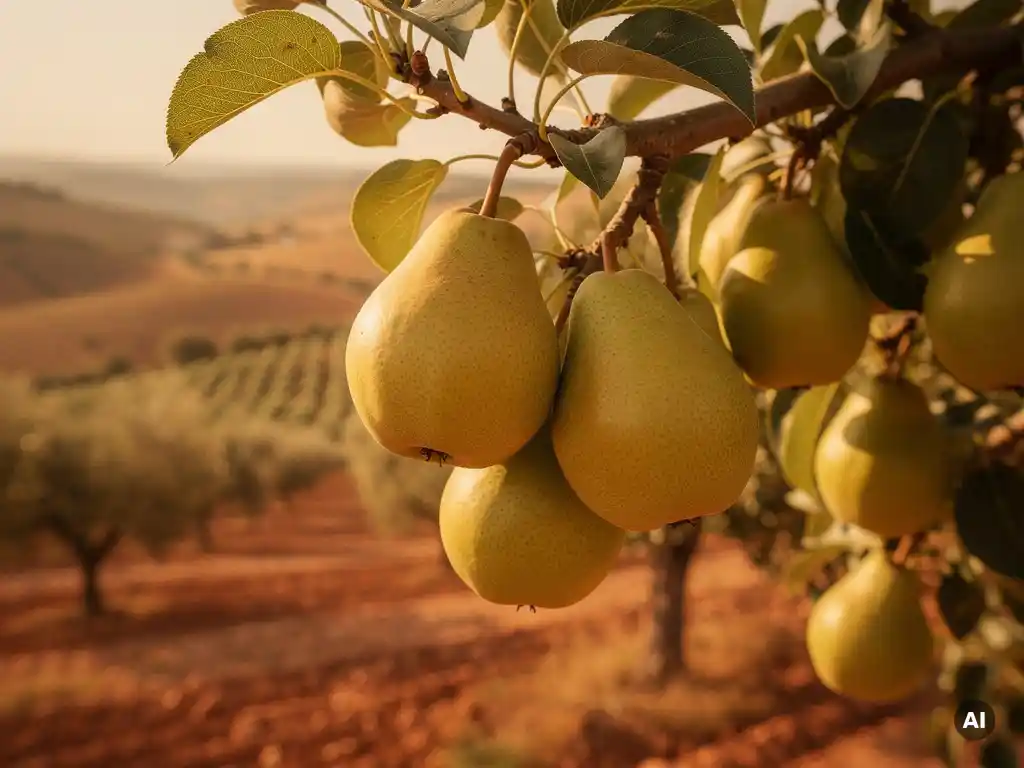
Spain is home to some of the most suitable growing conditions for pear cultivation in Europe, and the best varieties for Spanish growers include Conference, Blanquilla, Abate Fetel, and emerging low-chill cultivars bred for warmer climates. Choosing the right variety depends on your region’s altitude, rainfall, and winter chill hours. The sections below answer the most important questions Spanish pear growers are asking right now, and if you’d like to speak with someone directly, feel free to get in touch with us.
What growing conditions do pear trees need in Spain?
Pear trees in Spain need well-drained, deep soils with a slightly acidic to neutral pH, adequate winter chilling to break dormancy, and protection from late spring frosts. Most commercial pear cultivation in Spain is concentrated in regions where altitude moderates summer heat and winters are cold enough to meet the crop’s chilling requirements, typically between 400 and 1,200 hours below 7°C.
Spain’s diverse geography means growing conditions vary considerably. The Ebro Valley, Lleida, and parts of Extremadura are among the most productive pear-growing regions, each offering a combination of continental winters and warm, dry summers that suit traditional European pear varieties well. Irrigation is essential in most Spanish orchards, as summer rainfall is rarely sufficient to sustain commercial yields. Soil management is equally critical: pear trees are sensitive to waterlogging, so growers in heavier clay soils often invest in drainage infrastructure or raised-bed planting systems.
Spring frost is one of the most persistent risks in Spanish pear cultivation. Orchards at higher altitudes benefit from cooler summers but face a longer frost window during bloom. Wind machines, frost irrigation, and careful site selection all play a role in managing this risk effectively.
Which pear varieties are best suited to Spain’s climate?
The pear varieties best suited to Spain’s climate include Conference, Blanquilla (also known as Williams Bon Chrétien in some markets), Abate Fetel, and Ercolini. These varieties are well established in Spanish commercial orchards because they balance reliable productivity with the chilling requirements that most Spanish growing regions can meet during a normal winter.
Conference remains the dominant commercial variety across northern and central Spain, valued for its consistent yield, good storage life, and strong market recognition. Blanquilla is particularly popular in warmer, lower-altitude regions where its earlier harvest window is an advantage. Abate Fetel commands premium prices in export markets and performs well in the cooler inland regions of Aragón and Catalonia.
Beyond these established names, interest is growing in newer cultivars developed through modern apple and pear breeding programs. These varieties are being designed with Spanish growing conditions in mind, targeting traits such as reduced chilling requirements, heat tolerance, and improved disease resistance alongside excellent fruit quality.
What’s the difference between low-chill and high-chill pear varieties?
The key difference between low-chill and high-chill pear varieties is the number of cold hours they need during winter dormancy to flower and fruit reliably. High-chill varieties require 700 or more hours below 7°C, while low-chill varieties are bred or selected to break dormancy with fewer than 400 to 500 cold hours, making them suitable for warmer or coastal regions.
In practical terms for pear growing in Spain, this distinction determines which varieties can be grown profitably in which regions. Growers in the cooler interior regions of Castile, Aragón, or the Pyrenean foothills can successfully grow high-chill varieties like Conference or Abate Fetel. However, growers in warmer coastal zones or southern Spain often struggle to accumulate enough chill hours in mild winters, leading to erratic flowering, poor fruit set, and reduced yields.
Low-chill pear varieties offer a practical solution for these warmer areas, and they are becoming increasingly relevant as climate patterns shift. Milder winters, even in traditionally cold regions, are prompting growers across Spain to evaluate their variety portfolios with a longer time horizon in mind. Selecting varieties with some tolerance to lower chill accumulation is increasingly seen as a form of climate risk management rather than a niche consideration.
Which pear varieties offer disease resistance for Spanish growers?
For Spanish pear growers, the most commercially relevant disease pressures are fire blight, caused by the bacterium Erwinia amylovora, and pear scab. Varieties with genetic resistance or tolerance to fire blight are particularly valuable in Spain, where warm, wet spring conditions in some regions create ideal conditions for outbreaks. Conference has moderate susceptibility, while some newer breeding selections show stronger resistance profiles.
Fire blight resistance is one of the primary targets in modern pear breeding programs, including our own work at Better3Fruit. Developing varieties that reduce the need for chemical intervention not only lowers production costs for growers but also supports the broader move toward more sustainable orchard management across European agriculture.
Pear scab, caused by Venturia pirina, is less devastating than fire blight but adds spray program costs and can affect fruit appearance, which matters in fresh market production. Varieties with improved scab tolerance reduce fungicide applications and the associated labour and input costs. When evaluating new pear varieties for Spain, growers should assess disease resistance alongside yield and fruit quality, particularly as integrated pest management requirements tighten under European regulatory frameworks.
When should pears be harvested in Spain?
Harvest timing for pears in Spain depends on the variety and region, but the main commercial harvest window runs from late July through October. Early varieties such as Blanquilla are typically harvested in July and August in warmer areas, while mid-season varieties like Conference are picked from late August through September, and later varieties such as Abate Fetel extend the season into October.
Pears are almost always harvested before they are fully ripe on the tree, as most commercial varieties ripen best in cold storage or after a period of controlled-atmosphere storage. Harvesting at the correct maturity stage is critical: pick too early and the fruit lacks flavour development; pick too late and the flesh becomes mealy and the storage life shortens considerably.
Maturity indicators used by Spanish growers include firmness measured with a penetrometer, starch-iodine pattern tests, and background skin colour. Altitude plays a significant role in harvest timing within Spain, with higher-elevation orchards consistently harvesting one to three weeks later than lower-altitude sites growing the same variety. This natural spread in harvest dates across Spanish regions helps growers and packers manage supply more effectively across the season.
How do new pear breeding programs benefit Spanish growers?
New pear breeding programs benefit Spanish growers by developing varieties that combine superior fruit quality with practical agronomic traits such as disease resistance, reduced chilling requirements, and climate resilience. Rather than relying solely on decades-old cultivars, growers gain access to varieties specifically designed to perform well under the evolving conditions of modern commercial horticulture.
At Better3Fruit, we run one of the largest and most advanced apple and pear breeding programs in the world. Each year, we introduce thousands of new seedlings into evaluation, assessing them across multiple seasons and environments before any variety advances toward commercial release. This rigorous process means that by the time a variety reaches growers, it has been tested against the full range of traits that matter in the orchard and in the market.
For Spanish pear growers specifically, the benefits are tangible. Varieties with stronger fire blight resistance reduce the risk of catastrophic orchard losses. Cultivars with lower chill requirements open up growing possibilities in regions where warming winters are making traditional varieties less reliable. And varieties with improved post-harvest quality extend the commercial window, giving growers and their supply chain partners more flexibility. Our licensing model means that any grower or commercial partner worldwide can obtain a licence for a Better3Fruit variety, with no preferred partners and no geographic restrictions that lock out Spanish operators.
If you are a Spanish pear grower or commercial partner exploring new variety options for your orchards, we would be glad to discuss what might suit your region and your goals. Contact us to start the conversation.
This content was generated with the help of AI and it may contain mistakes