
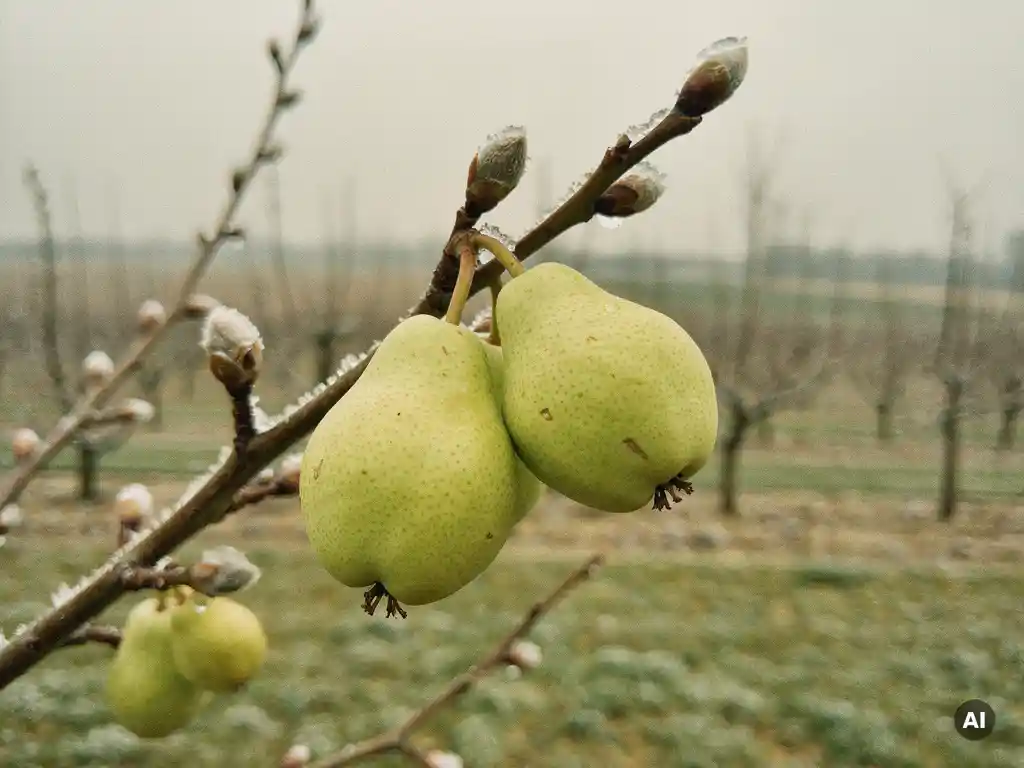
A mild winter can significantly reduce pear yields by depriving trees of the cold temperatures they need to complete dormancy. Without enough chilling hours, pear trees struggle to flower uniformly, set fruit reliably, and produce the quality harvests that growers and consumers expect. The questions below unpack exactly how this happens and what can be done about it, and if you want to discuss variety resilience or licensing options directly, feel free to get in touch with us.
What happens to pear trees when winters are too warm?
When winters are too warm, pear trees cannot complete their natural dormancy cycle. Dormancy is a physiological rest period triggered by cold temperatures, during which the tree conserves energy and prepares for the next growing season. Without sufficient cold, this process stalls, leaving trees in a kind of biological limbo that disrupts nearly every stage of spring development.
The visible consequences range from delayed and erratic budbreak to sparse, poorly timed flowering. In more severe cases, trees may produce very few flowers at all, or the flowers that do emerge open unevenly over several weeks rather than in a concentrated flush. This scattered flowering makes effective pollination far more difficult, since pollinators and compatible pollen sources may not be present at the right moment.
Beyond flowering, warm winters can weaken the tree’s overall vigor. Nutrient reserves that should have been consolidated during dormancy are drawn down inefficiently, leaving the tree less capable of supporting a full crop load even if some fruit does set. Over multiple consecutive mild winters, cumulative stress can affect the long-term productivity and health of an orchard.
What are chilling hours and why do pears need them?
Chilling hours are the number of hours during winter when temperatures fall between roughly 0°C and 7°C (32°F to 45°F). Pear trees need a minimum accumulation of these hours to satisfy their dormancy requirement, which is a genetically determined threshold that varies by variety. Without meeting this threshold, the hormonal signals that trigger uniform spring growth simply do not activate properly.
During dormancy, cold temperatures break down growth-inhibiting compounds that accumulate in buds over the summer. When chilling requirements are met, these inhibitors are cleared and the tree becomes responsive to warming spring temperatures. When chilling hours fall short, those inhibitors persist, causing the uneven, delayed, or suppressed budbreak that growers in warmer climates know all too well.
Different pear varieties have very different chilling requirements. Some traditional European varieties need upwards of 1,000 chilling hours to perform well, while certain newer breeding selections have been developed with lower requirements to suit warmer growing regions. Understanding the chilling requirement of each variety in an orchard is one of the most practical tools a grower has for anticipating risk in a mild winter.
How does a mild winter affect pear flowering and fruit set?
A mild winter directly disrupts pear flowering by causing buds to open irregularly and over an extended period rather than in a synchronized flush. This erratic flowering pattern reduces the overlap between a tree’s own flowers and those of its pollinators, making effective cross-pollination harder to achieve. The result is poor fruit set, meaning fewer flowers successfully develop into fruit.
Even when flowers do open, a tree that has not met its chilling requirement is often physiologically compromised. Pollen viability can be reduced, pistil development may be incomplete, and the tree’s capacity to support fertilized ovules through to fruit development is weakened. All of these factors compound to reduce both the number of fruit that set and their eventual size and quality at harvest.
Fruit set is also influenced by the timing mismatch between the tree and its pollinating partners. If a primary variety and its pollinator variety have different chilling requirements, a mild winter can push them out of sync, so that one variety flowers before the other is ready. This is a particularly important consideration when planning orchard layouts in regions where mild winters are becoming more frequent.
Which pear varieties are most vulnerable to warm winters?
Pear varieties with high chilling requirements are the most vulnerable to warm winters. Traditional European varieties such as Conference, Doyenné du Comice, and many classic Pyrus communis cultivars were bred in climates where cold winters are the norm, and they carry correspondingly high chilling thresholds. In regions experiencing warmer winters due to shifting climate patterns, these varieties face increasing risk of poor performance.
Vulnerability is not just about the chilling threshold itself. Varieties that evolved in consistently cold climates often have very narrow flowering windows, meaning that when dormancy is disrupted, the consequences for pollination timing are more severe. Varieties bred or selected for broader adaptability tend to be more forgiving when chilling accumulation is incomplete.
At Better3Fruit, climate resilience is one of our primary long-term breeding goals. As we develop new pear varieties, we actively evaluate how they perform under variable winter conditions, including seasons with reduced chilling accumulation. Exploring our current variety portfolio gives a sense of how breeding priorities have evolved to address exactly these kinds of climate-driven challenges.
What can growers do to protect the harvest after a mild winter?
After a mild winter, growers can take several practical steps to limit crop losses and support the best possible fruit set from a compromised start. The most effective interventions focus on stimulating more uniform budbreak, protecting vulnerable flowers, and managing the orchard to get the most out of whatever flowering does occur.
- Apply hydrogen cyanamide or mineral oils: These dormancy-breaking agents are applied to buds before the growing season and can help compensate for insufficient chilling by stimulating more synchronized budbreak. Timing and application rate are critical and should follow local agronomic advice.
- Introduce additional pollinators: When flowering is erratic and spread over a longer window, having more pollinator varieties or supplementary hive placement can improve the chances of effective cross-pollination during whatever flowering overlap exists.
- Adjust pruning timing and intensity: Lighter pruning after a mild winter can help the tree conserve energy and direct resources toward the flowers and fruit that do develop, rather than stimulating excessive vegetative growth at the expense of cropping.
- Monitor and manage nutrition carefully: Trees coming out of an incomplete dormancy may have uneven nutrient reserves. Targeted foliar applications of boron and calcium during flowering can support pollen tube growth and early fruit development.
- Plan for variety diversification over the longer term: No in-season intervention fully replaces the advantage of planting varieties that are inherently suited to lower chilling accumulation. In regions where mild winters are becoming more common, replanting decisions should factor in variety chilling requirements as a primary criterion.
Managing a pear orchard through increasingly variable winters requires both short-term tactics and long-term variety strategy. If you want to explore which pear varieties are best suited to your climate and growing conditions, contact us and we will be happy to help you find the right fit.
This content was generated with the help of AI and it may contain mistakes