
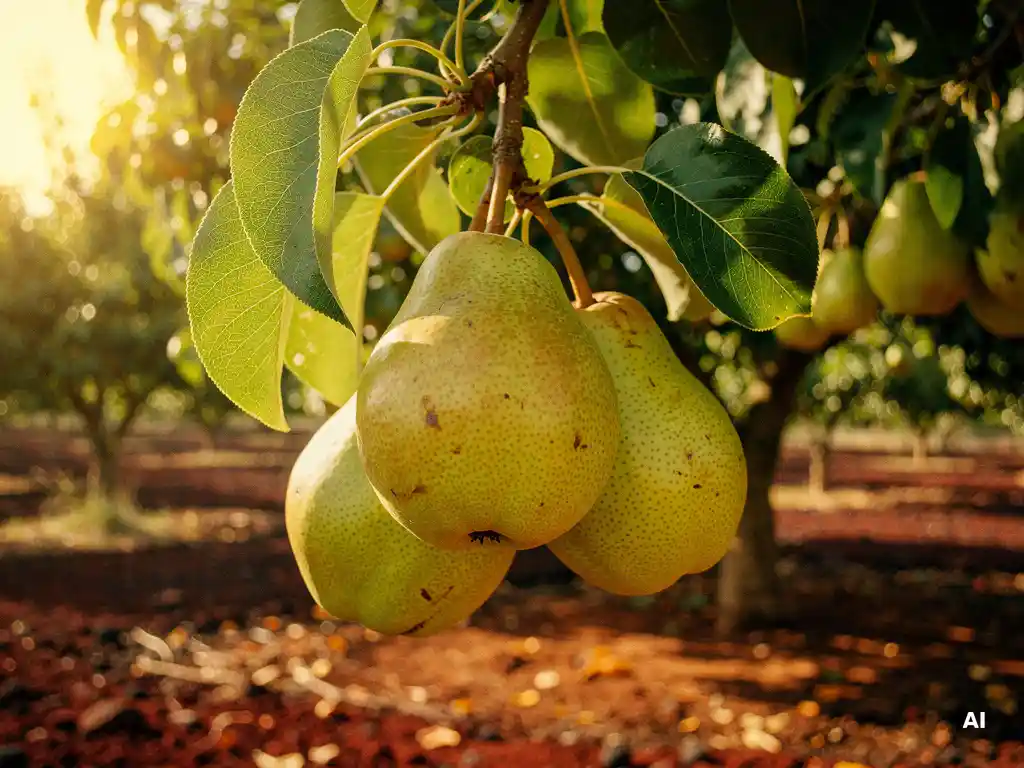
Pear varieties suited to the Southern Hemisphere include cultivars that perform well with moderate chilling hours, warm summers, and the region’s reversed growing season. Varieties such as Packham’s Triumph, Beurré Bosc, and Williams Bon Chrétien have long been staples across Southern Hemisphere orchards, while newer cultivars are expanding what growers can offer. If you want to explore which varieties might suit your operation, feel free to get in touch with us and we are happy to help. Below, we answer the most common questions growers ask when evaluating pear cultivation in the Southern Hemisphere.
What climate conditions do pear varieties need to thrive?
Pear varieties generally need a period of winter chilling to break dormancy, followed by a frost-free spring and a warm growing season to develop fruit quality. Most commercial pear cultivars require between 600 and 1,200 chilling hours below 7°C, though this varies significantly between varieties. Regions with mild winters may struggle to meet these requirements unless low-chill or moderate-chill cultivars are selected.
Beyond chilling, pears thrive in well-drained soils with good water retention, moderate humidity, and protection from late spring frosts that can damage blossom. High summer temperatures during fruit development can affect skin finish and internal quality, so altitude and aspect both play a role in site selection. Varieties also differ in their tolerance of heat stress, making climate matching a critical first step before any planting decision.
Which regions in the Southern Hemisphere grow pears commercially?
The main pear-growing regions in the Southern Hemisphere are South Africa, Argentina, Chile, Australia, and New Zealand. These countries collectively produce a significant share of the world’s pear supply and export to markets in Europe, Asia, and North America during the Northern Hemisphere’s off-season.
In South Africa, the Western Cape, particularly the Ceres, Elgin, and Grabouw areas, is the heart of commercial pear production. Argentina’s Río Negro and Neuquén valleys in Patagonia are among the most productive pear-growing zones in the world. Chile’s central valleys, Australia’s Goulburn Valley in Victoria, and New Zealand’s Hawke’s Bay region round out the key production areas. Each of these zones benefits from a continental or Mediterranean-style climate that provides the chilling hours and warm summers pears require.
What pear varieties perform best in Southern Hemisphere conditions?
The best pear varieties for Southern Hemisphere conditions are those that match local chilling hour availability, ripen within the regional growing window, and meet export market quality standards. Packham’s Triumph, Williams Bon Chrétien (Bartlett), Beurré Bosc, and Forelle are the most widely grown commercial cultivars across Southern Hemisphere orchards.
Packham’s Triumph is particularly dominant in South Africa and Argentina because of its adaptability, long storage life, and strong export appeal. Williams Bon Chrétien is valued for its flavour and dual use in fresh and processing markets. Forelle, with its distinctive red blush, has carved out a premium niche in export markets. Newer varieties entering the market are increasingly bred for improved disease tolerance, better post-harvest performance, and a stronger consumer eating experience, traits that are becoming essential as competition intensifies.
How does the Southern Hemisphere’s reversed season affect pear production?
The Southern Hemisphere’s reversed seasons mean that pears are harvested between January and April, which is the Northern Hemisphere’s winter and early spring. This counter-seasonal production gives Southern Hemisphere growers a natural competitive advantage, supplying fresh pears to European and North American markets when local production has ended.
This seasonal window is commercially valuable but also logistically demanding. Fruit must be harvested at precise maturity to survive long-haul shipping to Northern Hemisphere destinations, which means storage life and post-harvest performance are critical variety selection criteria. Growers and exporters invest heavily in controlled-atmosphere storage to extend shelf life across the shipping journey. The reversed season also means that variety trials and breeding evaluations conducted in the Northern Hemisphere need to be carefully interpreted before being applied to Southern Hemisphere planting decisions, since phenological timing and pest pressure differ between hemispheres.
What traits should growers look for in a new pear variety?
When evaluating a new pear variety, growers should prioritise taste and eating quality, disease and pest tolerance, yield consistency, post-harvest storage performance, and suitability to local climate conditions. These traits together determine whether a variety can succeed commercially over the long term rather than just performing well in trial conditions.
- Eating quality: Flavour, texture, sweetness, and juiciness drive consumer repeat purchase and premium pricing.
- Disease tolerance: Resistance or tolerance to fire blight, scab, and psylla reduces input costs and supports more sustainable growing practices.
- Yield and orchard efficiency: Consistent cropping, good fruit size distribution, and manageable tree vigour all affect profitability per hectare.
- Post-harvest performance: Long storage life and resilience during transport are non-negotiable for export-oriented growers.
- Climate adaptability: Varieties that perform across a range of chilling-hour profiles and summer temperature conditions offer growers more flexibility as climates shift.
Climate resilience is increasingly central to variety selection. As growing conditions become less predictable in many Southern Hemisphere regions, varieties that can tolerate variability in chilling accumulation or handle warmer summers without losing quality are becoming more attractive to forward-thinking growers.
How are new pear varieties licensed and commercialized globally?
New pear varieties are typically protected through plant breeders’ rights or patents, and then licensed to growers, nurseries, and marketing organisations in specific territories. Licensing ensures that the breeder can fund continued research through royalties while giving commercial partners the rights to propagate, grow, and sell the variety.
We operate exactly this model at Better3Fruit. Our varieties are protected by intellectual property rights and licensed to partners worldwide, with no exclusivity tied to any single partner or region by default. This means growers and marketers anywhere in the world can apply for a licence for a Better3Fruit variety. We actively encourage strategic partnerships that bring together coordinated marketing, quality control, and supply planning, because building a successful new variety requires more than just a good fruit: it requires a committed commercial network behind it. You can explore our current variety portfolio to see what is available for licensing.
For Southern Hemisphere partners specifically, the counter-seasonal harvest window creates an attractive proposition for building a branded club variety that fills Northern Hemisphere retail shelves during the winter months, a model that has proven highly successful with apple cultivars and is equally applicable to pears.
Selecting the right pear variety for the Southern Hemisphere is a decision that combines climate science, market strategy, and long-term orchard planning. Whether you are evaluating new cultivars for the first time or looking to diversify an established orchard, we are here to help you find the best fit. Contact us to discuss your goals and discover what our breeding programme can offer your operation.
This content was generated with the help of AI and it may contain mistakes