
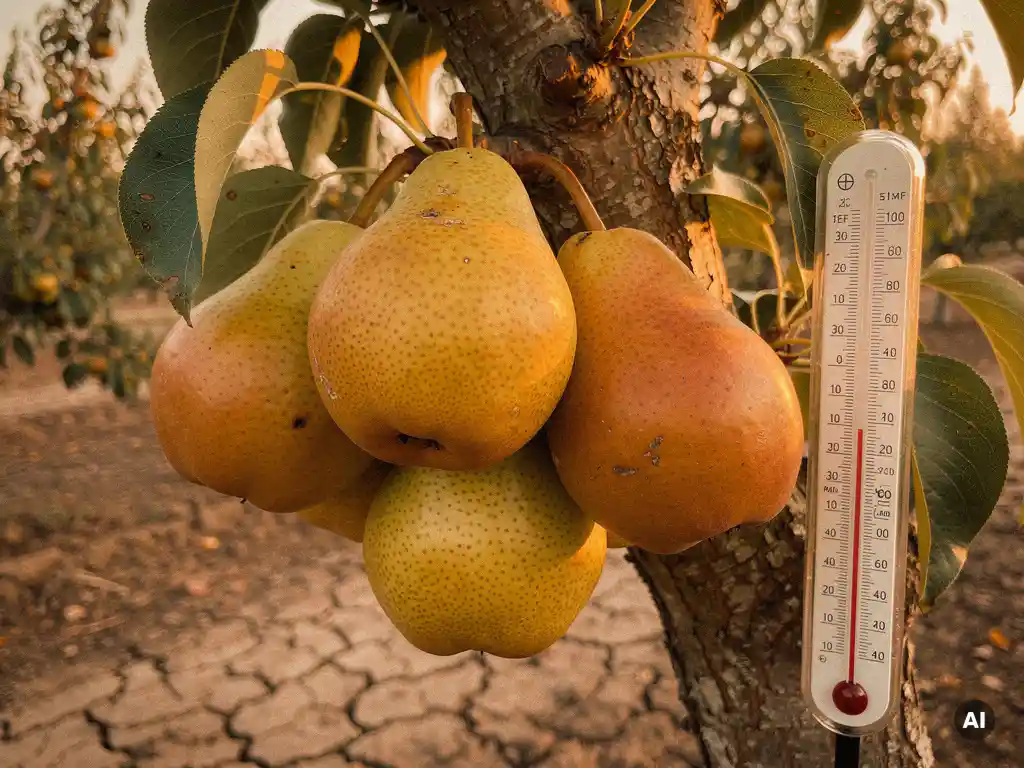
As chill units decrease across major pear-growing regions, varieties with lower chilling requirements are becoming the most practical alternative for growers who want to maintain reliable yields and fruit quality. Low-chill pear varieties, including several emerging from modern breeding programs, can flower and fruit consistently even when winter temperatures stay mild. This article walks through the key questions growers are asking right now, from why chilling is declining to what to look for when making a switch. Feel free to get in touch with us if you want to explore variety options directly.
Why are chill units dropping in pear-growing regions?
Chill units are dropping because average winter temperatures in temperate fruit-growing regions are rising as a result of climate change. Milder winters mean fewer hours spent at the cool temperatures that deciduous fruit trees need to break dormancy properly. This trend is well documented across Europe, South Africa, parts of the United States, and Southern Hemisphere growing zones, and it is accelerating.
Pear trees, like apples, rely on a period of cold accumulation during dormancy to trigger coordinated budbreak in spring. When that cold accumulation falls short, trees may break dormancy unevenly, produce fewer flowers, or fail to set fruit altogether. Even in traditionally cool regions, the number of years with adequate chill accumulation is becoming less predictable, turning what was once a reliable seasonal rhythm into an annual uncertainty.
For growers, this is not a distant risk. In many regions, insufficient chilling is already affecting the performance of established orchards planted with varieties bred for cooler climates. The practical response is to start evaluating alternative pear varieties now, before yield losses become severe.
What chilling requirement do most commercial pear varieties need?
Most commercial pear varieties require between 800 and 1,500 chill units to break dormancy reliably and produce a full crop. The exact requirement depends on the variety and the chilling model used to calculate accumulation, but the majority of widely grown cultivars, including Conference, Doyenné du Comice, and Williams Bon Chrétien, sit toward the higher end of that range.
This means that many of the pear varieties currently planted in commercial orchards were selected and bred for climates that are becoming less common. A variety requiring 1,200 chill units that was well suited to a region 30 years ago may now regularly fall short in the same location, leading to erratic flowering, poor fruit set, and reduced marketable yield. Understanding the chilling requirement of each variety in an orchard is the first step toward identifying where climate risk is concentrated.
Which pear varieties perform well with fewer chill units?
Pear varieties with chilling requirements below 600 to 800 chill units perform most reliably as winters become milder. These low-chill pears can complete dormancy under warmer winter conditions and still produce consistent flowering and fruit set. Varieties with Asian pear genetics, as well as some modern European-Asian hybrid cultivars, tend to have naturally lower chilling requirements.
Beyond heritage low-chill types, newer varieties developed through targeted breeding programs are expanding the options available to growers. The key is finding varieties that combine a low chilling requirement with commercially relevant traits: good eating quality, appropriate fruit size, shelf life, and disease tolerance. A variety that flowers reliably but produces fruit with limited market appeal is not a viable long-term solution.
We are actively developing pear varieties with climate resilience as a core breeding objective, working to bring together low chilling requirements with the taste, texture, and grower-friendly traits that make a variety commercially sustainable. You can explore our current pear variety portfolio to see what is available and what is in the pipeline.
How do breeders develop pear varieties for low-chill conditions?
Breeders develop low-chill pear varieties by identifying and selecting parent material with naturally low chilling requirements, then crossing those parents with varieties that carry strong commercial traits. The goal is to combine climate adaptability with eating quality, disease resistance, and yield in a single cultivar. Modern breeding tools, including molecular markers, make this process significantly more targeted and efficient.
Molecular markers allow breeders to screen seedlings at an early stage for specific genetic traits, including those linked to chilling requirement, without waiting years for the plant to flower and fruit. This dramatically accelerates the breeding cycle and reduces the number of seedlings that need to be grown to full maturity before evaluation. At Better3Fruit, we work with over 30,000 new varieties under evaluation at any given time, using these tools to identify the most promising candidates as early as possible.
Climate resilience is not a single trait but a combination of factors: low chilling requirement, tolerance of irregular temperatures during dormancy, and the ability to set fruit reliably even when spring conditions are variable. Breeding for all of these simultaneously, without compromising on fruit quality, is one of the central challenges in modern pear breeding and one we treat as a long-term priority.
What should growers consider when switching to a low-chill pear variety?
When switching to a low-chill pear variety, growers should evaluate chilling requirement, market fit, rootstock compatibility, and disease resistance before committing to a new planting. A lower chilling requirement solves a climate problem but does not automatically guarantee commercial success, so each factor needs to be assessed together.
- Chilling requirement fit: Match the variety’s documented chilling requirement to the realistic winter accumulation in your specific location, not regional averages. Microclimates within an orchard can vary meaningfully.
- Market and variety positioning: Understand where the variety sits commercially. Is it a club variety with coordinated marketing support, or an open variety? What eating quality profile does it offer, and is there a clear market for it?
- Rootstock and orchard system compatibility: Low-chill varieties may behave differently on the rootstocks you already use. Check compatibility and consult with nurseries or breeders before making large-scale commitments.
- Disease and pest tolerance: Climate change does not only affect chilling. Warmer, wetter springs can increase disease pressure. Varieties with built-in tolerance to common pear diseases offer an additional layer of resilience.
- Trial before scaling: Where possible, plant a trial block before converting significant orchard area. Local performance data from your own site is more reliable than variety trials conducted in different soil and climate conditions.
Switching varieties is a long-term investment, and the decision is best made with access to current breeding data and variety performance information. Contact us to discuss which low-chill pear varieties may be the right fit for your growing region and commercial goals.
This content was generated with the help of AI and it may contain mistakes