
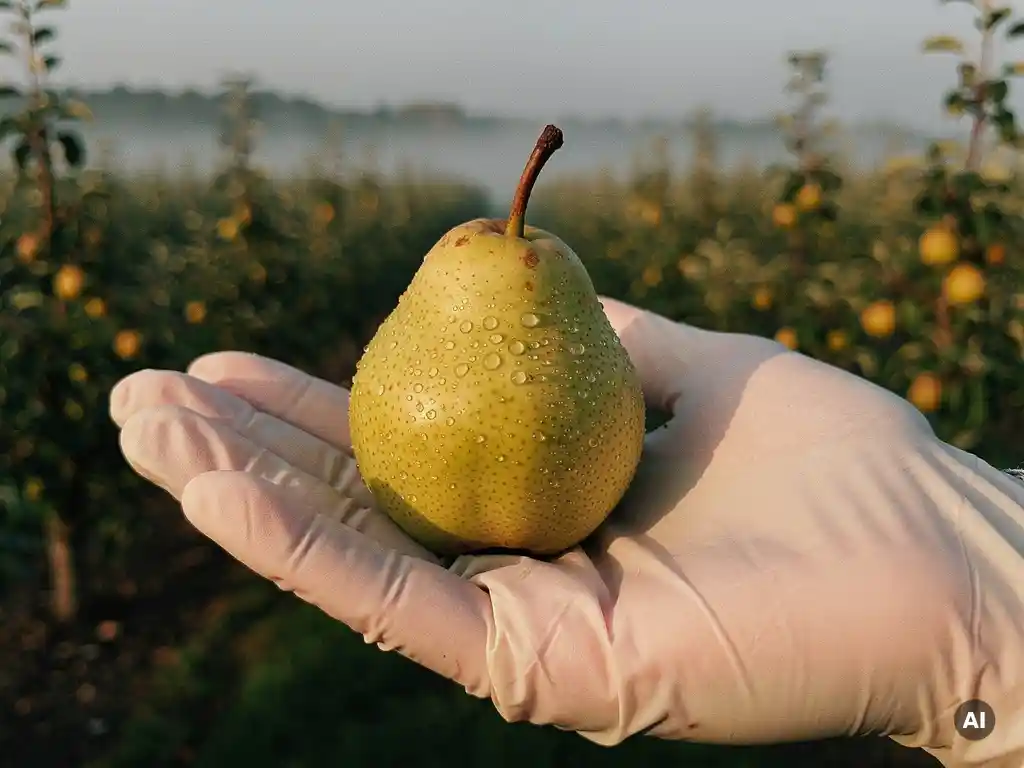
To license a climate-resilient pear variety from Better3Fruit, you submit an expression of interest directly to our team, go through a suitability assessment, and enter into a licensing agreement that defines your rights to grow and market the variety. The process is open to growers, commercial partners, and marketing organizations worldwide; we place no restrictions on geography or preferred partners. Below, we answer the most common questions about what climate resilience means in a pear variety, who qualifies, how licensing works, and which varieties are currently available.
If you want to skip straight to a conversation, feel free to get in touch with us and we will be happy to guide you through the next steps.
What makes a pear variety climate-resilient?
A climate-resilient pear variety is one that maintains stable yield and fruit quality across a wider range of environmental conditions, including temperature fluctuations, irregular rainfall, late frosts, and increased pest or disease pressure driven by shifting climates. Resilience is not a single trait but a combination of genetic characteristics that reduce a variety’s vulnerability to environmental stress.
In practical breeding terms, climate resilience in a pear cultivar typically involves several overlapping properties:
- Disease and pest tolerance or resistance – reducing dependence on chemical inputs when pressure increases due to warmer, wetter seasons
- Thermal adaptability – the ability to perform well across a broader range of growing temperatures without compromising flavor or texture
- Consistent fruit set – reduced sensitivity to late frost events or irregular pollination conditions
- Shelf stability – maintaining post-harvest quality even when growing conditions vary from season to season
At Better3Fruit, climate resilience and multi-level sustainability are primary long-term goals in our breeding strategy. We use molecular markers to accelerate the identification of these traits in our breeding populations, which means we can evaluate tens of thousands of new varieties at any one time and select only those that meet a high combined standard of resilience, taste, and grower yield.
Who can apply for a pear variety license?
Anyone can apply for a pear variety license from Better3Fruit. We operate with no preferred partners and no geographic restrictions, meaning growers, nurseries, packing houses, and commercial marketing organizations from any country are eligible to submit an expression of interest for a license on one of our varieties.
That said, the suitability of a license depends on the variety in question. Some of our varieties are released as club varieties, which involve a more selective partner selection process to maintain quality control and coordinated market development. Others are available under more open licensing structures. In both cases, we look for partners who can contribute meaningfully to building the variety’s market presence and maintaining the quality standards that protect the brand and the grower network.
How does the pear variety licensing process work?
The pear variety licensing process at Better3Fruit begins with an expression of interest, moves through a suitability assessment, and concludes with a formal licensing agreement that defines your rights to propagate, grow, and market the variety within agreed terms.
Here is a general outline of how the process unfolds:
- Initial contact – You reach out to our team to express interest in a specific variety or ask which varieties suit your growing region and commercial goals.
- Suitability assessment – We evaluate whether your profile, growing conditions, and market access are a good fit for the variety you are interested in.
- Licensing agreement – If the fit is confirmed, we enter into a formal agreement that outlines propagation rights, royalty structures, quality requirements, and any marketing obligations tied to the variety.
- Ongoing relationship – Licensing is not a one-off transaction. We work with our licensees to support variety performance, quality monitoring, and market development over time.
Because we are funded by variety royalties rather than external investors, our licensing decisions are driven purely by what is best for the variety and the growers who grow it, not by shareholder pressure or preferred commercial relationships.
What are the costs involved in licensing a fruit variety?
The costs involved in licensing a fruit variety from Better3Fruit are primarily structured around royalties – payments made per tree planted or per kilogram of fruit sold, depending on the variety and the agreement. There is no universal flat fee, as costs are tailored to the variety, the scale of the operation, and the type of license granted.
Royalty-based licensing is standard practice across the fruit breeding industry and serves a clear purpose: it aligns the breeder’s income with the commercial success of the variety, which means we are incentivized to release varieties that genuinely perform well in the field and in the market. For growers, this also means that upfront costs are generally lower than purchasing outright IP rights, and ongoing payments scale with actual production.
For specific cost information relevant to your situation, we recommend contacting our team directly, as pricing reflects the variety, the territory, and the licensing structure involved.
What’s the difference between a club variety and an open variety license?
A club variety license grants exclusive or restricted access to a variety within a defined grower or marketing network, while an open variety license allows any qualifying party to grow and sell the variety without belonging to a controlled group. The key distinction is the level of market coordination and the conditions attached to becoming a licensed grower.
Club variety licensing
Club varieties are released to a carefully selected group of partners who commit to coordinated marketing, quality standards, and supply management. The goal is to build a strong, consistent brand in the market, protecting the value of the variety for all members of the club. Kanzi® is one of the most well-known examples of a successful club variety model in the apple category, and we apply the same strategic thinking to our pear portfolio. Access to a club variety requires meeting specific criteria and being accepted into the network.
Open variety licensing
An open variety license gives growers more commercial freedom – you can grow and sell the variety without being part of a controlled marketing structure. Open licenses are typically better suited to growers who have their own established routes to market and do not need the brand infrastructure that a club provides. Royalties still apply, but the operational constraints are fewer.
Which climate-resilient pear varieties are currently available to license?
Better3Fruit currently has a growing portfolio of pear varieties at various stages of commercial availability, including varieties specifically selected for disease tolerance and climate adaptability. The exact availability of specific cultivars for licensing depends on the territory, the stage of commercial rollout, and whether the variety is structured as a club or open license.
Our breeding program evaluates over 10,000 new pear varieties entering the field every year, with more than 30,000 under evaluation at any given time. From this pipeline, only varieties that meet our combined standards for taste, disease resistance, grower yield, and climate resilience make it to commercial release. This means that varieties we bring to market have already passed a rigorous multi-year selection process.
To see which pear varieties are currently available and suitable for your region and operation, we encourage you to explore our variety portfolio for an up-to-date overview of what we offer across both apple and pear categories.
Licensing a climate-resilient pear variety is a straightforward process when you have the right partner. Whether you are a grower looking for a variety that performs under changing weather conditions or a marketing organization seeking the next standout cultivar, we are here to help you find the right fit. Contact our team to start the conversation and find out which variety and licensing structure works best for you.
This content was generated with the help of AI and it may contain mistakes