
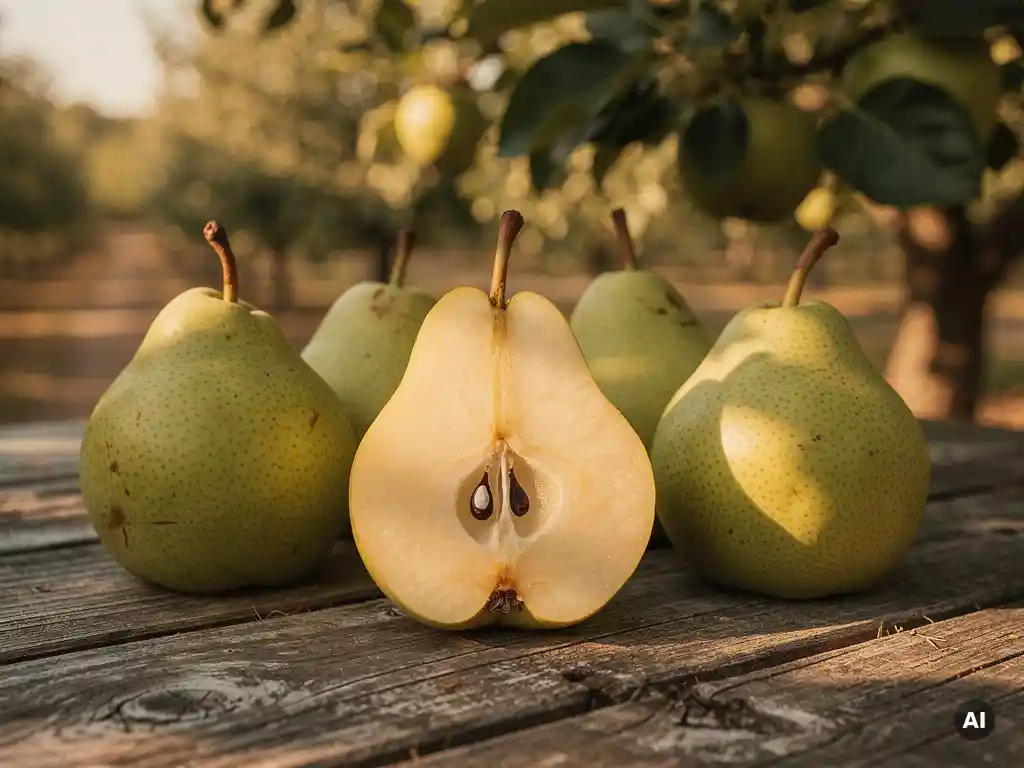
Ripening fundamentally transforms pear texture by breaking down the firm, often gritty cell walls inside the fruit into a softer, smoother, and juicier structure. This change is driven by enzymes that dismantle the compounds holding cells together, turning a hard, starchy fruit into the buttery, melt-in-your-mouth experience a perfectly ripe pear delivers. The questions below unpack exactly how and why this transformation happens, and how to make the most of it. If you ever want to learn more about pear varieties and what makes each one unique, feel free to get in touch with us.
What actually happens inside a pear as it ripens?
As a pear ripens, its cells undergo a coordinated biochemical process driven largely by the plant hormone ethylene. Ethylene triggers enzymes that break down pectin, the structural compound that holds cell walls together, while starches convert into sugars and organic acids mellow in intensity. The result is a fruit that softens, sweetens, and develops its characteristic aroma.
Unlike apples, most pear varieties do not ripen well on the tree. They are typically harvested at physiological maturity while still firm, then allowed to ripen off the tree, either at room temperature or after a period of cold storage. Cold storage actually initiates the ripening process in many varieties, triggering the ethylene response that gets everything moving. Without this cold conditioning, some pears will never reach their full softness or flavor potential, instead remaining starchy and bland even as they age.
The ethylene produced during ripening also acts as a signal to neighboring fruit, which is why storing a pear near a ripe banana or apple can speed up the process noticeably.
Why do pears go from gritty to smooth as they ripen?
The grittiness in unripe pears comes from clusters of stone cells, also called sclereids, which are thick-walled cells that resist breakdown. As pear ripening progresses, enzymes soften the tissue surrounding these stone cells, reducing the perception of grittiness even though the stone cells themselves do not fully disappear. The overall texture shifts from coarse and fibrous to smooth and yielding.
The key enzymes involved are polygalacturonase and pectin methylesterase, both of which attack the pectin matrix holding cells in place. As pectin breaks down, cells separate more easily from one another rather than rupturing, which is what creates that characteristic juicy, melting texture in a fully ripe pear. When cells separate cleanly, juice is released freely and the flesh feels smooth rather than fibrous.
Varieties bred with fewer stone cells tend to feel smoother even before full ripeness, which is one reason pear texture varies so noticeably from one cultivar to the next. At Better3Fruit, texture is a core consideration in our breeding program, selecting for varieties that deliver a genuinely pleasant eating experience at the right stage of ripeness.
How does ripening temperature affect pear texture?
Ripening temperature has a direct and significant effect on the speed and quality of pear softening. Pears ripen fastest at room temperature, typically between 18 and 22 degrees Celsius, where enzyme activity is highest. At refrigerator temperatures, the process slows dramatically, allowing you to extend the window of peak ripeness by several days. Temperatures that are too high, above 25 degrees Celsius, can cause uneven softening and off-flavors.
For many commercial pear varieties, a period of cold storage between 0 and 4 degrees Celsius is actually a prerequisite for good ripening. This cold conditioning breaks dormancy and primes the fruit to respond to ethylene. Without it, pears may soften unevenly, becoming mealy or mushy on the outside while remaining hard at the core, a condition sometimes called “core breakdown.”
Once cold conditioning is complete, bringing pears back to room temperature allows them to ripen evenly and develop the smooth, buttery texture consumers expect. Managing this temperature transition carefully is one of the most important factors in delivering consistent pear quality from orchard to table.
What’s the difference in texture between pear varieties when ripe?
Ripe pear texture varies considerably between varieties, ranging from the soft, buttery melt of a Doyenné du Comice to the crisp, slightly firmer bite of an Asian pear. European pear varieties typically soften significantly as they ripen, while Asian pear varieties remain noticeably crunchier and retain more of their cell structure even at full ripeness. This difference comes down to genetics, stone cell content, and how each variety’s cell walls respond to ripening enzymes.
European pear varieties
European varieties such as Conference, Williams, and Beurré Hardy are bred for the classic melting texture that most Western consumers associate with a ripe pear. Their cell walls break down more completely during ripening, giving them a soft, juicy, almost creamy consistency. The window of peak texture in these varieties can be short, sometimes only a few days, so timing matters.
Asian pear varieties
Asian pears, by contrast, maintain a crisp, apple-like texture even when fully ripe. Their stone cell content is typically higher, and their cell walls are more resistant to the softening enzymes that transform European varieties. This makes them more forgiving in storage and handling, but the eating experience is fundamentally different, refreshing and crunchy rather than soft and yielding.
Newer bred varieties, including some in our portfolio at Better3Fruit, are designed to hit specific texture targets, whether that means extending the firmness window for easier logistics or achieving a particularly smooth, refined eating experience. You can explore the range of our varieties to see how texture profiles differ across our commercial releases.
How can you tell when a pear has reached the right texture?
The most reliable way to check pear ripeness and texture is the neck test: apply gentle thumb pressure near the stem end of the pear. When the flesh gives slightly under light pressure, the pear has reached peak texture, soft enough to eat but not yet overripe. This works because the neck of the pear ripens from the inside out and reaches peak softness before the body does.
Visual cues can also help, though they vary by variety. Some pears change color as they ripen, Williams pears shift from green to yellow, while others, like Conference, remain green even at full ripeness. Color alone is therefore not a dependable indicator of pear texture or firmness.
Aroma is another useful signal. A ripe pear typically develops a sweet, floral fragrance near the stem. If a pear has no detectable scent, it likely needs more time. If it smells fermented or overly sweet, the softening process has gone too far and the texture will be mealy rather than smooth.
For growers and packers, firmness is measured more precisely using a penetrometer, a device that records the force needed to press a probe into the flesh. This gives a consistent, objective reading of pear firmness across batches, which is essential for deciding when to harvest or when fruit is ready for retail. If you want to talk through pear variety selection and what texture profiles suit your market, get in touch with us, we are happy to help.
This content was generated with the help of AI and it may contain mistakes