
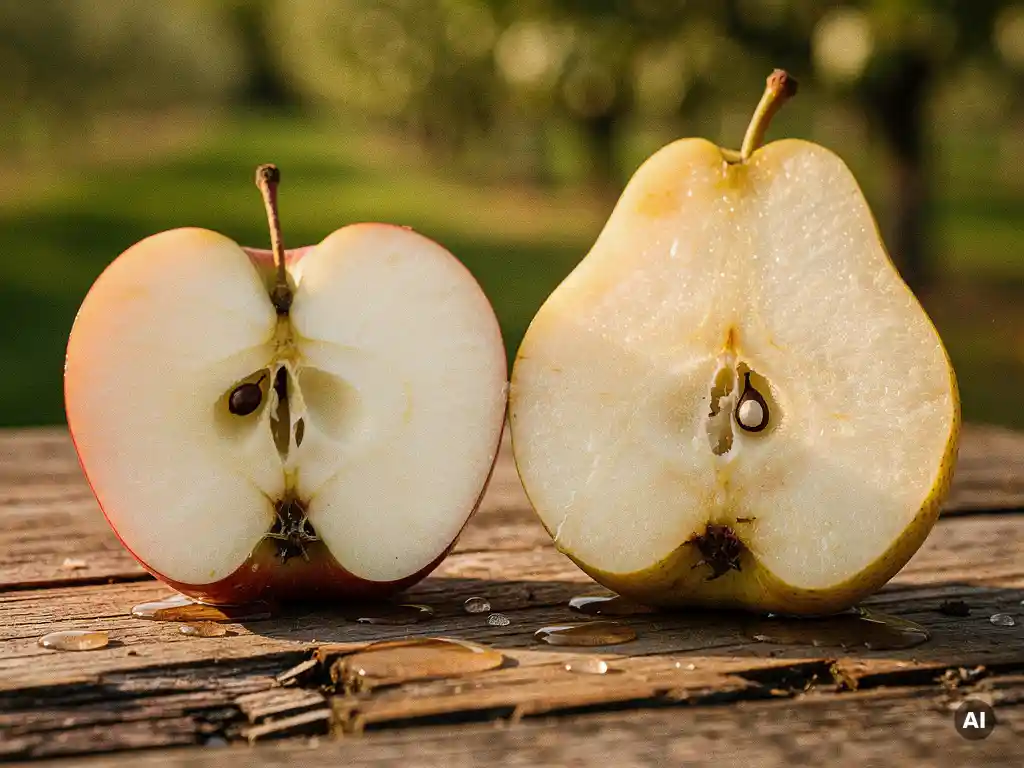
Apples and pears differ significantly in texture: apples are typically firm and crisp, while pears are softer and sometimes slightly grainy. This difference comes down to their distinct cell structures and the types of plant compounds each fruit contains. Below, we unpack the science and variety-specific nuances behind this classic apple vs pear texture comparison, and if you want to explore the varieties behind these textures firsthand, feel free to get in touch with us.
Why do apples feel crunchier than pears?
Apples feel crunchier than pears because their flesh cells are tightly packed and reinforced with rigid cell walls, creating resistance when you bite into them. Pears have larger, looser cells with thinner walls that collapse more easily under pressure, producing a softer, more yielding bite. The crispness of an apple is one of its most defining sensory qualities.
At a structural level, apple flesh contains a high proportion of parenchyma cells bound together by pectin, a natural glue-like substance. When you bite a crisp apple, these cells fracture cleanly, releasing juice and producing that satisfying snap. The amount of pectin and the strength of the bonds between cells directly influence how firm or soft a fruit feels. Apples tend to maintain strong cell-to-cell bonding even as they ripen, whereas pears begin to soften more rapidly as their pectin breaks down.
What causes the gritty texture in pears?
The gritty or grainy texture in pears is caused by clusters of stone cells, also known as sclereids, scattered throughout the flesh. These are thick-walled, lignified cells that do not break down during ripening the way regular flesh cells do. The result is a slightly rough, sandy mouthfeel that is unique to pears and largely absent in apples.
Stone cells are a natural defense mechanism the fruit developed to protect its seeds, and their concentration varies significantly between pear varieties. Some varieties have very few stone cells and feel almost buttery, while others are noticeably grainy throughout. Breeders working on new pear cultivars often pay close attention to stone cell content, since consumers generally prefer a smoother, less gritty eating experience. This is one of the many traits we evaluate when developing new pear varieties in our breeding program.
How does ripeness change the texture of apples and pears differently?
Ripeness affects apple and pear texture in fundamentally different ways. Apples soften gradually and relatively uniformly as they ripen, losing crispness over time but rarely becoming truly soft unless overripe. Pears, by contrast, ripen from the inside out, and their texture can shift from firm and starchy to smooth and almost creamy within a very short window.
This inside-out ripening pattern in pears means the core softens before the skin shows visible signs of ripeness, which is why many consumers misjudge pear ripeness by appearance alone. A pear at peak texture can feel just barely yielding at the neck when gently pressed. Miss that window and the flesh becomes mealy and waterlogged. Apples are far more forgiving in this regard, their texture degrades more slowly, making them easier to time for eating. Cold storage slows the process for both fruits, but pears require more careful management to hit their textural peak.
Which apple and pear varieties have the most distinctive textures?
Among apples, varieties like Kanzi® stand out for their exceptionally dense, juicy crunch, while some heritage varieties offer a softer, more floury bite. Among pears, certain Asian varieties are notably crisp and apple-like, while European varieties such as Conference or Doyenné du Comice are prized for their smooth, buttery flesh with minimal graininess.
Texture is one of the most important traits in commercial apple and pear breeding, and it varies enormously across cultivars. We breed with texture as a core selection criterion, looking for that ideal balance of firmness, juiciness, and mouthfeel that consumers expect. Our Kanzi® apple, for instance, has built much of its market success on a consistently firm, high-crunch eating experience. Newer varieties in our portfolio, including Morgana® and Giga®, are also selected partly for their distinctive textural profiles. You can explore the full range of our apple and pear varieties to see how texture differs across our commercial releases.
Does texture affect how apples and pears are used in cooking?
Yes, fruit texture has a direct impact on how apples and pears perform in cooking. Crisp, firm apples hold their shape well during baking and are ideal for tarts, pies, and sautéed dishes. Softer apples break down into smooth sauces and purees. Pears, with their delicate texture and tendency to soften quickly, work beautifully in poached preparations, cakes, and salads where a tender result is desirable.
The grainy texture found in some pear varieties tends to disappear when cooked, as heat breaks down the stone cells and softens the flesh. This makes even grainier fresh-eating pears perfectly suitable for cooked applications. For raw preparations like salads or cheese boards, smoother, less gritty pear varieties are generally preferred. With apples, the choice between a firm variety and a floury one can make or break a recipe: a floury apple will collapse in a tart where you want defined slices, while a very firm variety may not break down sufficiently for a smooth applesauce. Understanding the texture profile of a variety before cooking with it leads to consistently better results.
Fruit texture is shaped by genetics, ripening behavior, and variety selection, and it is one of the most exciting dimensions of apple and pear breeding. Whether you are curious about which varieties suit specific culinary uses or want to learn more about how we develop new cultivars with texture in mind, we would love to hear from you. Contact us to start the conversation.
This content was generated with the help of AI and it may contain mistakes