
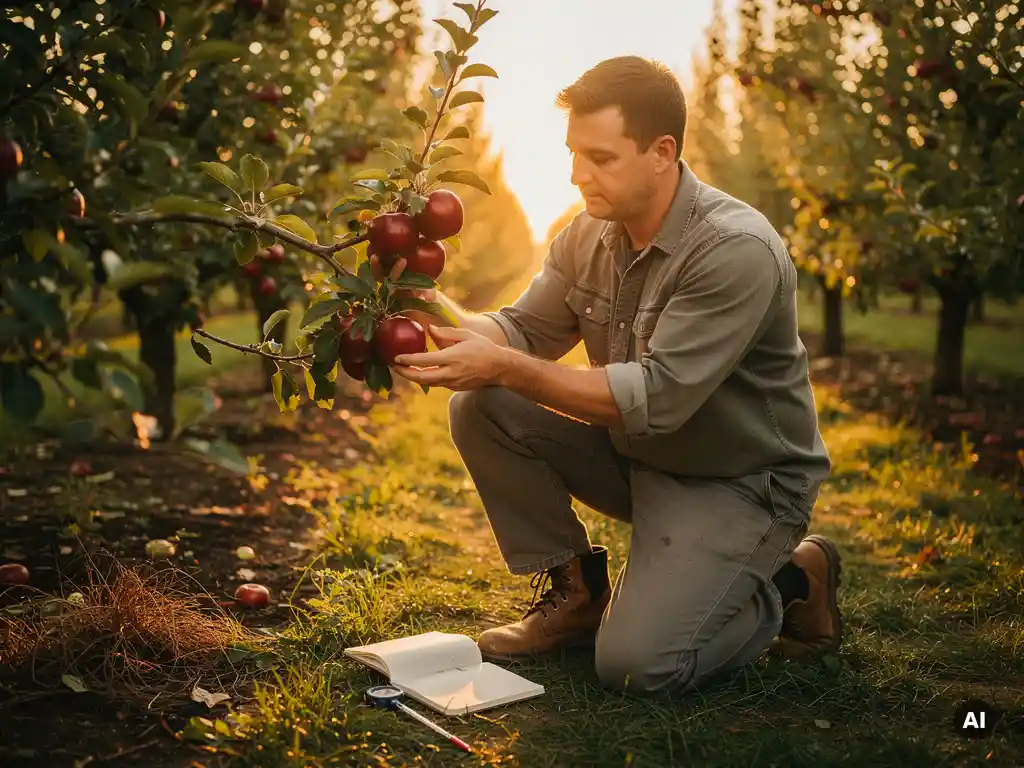
Growers select a variety based on climate suitability by matching a variety’s key biological requirements, primarily chilling hours, heat accumulation, frost tolerance, and disease pressure, to the specific conditions of their growing site. The right fit between variety and climate directly determines yield reliability, fruit quality, and long-term orchard profitability. The questions below unpack each of these factors in detail, helping growers make more confident variety decisions. If you want to talk through your specific situation, feel free to get in touch with us directly.
What climate factors matter most when choosing a fruit variety?
The most critical climate factors in variety selection are chilling hours, spring frost risk, summer heat accumulation, rainfall patterns, and regional disease pressure. Together, these conditions determine whether a variety will flower reliably, set fruit consistently, and ripen to its full quality potential in a given location.
Chilling hours, the number of hours below a certain temperature threshold during winter, are foundational. Without sufficient chilling, apple and pear trees struggle to break dormancy uniformly, leading to erratic flowering and poor fruit set. Heat accumulation during the growing season then drives how quickly fruit develops and whether it reaches the sugar levels and firmness that define its eating quality.
Spring frost risk is particularly important for early-flowering varieties. A variety that blooms two weeks earlier than average may perform brilliantly in a frost-free valley but fail repeatedly on an exposed hillside. Rainfall distribution affects both irrigation requirements and fungal disease pressure, which brings in a separate but equally important dimension: the variety’s inherent resistance or susceptibility to diseases like scab, mildew, and fire blight.
How does chilling requirement affect variety performance?
A variety’s chilling requirement is the minimum number of cold hours it needs during dormancy to flower and fruit normally. If a growing region does not consistently deliver those hours, the variety will underperform, producing weak, uneven flowering, reduced fruit set, and inconsistent annual yields.
Low-chill varieties are bred to break dormancy with fewer cold hours, making them suited to mild-winter regions. High-chill varieties need prolonged cold and are better matched to continental or higher-altitude climates. Placing a high-chill variety in a warm-winter region is one of the most common and costly mismatches in grower variety selection: the trees survive but never perform to their genetic potential.
As winters become milder in many apple and pear-producing regions, chilling requirement has become an increasingly decisive factor. Growers in areas where reliable chilling hours can no longer be taken for granted are actively prioritising varieties with lower or more flexible chilling requirements when planning new plantings.
How are apple and pear varieties bred for climate resilience?
Apple and pear varieties are bred for climate resilience by selecting parent lines that carry traits such as flexible chilling requirements, tolerance to late frost, heat stress resistance during fruit development, and durable resistance to climate-sensitive diseases. Modern breeding programs combine these traits using molecular marker technology to identify and select desirable genes far earlier than traditional methods allow.
At Better3Fruit, we use molecular markers as a core part of our breeding process. This allows us to screen thousands of seedlings for specific climate-relevant traits without waiting years for trees to reach maturity and fruit. With over 10,000 new varieties of each crop entering field evaluation every year, and more than 30,000 varieties under assessment at any one time, we can identify combinations of traits that would be extremely difficult to find through conventional selection alone.
Climate resilience in breeding is not a single trait but a combination. A truly resilient variety performs consistently across a range of seasonal conditions: it does not collapse in a warm winter, does not drop its crop in a late frost, and does not become unmarketable after a hot summer. Breeding for this kind of robustness requires long evaluation cycles and diverse trial environments, which is why serious breeding programs invest heavily in field infrastructure and long-term data collection.
What’s the difference between climate adaptability and climate specificity in a variety?
Climate adaptability refers to a variety’s ability to perform well across a broad range of growing conditions, while climate specificity describes a variety that is optimised for a narrow set of conditions and performs best, or only well, within that defined climate window. Neither is inherently better; the right choice depends on the grower’s location and risk tolerance.
A climate-adaptable variety is attractive to growers in regions with variable or transitional climates, or where long-term climate trends are uncertain. It offers more consistent performance across seasons that vary in winter cold, spring timing, or summer heat. The trade-off is that adaptable varieties rarely reach the absolute peak expression that a climate-specific variety achieves in its ideal environment.
A climate-specific variety, by contrast, can deliver exceptional fruit quality and yield when the conditions are right. Many of the world’s most celebrated apple and pear cultivars are climate-specific: they are outstanding in their home regions and mediocre elsewhere. Growers considering such varieties need to be confident that their site consistently delivers the required conditions, and that climate trends in their region are not moving away from those requirements.
Should growers trial a variety before large-scale planting?
Yes, trialling a variety before large-scale planting is strongly advisable, and for most growers it is the most reliable way to confirm climate suitability. A trial planting of even a small number of trees across two to four seasons provides direct, site-specific evidence of how a variety responds to local conditions, which no regional data or breeder description can fully replace.
Variety performance data from other regions is useful context, but orchards differ in microclimate, soil, water availability, and local disease pressure. A variety that performs well 50 kilometres away may behave differently on a specific site due to elevation, aspect, or frost pocket dynamics. Trialling removes that uncertainty before a grower commits significant capital to rootstock, trees, and infrastructure.
When setting up a trial, growers should aim to evaluate the variety across at least two contrasting seasons, ideally one with a warm winter and one with a cold winter, to understand how it handles chilling variability. Tracking flowering date, fruit set, ripening window, fruit size, colour development, and storage behaviour across those seasons gives a much clearer picture of long-term potential than a single-year snapshot. You can explore the varieties we currently offer to identify candidates worth including in a trial programme.
How is climate change shifting variety selection decisions?
Climate change is shifting variety selection decisions by making chilling reliability, late frost tolerance, and heat resilience during fruit development more important criteria than they were a generation ago. Growers who previously selected varieties based on historical climate averages are now factoring in greater seasonal variability and longer-term warming trends when planning new orchards.
The most immediate impact in many apple and pear-growing regions is the reduction in reliable chilling hours. Varieties that performed consistently for decades are showing more erratic flowering behaviour as winters warm. This is pushing growers toward lower-chill alternatives and increasing demand for breeding programs that specifically target flexible dormancy requirements.
At the same time, warmer summers are compressing the ripening window for some varieties and creating new heat stress challenges during the critical period of cell division and fruit sizing. Varieties with longer ripening windows or better heat tolerance are gaining commercial interest in regions that previously had no need for them. Disease dynamics are also shifting: warmer, wetter springs in some regions are increasing scab and fire blight pressure, making disease resistance a climate-resilience trait as much as a production efficiency one.
For growers making planting decisions today, the practical implication is clear: variety selection for climate suitability now needs to account not just for current conditions but for the likely conditions over a 20 to 30-year orchard lifespan. That shift in planning horizon changes which varieties make sense, and it makes the quality of a breeding program’s long-term climate strategy an increasingly important factor in the licensing decisions growers make. Contact us to discuss how our varieties align with your growing conditions and long-term orchard plans.
This content was generated with the help of AI and it may contain mistakes