
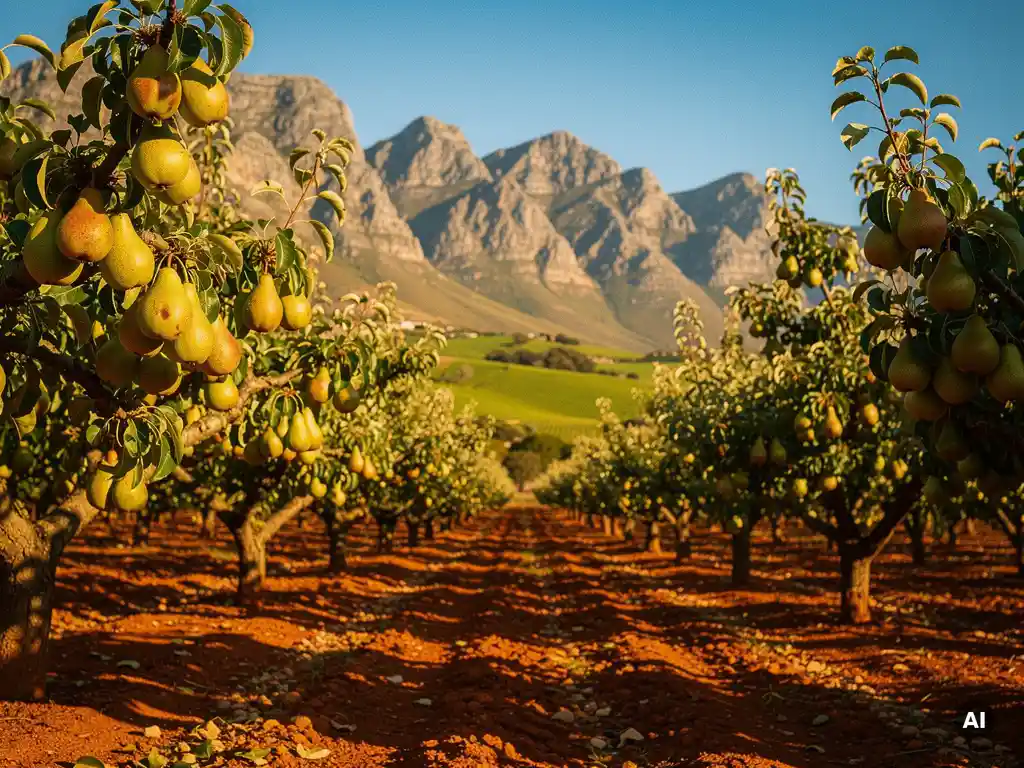
Pear growing in South Africa differs from Europe primarily because of climate, seasonal timing, and the specific challenges that come with a Southern Hemisphere growing environment. South African orchards benefit from warm, dry summers and cool winters in key production regions, which suits certain pear varieties well but also creates distinct pest pressures and market dynamics. The sections below explore the most important differences across climate, variety choice, seasonality, pest management, and breeding strategy.
If you want to discuss variety selection or licensing opportunities for your region, feel free to get in touch with us directly.
What climate conditions do South African pear growers work with?
South African pear growers primarily operate in the Western Cape, particularly the Ceres, Elgin, and Grabouw valleys. These areas offer a Mediterranean climate with hot, dry summers and cold, wet winters, providing the chilling hours that pear trees need to break dormancy properly. Rainfall is concentrated in winter, and irrigation during the dry growing season is standard practice.
Compared to the main European pear-growing regions, such as Belgium, the Netherlands, northern Italy, and northern Spain, South Africa’s climate is generally warmer and drier during the growing season. European orchards often deal with higher humidity and more variable summer weather, which affects both fruit development and disease pressure differently. South African growers must manage heat stress and water availability carefully, while European growers more often contend with excess moisture and the disease problems that come with it.
Altitude plays an important role in South Africa. Many orchards sit at elevation, which moderates temperatures and helps achieve the fruit colour and firmness that premium markets demand. This geographic specificity means that pear cultivation in South Africa is concentrated in a relatively small but highly productive region, unlike Europe, where production is spread across a much wider geographic and climatic range.
Which pear varieties are most popular in South Africa versus Europe?
In South Africa, the Packham’s Triumph and Forelle pear are the dominant commercial varieties, with Beurre Bosc and Abate Fetel also grown for export. Forelle in particular is strongly associated with South African production and is rarely grown at commercial scale elsewhere. In Europe, Conference is the most widely grown variety, especially in Belgium and the Netherlands, followed by Doyenné du Comice and Abate Fetel in warmer southern regions.
The variety landscape reflects both climate suitability and market history. Conference thrives in the cooler, moister conditions of northern Europe and has built decades of consumer recognition. Forelle suits the specific conditions of the Western Cape and has carved out a niche in export markets as a distinctly South African product. Exploring the full range of pear varieties available makes clear how strongly regional conditions shape commercial variety choices.
One shared trend across both regions is growing interest in varieties with better disease tolerance, stronger shelf life, and improved eating quality. Consumer expectations are rising globally, and both South African and European growers are looking for new cultivars that can meet those demands without heavy input costs.
How does the Southern Hemisphere growing season affect global pear supply?
South Africa’s growing season runs roughly from January to April for harvest, which is the opposite of the Northern Hemisphere. This counter-seasonal production plays a valuable role in global pear supply, allowing retailers in Europe, the UK, and North America to offer fresh Southern Hemisphere pears during the European off-season, typically from March through to mid-year.
For the global pear industry, this seasonal complementarity is commercially significant. South African pears arrive in European markets when local production is either depleted or not yet available, filling a supply gap that would otherwise require reliance on cold-stored fruit. The quality of freshly harvested Southern Hemisphere fruit can be a strong selling point compared to pears that have been in controlled-atmosphere storage for several months.
This dynamic also creates a degree of interdependence between South African growers and European importers. A poor South African harvest affects Northern Hemisphere availability during spring and early summer, while strong European production can suppress the prices South African exporters receive. Understanding this seasonal rhythm is essential for anyone involved in pear farming, trade, or variety development on either side of the equator.
What are the biggest pest and disease challenges for South African pear growers?
South African pear growers face a distinct set of pest and disease pressures shaped by their climate. Fire blight, caused by the bacterium Erwinia amylovora, is a serious concern in warm, humid conditions and can devastate orchards rapidly. Pear psylla is another major pest, damaging fruit and spreading sooty mould. Codling moth management is also a significant ongoing challenge for South African producers.
Compared to Europe, South Africa generally experiences lower pressure from fungal diseases like scab (Venturia pirina) due to the drier summer climate. However, the warmer temperatures can intensify certain insect pest cycles, making integrated pest management more complex. Phytosanitary requirements for export markets add another layer of pressure, since any pest or disease presence can result in consignments being rejected at the border.
For breeding programs like ours, these regional differences in pest and disease pressure are directly relevant. Developing varieties with built-in tolerance or resistance to the specific challenges faced in South Africa requires a different emphasis than breeding for European conditions. A variety that performs well in Belgium may not have the right disease resistance profile for the Western Cape, and vice versa.
Should pear breeders develop different varieties for South Africa and Europe?
Yes, pear breeders should account for regional differences when developing new varieties, though a single variety can sometimes perform well in both environments if it combines the right traits. Climate adaptation, specific pest and disease resistance profiles, chilling hour requirements, and consumer market preferences all vary enough between South Africa and Europe to justify region-specific breeding targets alongside globally applicable ones.
At Better3Fruit, our breeding strategy focuses on bringing together disease tolerance, taste, texture, and grower yield, all within a framework of climate resilience and long-term sustainability. These goals are broadly applicable, but the specific disease resistances prioritised, the heat tolerance of a variety, and its chilling requirements must be calibrated to the target growing region. A variety bred with the cool, humid conditions of northern Europe in mind may simply not thrive in the Western Cape without adaptation.
That said, there is genuine value in identifying varieties with wide adaptability. Varieties that can perform across both hemispheres give licensees and growers more flexibility, and they create larger potential markets. The ideal outcome for a breeding program is a portfolio that includes both broadly adapted varieties and regionally optimised ones, giving growers in South Africa and Europe access to cultivars genuinely suited to their conditions.
If you are a grower, marketer, or industry partner interested in pear varieties suited to your specific region, we would be glad to discuss what our current and upcoming portfolio could offer. Contact us to start the conversation.
This content was generated with the help of AI and it may contain mistakes