
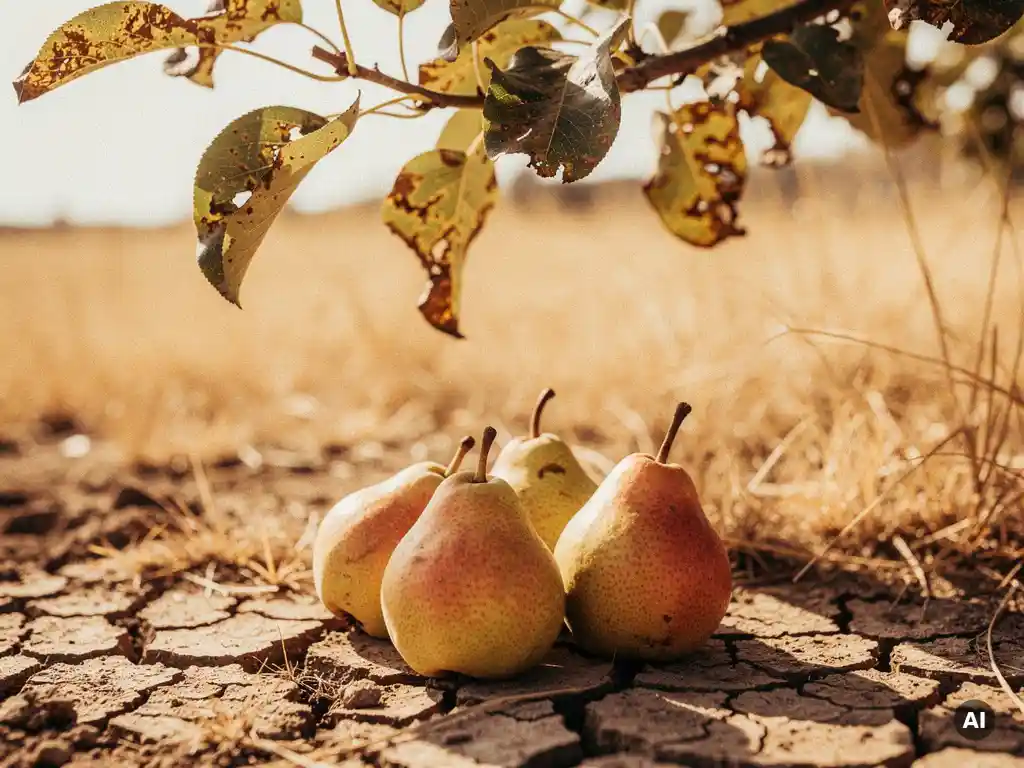
Climate change poses serious and growing risks to the pear industry, threatening everything from crop yields and fruit quality to long-term orchard viability. Rising temperatures, shifting rainfall patterns, and increasingly unpredictable seasons are disrupting the precise growing conditions that pear production depends on. The questions below unpack the specific challenges pear growers and breeders are navigating right now, and what the industry can do about them. If you want to discuss how variety choice can help your operation adapt, feel free to get in touch with us directly.
How is climate change already affecting pear-growing regions?
Climate change is already reshaping pear-growing regions through warmer winters, more frequent late frosts, prolonged droughts, and extreme heat events during the growing season. These shifts are disrupting the predictable seasonal rhythms that pear orchards depend on, leading to inconsistent harvests, reduced fruit quality, and in some regions, significant crop losses year after year.
Across traditional pear-producing areas in Europe, North America, and parts of Asia, growers are reporting earlier bloom times driven by warmer springs. While this sounds positive, earlier flowering dramatically increases exposure to late frost events, which can destroy an entire season’s potential in a single night. At the same time, summer heatwaves are causing sunburn damage on fruit and accelerating ripening in ways that compress harvest windows and reduce storage life. Water stress during dry summers is also pushing growers toward more intensive irrigation, adding cost and sustainability pressure to an already tight-margin business.
Why do pear trees struggle more with warming temperatures than other fruit crops?
Pear trees are particularly sensitive to warming temperatures because they have a high chilling requirement, meaning they need a sustained period of cold winter temperatures to break dormancy and flower reliably. When winters become too mild, pear trees fail to accumulate enough chilling hours, leading to erratic budbreak, poor flowering, and drastically reduced yields, even when the rest of the season is otherwise suitable.
This chilling dependency makes pears more vulnerable than many other fruit crops. Apples, for example, generally have a wider range of varieties with lower chilling requirements, giving breeders and growers more flexibility to adapt. Pears, by contrast, have a narrower genetic base in commercial production, and the dominant varieties grown today were selected for conditions that are becoming less reliable. On top of the chilling problem, pear trees are also more susceptible to fire blight, a bacterial disease that thrives in warm, wet spring conditions that are becoming more common across key growing regions.
What are the biggest pest and disease threats driven by climate change?
The biggest climate-driven pest and disease threats to pear production are fire blight, pear psylla, and an expanding range of fungal diseases, all of which benefit from the warmer temperatures and altered rainfall patterns that climate change is bringing. These pressures are intensifying in regions where they were previously manageable and appearing in new areas where growers have little experience dealing with them.
Fire blight
Fire blight, caused by the bacterium Erwinia amylovora, is one of the most destructive diseases in pear production. It spreads rapidly during warm, humid spring weather, precisely the conditions that are becoming more frequent. An infected tree can lose entire branches, and in severe outbreaks, whole orchards can be devastated. Because many commercially grown pear varieties have limited resistance, the disease is increasingly difficult to manage through spraying alone.
Pear psylla and emerging pests
Pear psylla is a sap-sucking insect that thrives in warmer conditions and is expanding its range and season length as temperatures rise. Beyond psylla, milder winters mean that overwintering pest populations survive in greater numbers, increasing pressure on orchards the following spring. Invasive pests that were once limited by cold winters are also establishing themselves in previously unaffected regions, creating new challenges for growers who have no established management strategies in place.
How does climate change disrupt pear pollination and fruit set?
Climate change disrupts pear pollination and fruit set by causing a timing mismatch between when pear trees flower and when pollinators are active. When warmer springs accelerate tree flowering but bee populations and other pollinators have not yet emerged in sufficient numbers, or when different pear varieties bloom out of sync with each other, pollination rates drop and fruit set becomes inconsistent.
Pears are not self-fertile, which means they depend on cross-pollination between compatible varieties to produce fruit. Orchard layouts are carefully planned around bloom timing to ensure compatible varieties flower together. When climate change shifts those bloom windows, the synchronization that growers have relied on for decades can break down. Late frosts compound this problem further: even when pollination succeeds, a frost event during or just after flowering can kill developing fruitlets before they have a chance to grow. The result is unpredictable yields that make commercial planning extremely difficult.
What role does variety selection play in managing climate risk?
Variety selection is one of the most powerful tools available to manage climate risk in pear production. Choosing varieties with lower chilling requirements, stronger disease resistance, and greater heat tolerance can significantly reduce an orchard’s vulnerability to the specific pressures that climate change is intensifying. Getting variety choice right at planting time is critical, because orchards are long-term investments that will face conditions very different from those of today.
At Better3Fruit, we place climate resilience at the heart of our breeding strategy. Our apple and pear breeding programme actively selects for disease and pest tolerance, reduced chilling requirements, and the ability to perform well under variable growing conditions. With over 30,000 new varieties under evaluation at any given time, we are working to build a pipeline of varieties that can thrive in the orchards of the future, not just the orchards of the past. Growers looking to future-proof their operations can explore our current variety portfolio to see what is available now and what is in development.
Beyond disease resistance, newer varieties are being evaluated for their performance under heat stress, their bloom timing relative to changing spring temperatures, and their compatibility with reduced inputs. Variety selection is not a one-time decision either. As the climate continues to shift, growers and their supply chain partners need to stay actively engaged with what new genetics can offer.
What should the pear industry prioritise to stay resilient long term?
To stay resilient long term, the pear industry should prioritise investment in climate-adapted varieties, stronger collaboration between breeders, growers, and retailers, and a shift toward sustainable orchard management practices that reduce dependence on inputs that are becoming less effective or less available. Resilience is not a single action but a combination of decisions made across the entire value chain.
Several priorities stand out as particularly urgent:
- Accelerating the adoption of disease-resistant varieties to reduce reliance on chemical controls that are under regulatory pressure and increasingly ineffective against evolving pathogen strains.
- Investing in water management infrastructure to cope with more frequent drought years without sacrificing fruit quality or yield.
- Rethinking orchard design to include better frost protection, shade management for extreme heat events, and pollinator-friendly planting strategies.
- Strengthening supply chain coordination so that variety rollouts are matched with market development, quality standards, and grower support from the start.
- Engaging with long-term breeding programmes that are already developing the varieties the industry will need in ten or twenty years, not just the ones that solve today’s problems.
The pear industry has always adapted to challenges, but the pace and scale of climate change demand a more proactive and coordinated response than the sector has historically been required to make. Growers, breeders, and commercial partners who engage with these challenges now will be far better positioned than those who wait for conditions to force their hand. If you want to explore how the right variety strategy can help your business build genuine climate resilience, contact us and we will be happy to talk through the options with you.
This content was generated with the help of AI and it may contain mistakes