
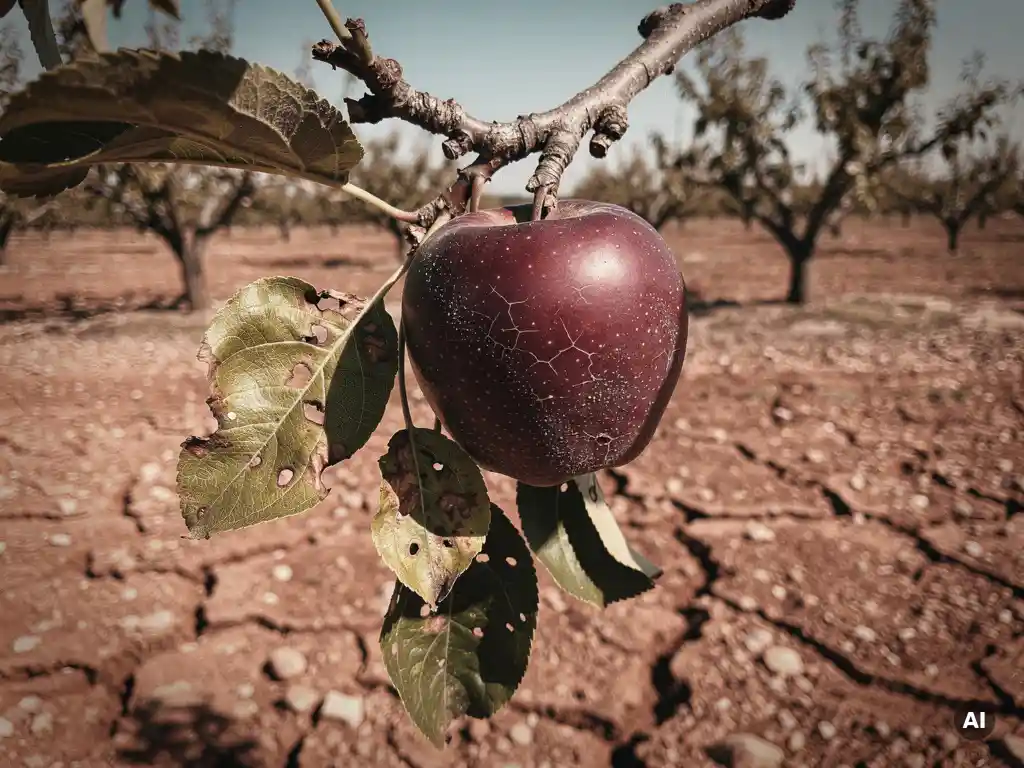
Climate change poses serious and growing consequences for apple growers worldwide. Rising temperatures, erratic rainfall, and shifting pest pressure are already disrupting apple production cycles, reducing yields, and threatening fruit quality in many established growing regions. The sections below unpack the most pressing climate-related challenges facing orchards today and what growers can do to respond.
If you want to discuss how variety choice can help future-proof your orchard, feel free to get in touch with us directly.
How are rising temperatures affecting apple tree development?
Rising temperatures disrupt apple tree development by interfering with two critical biological processes: chilling accumulation and flowering timing. Apple trees need a sustained period of cold temperatures during dormancy to bloom reliably in spring. As winters warm, many orchards in traditional growing regions are no longer accumulating enough chilling hours, leading to irregular budbreak, poor fruit set, and reduced yields.
Beyond dormancy, warmer springs cause bloom periods to shift earlier in the season. This exposes delicate blossoms to late frost events, which have become more common and unpredictable even as average temperatures climb. A single frost event during bloom can devastate an entire season’s crop. Summer heat also affects fruit development directly, causing sunburn, poor skin color in red varieties, and softer flesh texture at harvest, all of which reduce commercial value.
Over the longer term, some established apple-growing regions may become climatically unsuitable for certain varieties altogether, pushing productive zones toward higher altitudes or latitudes.
What are the biggest pest and disease risks linked to climate change?
Climate change is expanding the range and severity of key apple pests and diseases by creating warmer, wetter, or more variable conditions that favor their spread. Pathogens and insects that were once limited by cold winters are now surviving and reproducing in regions where they previously posed little threat.
Apple scab, caused by the fungus Venturia inaequalis, thrives under wet spring conditions and mild temperatures, a combination that is becoming more frequent across many growing regions. Fire blight, a bacterial disease that spreads rapidly in warm and humid conditions, is also increasing in prevalence and geographic range. Both diseases can cause severe crop losses and require intensive chemical management if resistant varieties are not in place.
On the pest side, warmer winters allow insects like codling moth and woolly apple aphid to complete more generations per season and establish in new areas. Invasive species such as the spotted wing drosophila and the brown marmorated stink bug are also spreading northward as temperature barriers weaken. Managing this shifting pest landscape demands more vigilance, higher input costs, and in many cases a rethink of integrated pest management strategies.
How does unpredictable rainfall affect apple orchards?
Unpredictable rainfall harms apple orchards through two opposing extremes: drought stress and waterlogging. When rainfall is insufficient during critical growth periods, trees experience water stress that reduces fruit size, triggers premature drop, and weakens the tree’s long-term health. When rainfall arrives in intense bursts, it saturates soil, damages roots, and creates ideal conditions for fungal diseases.
Irrigation infrastructure that was once sufficient is increasingly inadequate in regions experiencing prolonged dry spells. At the same time, orchards in low-lying areas face flooding risks that were historically rare. Hail events, often associated with intense convective storms, are also increasing in frequency in parts of Europe and North America, causing direct physical damage to fruit and bark that opens pathways for secondary infection.
Growers are finding that water management, both conservation and drainage, has become one of the most operationally demanding aspects of running a modern apple orchard under changing climate conditions.
Which apple varieties are most vulnerable to climate shifts?
Apple varieties with high chilling requirements, low disease resistance, and narrow temperature tolerances are the most vulnerable to climate change. Many heritage and traditional commercial varieties were selected under stable climate conditions and lack the genetic flexibility to perform well as those conditions shift.
Varieties that require long, cold winters to break dormancy reliably, such as some older European cultivars, are particularly at risk in regions where chilling hours are declining. Similarly, varieties with susceptibility to apple scab or fire blight face compounding pressure as disease-favorable weather becomes more common. Varieties that color poorly under warm conditions also lose commercial appeal as summers heat up.
In contrast, modern bred varieties that combine disease tolerance, lower chilling requirements, and resilience to temperature variability are far better positioned for the decades ahead. This is precisely why breeding programs focused on these traits are becoming central to the future of apple production. You can explore our current variety portfolio to see how we approach this challenge.
What can apple growers do to adapt to climate change?
Apple growers can adapt to climate change through a combination of variety selection, orchard management upgrades, and long-term strategic planning. No single solution addresses every risk, but growers who act across multiple fronts are best placed to maintain productive, profitable orchards through the coming decades.
The most impactful adaptation steps include:
- Switching to climate-resilient varieties that carry built-in disease resistance, lower chilling requirements, and better heat tolerance, reducing input costs while maintaining yield stability
- Investing in frost protection systems such as wind machines, overhead irrigation for frost protection, or anti-frost candles to guard against late spring frosts during bloom
- Improving water management infrastructure through drip irrigation, soil moisture monitoring, and drainage systems that handle both drought and excess rainfall
- Adopting integrated pest management strategies that account for shifting pest pressure and reduce reliance on broad-spectrum pesticides
- Diversifying variety plantings to spread risk across different ripening windows, market segments, and climate tolerances
- Monitoring and scouting more intensively to catch disease and pest outbreaks early, when intervention is most effective and least costly
Growers who treat variety selection as a long-term climate adaptation tool, rather than a purely commercial decision, are building orchards that can absorb the disruptions that climate change will continue to bring to apple production. At Better3Fruit, climate resilience and multi-level sustainability are core pillars of our breeding strategy, and we actively develop varieties designed to perform under the conditions growers will face in the years ahead. Contact us to find out which varieties fit your growing region and long-term goals.
This content was generated with the help of AI and it may contain mistakes