
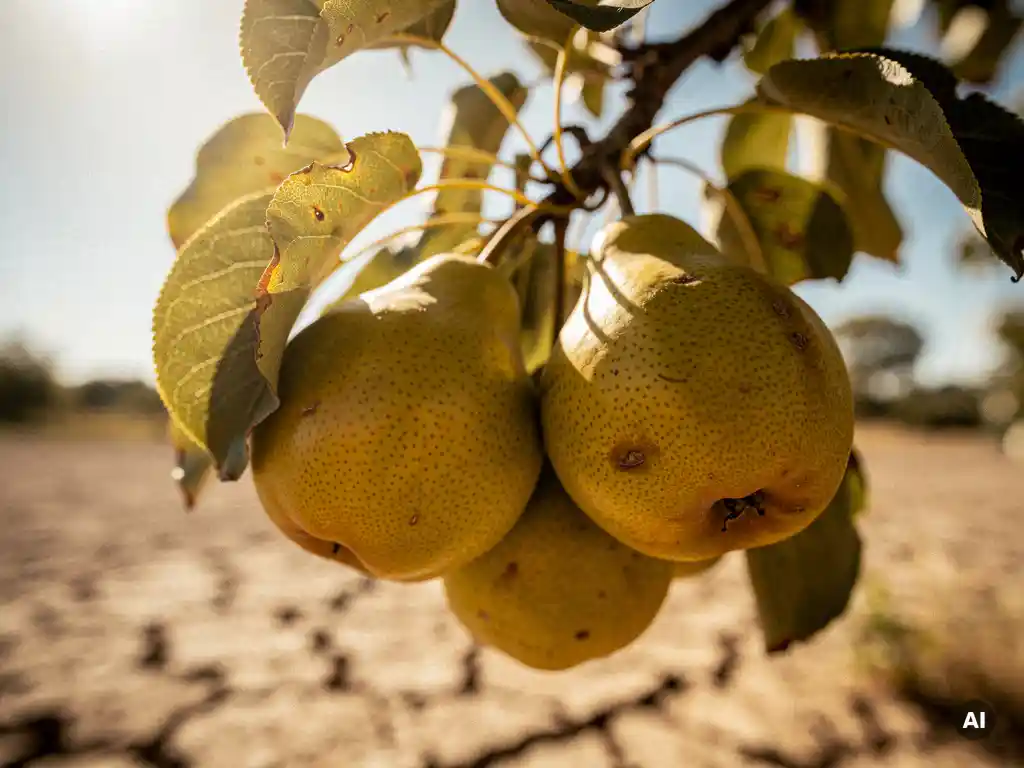
Several pear varieties are now being specifically bred and selected to perform well in a warming climate, with traits like reduced chilling requirements, heat tolerance during bloom, and improved drought resilience at the core of modern breeding programs. Climate adaptation has become one of the most urgent priorities in fruit breeding, as traditional growing regions experience milder winters and more intense summer heat. Below, we unpack the key questions growers and industry partners are asking about pear varieties and climate change. If you want to explore what we are working on at Better3Fruit, feel free to get in touch directly.
How does a warming climate affect pear growing conditions?
A warming climate disrupts pear growing in two primary ways: it reduces the number of cold hours trees receive during winter dormancy, and it increases heat and drought stress during the growing season. Both effects can reduce fruit set, delay or advance bloom unpredictably, and ultimately lower yield and fruit quality.
Pear trees, like most temperate fruit crops, depend on a period of sustained cold temperatures during winter, known as chill hours, to break dormancy and bloom uniformly in spring. When winters become shorter or warmer, trees may not accumulate enough chill hours, leading to erratic or incomplete flowering. At the same time, hotter and drier summers stress trees during fruit development, affecting size, skin finish, and internal quality. For growers in traditionally cool regions like northern Europe, these shifts are already visible. For growers in warmer regions such as southern Spain, Portugal, or parts of Australia, the pressure is even more acute.
What traits make a pear variety climate resilient?
A climate-resilient pear variety combines low chilling requirements, tolerance to heat stress during bloom and fruit development, efficient water use under drought conditions, and stable yield across variable seasons. No single trait defines climate resilience: it is the combination that determines how well a variety performs as conditions shift.
Breeding programs targeting climate resilience look at several interconnected characteristics:
- Low chill hour requirement: The ability to complete dormancy with fewer cold hours, enabling reliable flowering in warmer winters
- Heat tolerance at bloom: Pollen viability and fruit set are maintained even when temperatures spike during flowering
- Drought tolerance: Efficient water use and the ability to maintain fruit quality under reduced irrigation or dry spells
- Disease resilience: Warmer, wetter springs can increase pressure from diseases like fire blight and scab, so resistance traits remain critical
- Phenological flexibility: Varieties that can adjust their growth timing without losing synchrony between flowering and pollinator activity
At Better3Fruit, climate resilience and multi-level sustainability are among our primary long-term breeding goals. We integrate these traits into our evaluation pipeline alongside taste, texture, and grower yield, because a variety that survives a warming climate but fails to deliver at the shelf is not a commercial solution.
Which pear varieties are bred to tolerate lower chill hours?
Pear varieties bred for lower chill hour tolerance are typically selected from breeding programs working with genetic material from warmer growing regions, or through crosses that introduce low-chill traits from wild or semi-cultivated relatives. These varieties can complete dormancy with significantly fewer cold hours than traditional European or Asian pear cultivars.
Conventional European pear varieties like Conference or Doyenné du Comice were bred for cool-temperate climates and typically require 800 to 1,200 chill hours. Newer selections targeting warmer climates aim to perform reliably at 400 to 600 hours or fewer. Some programs have explored crosses with Pyrus communis accessions from warmer provenances, as well as interspecific crosses with Asian pear species that naturally evolved in climates with less pronounced winters.
The commercial pipeline for low-chill pear varieties is still developing. Most varieties currently available with reduced chilling needs have been bred primarily for subtropical markets and may not yet meet the flavor profile and storage requirements expected by European or North American premium markets. This gap is precisely where next-generation breeding programs are focusing their energy, combining low-chill adaptation with the eating quality that consumers and retailers demand. You can explore our current variety portfolio at Better3Fruit varieties to see how our selections are progressing.
How are modern pear breeding programs selecting for climate adaptation?
Modern pear breeding programs select for climate adaptation using molecular markers, genomic tools, and multi-site field evaluation across contrasting climates. These tools allow breeders to identify and stack climate-relevant traits far more efficiently than traditional observation-based selection alone.
At Better3Fruit, we use molecular markers to accelerate our breeding work, enabling us to detect the presence of desirable traits at the seedling stage rather than waiting years for trees to mature and fruit. With over 10,000 new pear varieties entering field evaluation every year and more than 30,000 under evaluation at any given time, the scale of our program means we can apply rigorous selection pressure across a very broad genetic base.
Multi-environment testing is equally important. A variety that performs well in Belgium may behave very differently in a warmer, drier growing region. By evaluating selections across diverse climates, breeding programs can identify which individuals maintain consistent performance under heat, drought, or low-chill conditions, rather than those that simply perform well in a single favorable location. This kind of climate-stratified testing is becoming standard practice in leading programs worldwide.
What’s the difference between heat-tolerant and drought-tolerant pear varieties?
Heat tolerance and drought tolerance are related but distinct traits in pear varieties. Heat tolerance refers to a variety’s ability to maintain fruit set, fruit quality, and tree health when air temperatures are elevated. Drought tolerance refers to a variety’s ability to function with reduced water availability in the soil, regardless of temperature.
A variety can be heat-tolerant without being drought-tolerant, and vice versa. In practice, the two stresses often occur together during summer, which is why breeders increasingly look for varieties that handle both simultaneously.
Heat tolerance in pear varieties
Heat stress during bloom is one of the most damaging climate risks for pear production. When temperatures rise sharply during the flowering window, pollen viability drops, fertilization fails, and fruit set is reduced or lost entirely. Heat-tolerant varieties maintain viable pollen and effective pollination across a wider temperature range. During fruit development, heat tolerance also relates to the variety’s ability to avoid sunburn, maintain skin integrity, and develop normal sugar and acid profiles even in high-temperature conditions.
Drought tolerance in pear varieties
Drought-tolerant pear varieties are those that can sustain adequate growth and fruit development under reduced soil moisture. This involves traits like deeper or more efficient root systems, stomatal regulation that limits water loss through leaves, and the ability to maintain cellular function during periods of water deficit. Drought tolerance is particularly relevant in regions where irrigation water is becoming scarce or expensive, and where summer rainfall is declining as a result of shifting climate patterns.
When will climate-adapted pear varieties reach commercial growers?
Climate-adapted pear varieties are already entering commercial pipelines, though widespread availability for mainstream growers is likely still several years away for most regions. The timeline depends on the breeding program, the regulatory and IP pathway, and the time needed to build sufficient nursery stock and establish commercial plantings at scale.
Fruit breeding operates on long cycles. From the moment a promising seedling is identified, it typically takes ten to fifteen years before a variety reaches commercial growers in meaningful volumes, accounting for multi-year field evaluation, regional trials, IP protection, licensing, and nursery multiplication. Programs that use molecular markers and genomic tools can compress some of these timelines, but the biological reality of tree crops means patience remains essential.
For growers planning new plantings today, the most practical approach is to work closely with breeding companies and licensing partners who can share what is in the pipeline and which selections are approaching commercial readiness. At Better3Fruit, we work with partners worldwide to bring new varieties to market in a structured way, carefully matching varieties to regions and market requirements. If you want to learn more about what we are developing for a warming climate, contact us to start a conversation about licensing and future variety access.
This content was generated with the help of AI and it may contain mistakes