
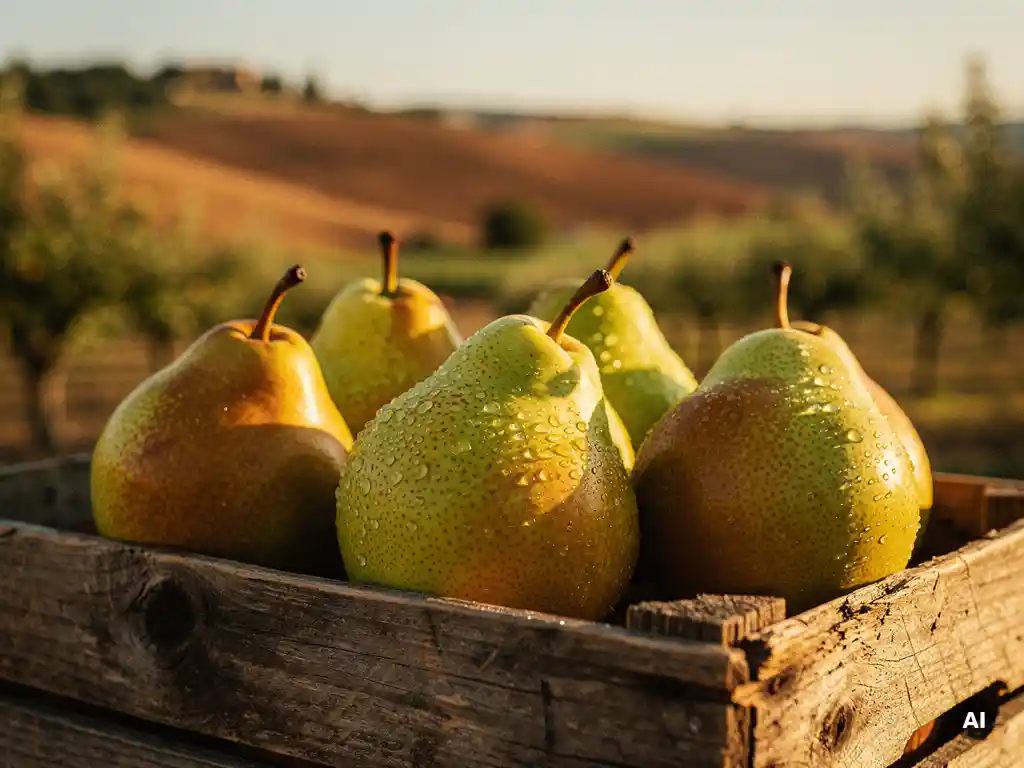
Italy grows a wide range of pear varieties, with Conference, Abate Fetel, and Williams Bon Chrétien (also known as Bartlett) among the most widely cultivated Italian pear cultivars. These varieties dominate commercial orchards across the country, particularly in the Po Valley, and are exported throughout Europe and beyond. Below, we answer the most common questions about pear varieties in Italy, from growing regions to harvest timing and what is coming next in pear breeding. If you would like to speak with someone directly about pear variety development or licensing opportunities, feel free to get in touch with us.
What are the most popular pear varieties grown in Italy?
The most popular pear varieties grown in Italy are Abate Fetel, Conference, Williams Bon Chrétien, Kaiser, and Decana del Comizio. Abate Fetel alone accounts for a significant share of Italian pear production, prized for its elongated shape, sweet flavour, and excellent shelf life. Conference is equally prominent, valued by growers for its reliable cropping and by consumers for its juicy, slightly grainy texture.
Beyond these commercial staples, Italian growers also cultivate Coscia, one of the earliest-ripening varieties of the season, and Max Red Bartlett, a red-skinned mutation of the classic Williams. Each of these Italian pear cultivars has carved out a market niche based on a combination of taste profile, appearance, and suitability to local growing conditions. Abate Fetel, in particular, has become something of a national icon in the Italian fresh fruit market, frequently associated with premium quality and traditional production methods.
Which Italian regions produce the most pears?
The Emilia-Romagna region is by far the largest pear-producing area in Italy, responsible for the majority of the country’s total pear output. The provinces of Ferrara, Modena, and Bologna are especially important, benefiting from fertile alluvial soils and a continental climate that suits varieties like Abate Fetel and Conference particularly well.
Outside Emilia-Romagna, significant pear cultivation also takes place in Veneto, Trentino-Alto Adige, and Lombardy. Trentino-Alto Adige, known for its mountain climate and clean air, tends to produce pears with excellent colour and firmness, while Veneto contributes meaningfully to both fresh market and processing volumes. Together, these northern Italian regions form the backbone of the country’s pear industry, supplying both domestic consumers and major export markets across Europe.
What is the difference between club and open pear varieties?
A club variety is a cultivar protected by intellectual property rights and licensed exclusively to a defined group of growers, packers, or marketers, whereas an open variety can be grown and sold by anyone without a licence or royalty obligation. The key distinction is control: club varieties are managed to ensure consistent quality, coordinated supply, and strong brand identity in the marketplace.
Club pear varieties
Club varieties are typically developed by breeding companies and released under a brand name, with growers joining a programme that sets production standards and marketing guidelines. This structure allows the variety owner to build a recognisable consumer brand, manage volumes to match demand, and maintain quality across different growing regions. For growers, joining a club programme often means access to marketing support and a premium price, but it also comes with obligations around production practices and exclusivity.
Open pear varieties
Open varieties, by contrast, are freely available to any grower. Classic Italian pear cultivars like Conference and Williams Bon Chrétien are open varieties; anyone can plant them, and there is no central body coordinating their marketing or quality standards. While this gives growers maximum flexibility, it also means greater price competition and less differentiation at the retail level. For commodity markets, open varieties remain the dominant choice, but club programmes are growing in relevance as retailers increasingly seek consistent, branded fruit.
Are there new pear varieties being developed for Italian growers?
Yes, new pear varieties are actively being developed to address the challenges Italian growers face today, including climate change, disease pressure, and evolving consumer preferences. Breeding programmes are focusing on traits such as scab resistance, fire blight tolerance, improved storage life, and better flavour profiles that can compete with the most popular Italian pear cultivars already on the market.
At Better3Fruit, we run one of the most extensive apple and pear breeding programmes in the world, with thousands of new pear seedlings entering evaluation every year. Our approach combines traditional selection expertise with modern molecular marker technology, which allows us to identify promising traits early and bring new cultivars to market more efficiently. We are focused on varieties that perform well across a range of European climates, including the warmer, drier conditions that Italian growers are increasingly experiencing. You can explore our current pear variety portfolio to see what we have in development and what is already available for licensing.
The goal is not simply to replace existing Italian pear cultivars but to complement them with options that offer growers greater resilience and retailers a more differentiated product. Disease-tolerant varieties, for example, can reduce the number of spray applications needed during a season, which lowers production costs and supports more sustainable orchard management.
When is pear harvest season in Italy?
Pear harvest season in Italy runs broadly from late July through to November, depending on the variety and the growing region. Early-season varieties like Coscia are typically picked in July and August, while mid-season cultivars such as Williams Bon Chrétien and Bartlett are harvested in August and September. Late-season varieties, including Abate Fetel and Decana del Comizio, are generally harvested from September into October.
In Emilia-Romagna, the heart of Italian pear production, the bulk of the commercial harvest takes place between August and October. Altitude and climate play an important role: growers in higher-elevation areas like Trentino-Alto Adige may harvest slightly later than those in the warmer Po Valley lowlands. Controlled atmosphere storage technology allows many Italian pear cultivars to be kept in excellent condition well beyond harvest, extending the availability of varieties like Abate Fetel and Conference into the winter months and supporting year-round supply to European markets.
Understanding the seasonal rhythm of Italian pear production is essential for anyone involved in variety selection, orchard planning, or commercial supply chains. If you are looking to explore new pear varieties for Italian conditions or discuss licensing opportunities, we are happy to help, contact us to start the conversation.
This content was generated with the help of AI and it may contain mistakes