
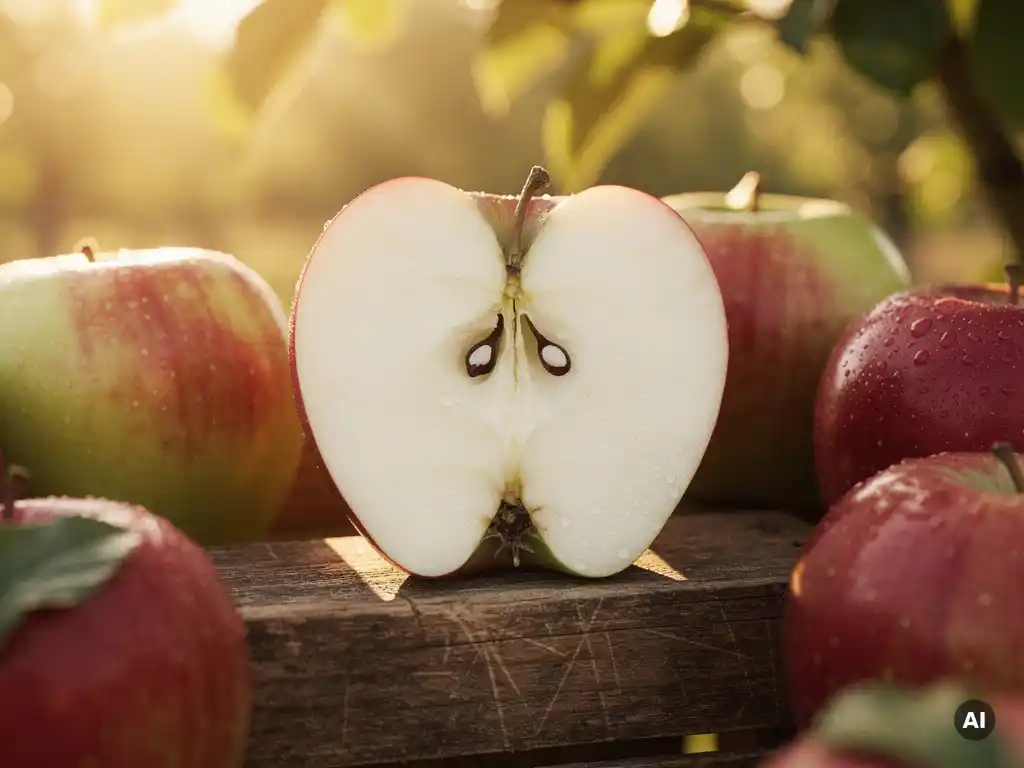
In apple varieties, crisp refers to a texture that snaps cleanly under pressure, delivering a satisfying break rather than a slow, yielding bend. This quality comes from firm, turgid cells packed with water and structural integrity, the kind of bite that feels fresh and lively. Crispness is one of the most sought-after traits in modern apple breeding, and it shapes everything from consumer preference to shelf life. If you want to learn more about how we approach variety development, feel free to get in touch with us directly. Below, we unpack the science, the breeding, and the varieties behind truly crisp apples.
What makes an apple texture crisp rather than soft?
An apple’s crispness comes from the structural strength of its cells and the pressure those cells exert against each other. When you bite into a crisp apple, the cells rupture cleanly and release juice in a burst. In a soft apple, the cells have lost turgor pressure or their walls have broken down, causing the flesh to compress rather than snap. The result is a mealy or floury texture rather than a clean, satisfying break.
Several factors determine whether an apple lands on the crisp or soft end of the spectrum:
- Cell turgor pressure: Cells filled with water push outward against their neighbors. High turgor pressure creates firmness and the characteristic snap of a crisp apple.
- Cell wall composition: The strength and thickness of the cell walls, largely determined by pectin content, affect how cleanly cells break apart when bitten.
- Cell size and arrangement: Smaller, more tightly packed cells generally produce a finer, crisper texture than large, loosely arranged cells.
- Starch-to-sugar conversion: As an apple ripens, starch converts to sugar and cell walls begin to soften. An apple harvested at peak ripeness retains more firmness than one that has been left too long on the tree.
Together, these biological factors determine the apple texture consumers experience, and they are largely governed by genetics, which is why crispness is a key target in apple breeding programs.
How do breeders develop crisp apple varieties?
Apple breeders develop crisp varieties by selecting parent plants with strong cell wall integrity and high turgor pressure, then crossing them to combine the best genetic traits in their offspring. Modern breeding programs use molecular markers to identify genes associated with crispness early in a seedling’s development, dramatically speeding up the selection process compared to traditional taste-and-feel evaluation alone.
At Better3Fruit, we run one of the largest apple and pear breeding programs in the world, evaluating over 30,000 new varieties at any given time. With 10,000 new seedlings entering the field each year, we use molecular marker technology to screen for desirable traits, including texture, before a single fruit is even harvested. This allows us to prioritize the most promising candidates without waiting years for each plant to mature and fruit.
Crispness does not exist in isolation during the breeding process. We evaluate it alongside taste, juiciness, disease tolerance, yield, and climate resilience. A variety that is exceptionally crisp but prone to disease or difficult to grow commercially will not make it through our program. The goal is always a balanced, commercially viable apple that delivers on texture without sacrificing other qualities consumers and growers care about. You can explore some of the varieties we have developed to see how these traits come together in practice.
Does crispness change as an apple ripens or is stored?
Yes, crispness changes significantly both during ripening and throughout storage. As an apple ripens on the tree, enzymes break down pectin in the cell walls, reducing their structural rigidity. Turgor pressure also drops as the fruit loses water. The result is a progressively softer texture. Apples that are harvested slightly before peak ripeness tend to hold their crispness longer than those left on the tree too long.
During storage, the rate of texture change depends heavily on conditions:
- Controlled atmosphere (CA) storage: Reducing oxygen levels and increasing carbon dioxide slows the enzymatic processes that break down cell walls. Many commercial crisp varieties are stored this way to maintain texture for months after harvest.
- Temperature: Cold storage significantly slows cell wall degradation. Apples kept near freezing retain crispness far longer than those stored at room temperature.
- Variety genetics: Some varieties are genetically better suited to long-term storage without losing texture. This is an increasingly important trait in breeding, especially for varieties destined for export markets where time between harvest and consumption is longer.
A crisp apple bought in early spring has almost certainly been in controlled atmosphere storage since the previous autumn. The fact that it still snaps cleanly is a testament to both the variety’s genetics and the storage technology used by modern supply chains.
What’s the difference between crisp, crunchy, and firm apples?
Crisp, crunchy, and firm describe related but distinct aspects of apple texture. A crisp apple snaps cleanly when bitten, releasing juice and breaking apart with minimal resistance. A crunchy apple produces an audible sound and requires more force to bite through, it is often associated with a denser, more fibrous texture. A firm apple resists pressure but does not necessarily snap, it may feel solid without delivering the clean, juicy break that defines crispness.
In everyday conversation these terms are often used interchangeably, but in sensory science and apple breeding they carry distinct meanings. An apple can be firm without being crisp, think of an underripe apple that feels hard but delivers a dry, starchy bite rather than a juicy snap. Equally, an apple can be crisp without being particularly crunchy if its cells break apart easily and quietly.
For most consumers, the ideal apple combines all three qualities in a balanced way: enough firmness to feel fresh and substantial, enough crispness to snap cleanly and release juice, and enough crunchiness to make the eating experience satisfying and audible. This combination is what modern breeders aim for when targeting premium apple texture.
Which apple varieties are known for exceptional crispness?
Several apple varieties stand out for exceptional crispness, consistently delivering the clean snap and juicy release that consumers associate with a high-quality eating experience. Among the best crisp apple varieties available today, a few have become benchmarks for the trait.
Kanzi® (‘Nicoter’), developed by us at Better3Fruit, is widely recognized as one of the crispest club apples on the market. Its dense, fine-grained flesh delivers a clean, juicy bite with excellent texture retention during storage, one of the reasons it became one of the most successful club cultivars of the past decade.
Other varieties widely recognized for crispness include:
- Honeycrisp: Bred at the University of Minnesota, Honeycrisp became famous specifically for its explosive crispness and large cells that rupture dramatically when bitten.
- SweeTango®: A Honeycrisp cross that combines exceptional crispness with a more complex flavor profile.
- Cosmic Crisp®: A Washington State University variety bred explicitly for crispness and long storage life.
- Morgana®: One of our newer commercial releases, Morgana® is gaining recognition for its firm, crisp texture alongside a distinctive flavor.
- Giga®: Another variety from our portfolio, noted for impressive size and a satisfying, crisp eating experience.
What these varieties share is a genetic foundation that prioritizes cell wall integrity and turgor pressure, the two core drivers of apple crispness. As consumer demand for premium texture continues to grow, crispness remains one of the most important traits in new variety development worldwide. If you are interested in licensing one of our crisp varieties or want to explore what our breeding program can offer, reach out to us and we will be happy to help.
This content was generated with the help of AI and it may contain mistakes