
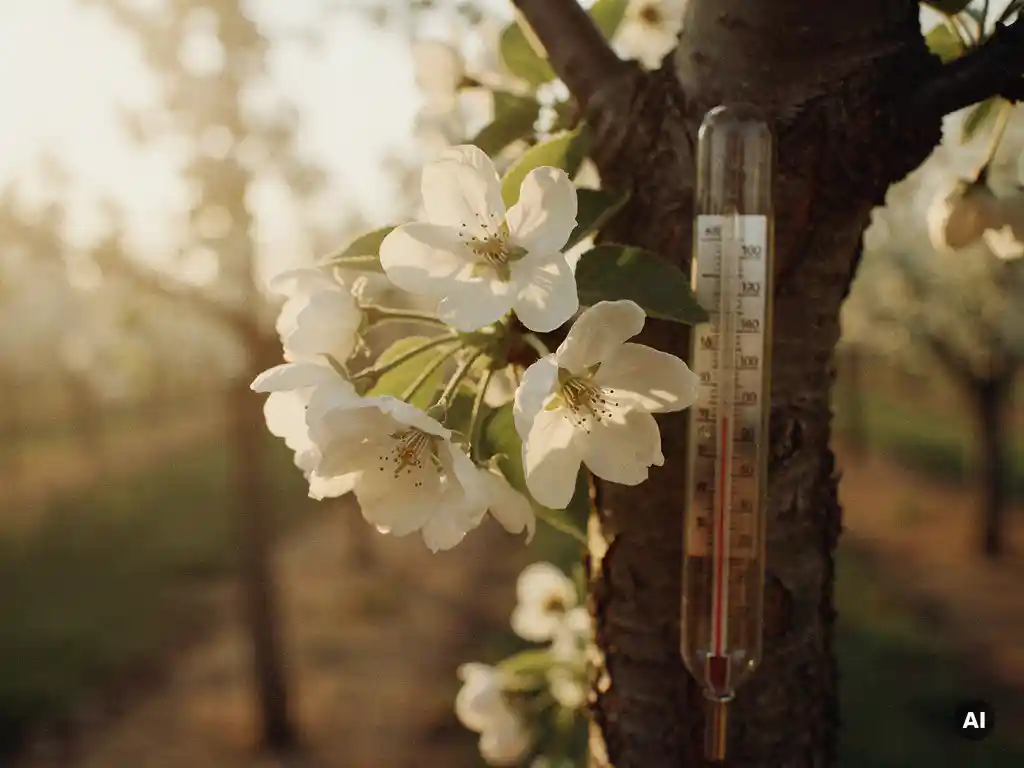
Heat significantly reduces pear bloom success by damaging pollen viability, shortening the effective pollination window, and disrupting the activity of pollinating insects. Even brief exposure to temperatures above 25-28°C during flowering can compromise fruit set, making heat one of the most critical environmental risks growers face at this stage. The questions below unpack exactly how this happens and what growers and breeders can do about it.
If you want to discuss heat resilience in pear varieties or explore breeding options suited to your growing region, feel free to get in touch with us directly.
How does heat stress affect pear pollination success?
Heat stress during pear bloom reduces pollination success by impairing pollen germination, shortening stigma receptivity, and discouraging pollinator activity. When temperatures climb above the optimal range for flowering, the biological processes that enable fertilisation become unreliable, leading to poor fruit set and uneven crop loads even when flowers appear healthy.
Pollen viability is particularly sensitive to high temperatures. Heat causes proteins within pollen grains to denature, reducing their ability to germinate on the stigma and grow a pollen tube down to the ovule. A pollen tube that fails to reach the ovule in time means no fertilisation occurs, regardless of how many flowers open.
Stigma receptivity also shortens under heat. Under cool, favourable conditions, a pear flower’s stigma remains receptive for several days. High temperatures compress that window dramatically, sometimes to less than a day, leaving far less time for successful pollen transfer. When bees and other pollinators are also less active during the hottest parts of the day, the combination creates a particularly difficult set of conditions for reliable fruit set.
What temperatures are too high for pear blossom development?
Pear blossom development is generally considered at risk when daytime temperatures exceed 25°C and significantly compromised above 28-30°C during the bloom period. Temperatures in this range accelerate flower development to the point where the window for effective pollination shortens, and the reproductive tissues themselves begin to suffer heat-related damage.
Night temperatures matter too. Warm nights prevent the cooling that pear flowers need to maintain cellular integrity. A pattern of warm days followed by warm nights gives the plant no recovery period, compounding stress on developing floral tissue and reducing the energy available for pollen tube growth and fertilisation.
It is worth noting that the threshold is not a hard cutoff. Humidity, wind, and the duration of heat exposure all influence how damaging a given temperature is. A single afternoon spike above 28°C may cause limited harm, while several consecutive days above 25°C can substantially reduce the final crop. Growers should monitor cumulative heat exposure across the full bloom period rather than reacting to individual temperature readings.
Why does timing of heat exposure matter during pear bloom?
The timing of heat exposure during pear bloom is critical because different stages of flower development have different sensitivities to high temperatures. Heat that arrives at balloon stage, full bloom, or petal fall each carries distinct risks, and damage at the wrong moment can eliminate an entire crop regardless of otherwise favourable conditions.
At balloon stage, before flowers open, heat can accelerate development and push bloom to open unevenly or prematurely. This creates an asynchronous flowering pattern that complicates pollination, particularly when polliniser varieties are out of sync with the main variety.
At full bloom, heat directly targets the most vulnerable reproductive structures. The stigma, style, and pollen are all exposed, and this is the period when high temperatures cause the most measurable reduction in fertilisation rates. Even a short heat event of two to three days during peak bloom can have a disproportionate effect on final fruit set.
After petal fall, heat stress becomes less damaging to pollination itself but can still affect early fruit development and cause young fruitlets to drop. Understanding which stage is being affected helps growers and breeders prioritise which heat events to mitigate most urgently.
How does climate change affect pear bloom heat risks?
Climate change is increasing the frequency and intensity of heat events during the pear bloom period, making heat stress at flowering a growing concern for orchards across traditional and emerging pear-growing regions. Earlier springs combined with more unpredictable late-season warm spells mean that bloom timing and heat risk are increasingly difficult to manage with conventional approaches.
In many European and temperate pear-growing regions, average spring temperatures have shifted enough to push bloom dates earlier by one to two weeks over recent decades. Earlier bloom does not necessarily mean safer bloom. In fact, earlier flowering can expose pear blossoms to a wider range of unpredictable weather, including both late frosts and unseasonably warm periods.
The compounding effect is significant. Heat events that once occurred after bloom now increasingly overlap with it. At the same time, pollinators are also affected by temperature extremes, and their activity patterns are shifting in ways that do not always align with earlier bloom windows. For growers, this means the margin for error at bloom time is narrowing, and planning for heat risk needs to be built into variety selection and orchard management rather than treated as an occasional exception.
What role does variety selection play in heat resilience at bloom?
Variety selection is one of the most effective long-term strategies for managing heat stress at pear bloom. Varieties differ meaningfully in their pollen viability under heat, stigma longevity, and the duration of their bloom window, and choosing varieties bred or selected for heat resilience can substantially reduce crop losses in warmer growing conditions.
Not all pear varieties respond to heat in the same way. Some varieties maintain higher pollen germination rates at elevated temperatures, giving them a natural advantage in regions where heat events during bloom are common. Others have a more compressed bloom window, which can be a disadvantage when heat arrives, but may also mean they are less exposed if the heat event is brief and they bloom outside its peak.
At Better3Fruit, variety development takes climate resilience seriously as a long-term breeding goal. Our apple and pear breeding programme evaluates new selections across a wide range of environmental conditions, with disease and pest tolerance alongside agronomic performance and fruit quality. As heat stress at bloom becomes a more consistent challenge, tolerance to high-temperature conditions during flowering is an increasingly important trait in how we assess and advance new pear varieties. Growers looking for varieties suited to warmer or more variable spring climates can explore our current variety portfolio as a starting point for discussion.
Matching the right variety to the right growing environment has always been central to successful orchard management, and as climate conditions evolve, the importance of that match at bloom time will only grow. Contact us to discuss which pear varieties may be best suited to your region’s heat conditions and long-term climate outlook.
This content was generated with the help of AI and it may contain mistakes