
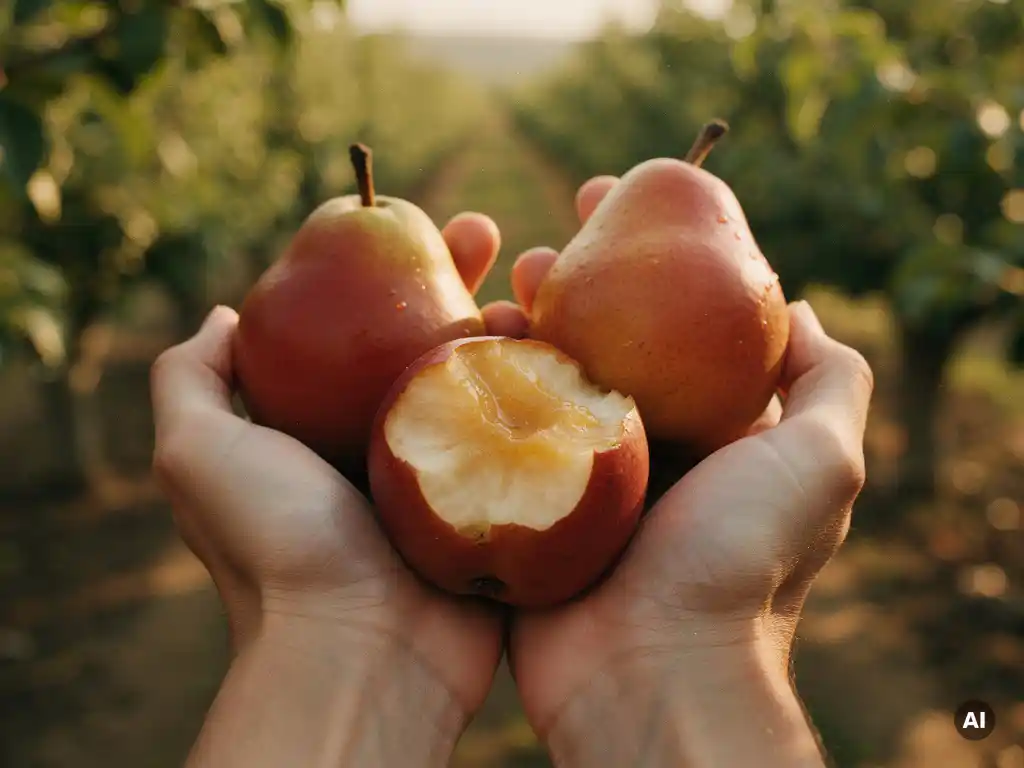
The pear varieties easiest to eat without a knife are those with thin, tender skin and a firm-yet-juicy flesh that holds together when bitten into. Varieties like Comice, Forelle, and Asian pears top the list for fresh eating, as their skin rarely requires peeling and their texture makes clean bites straightforward. If you want to explore the full range of pear varieties bred for fresh eating and snacking, get in touch with us and we will be happy to point you in the right direction. Below, we answer the most common questions about snacking pears so you can find the perfect match for your needs.
What makes a pear easy to eat without a knife?
A pear is easy to eat without a knife when it combines thin, smooth skin with a soft, cohesive flesh that does not turn grainy or fibrous as it ripens. The key factors are skin thickness, flesh texture, and the size of stone cells (also called grit cells) within the fruit. Varieties with minimal grit, fine-grained flesh, and skin that softens fully at peak ripeness require no peeling and no cutting to enjoy.
Skin texture is arguably the most important factor. Thick or tough skin creates resistance when biting in, making a knife feel necessary even if the flesh underneath is perfectly ripe. Varieties bred for fresh consumption tend to have thinner, more pliable skin that becomes almost imperceptible when the fruit reaches maturity.
Flesh consistency matters just as much. A pear that turns mushy when ripe loses structural integrity and becomes messy to eat out of hand. The ideal snacking pear holds its shape when bitten, releases juice without dripping excessively, and has flesh that is neither crunchy-hard nor falling apart. Breeding programs like ours increasingly focus on exactly these traits when developing new varieties for the fresh market.
Which pear varieties have the most tender, edible skin?
The pear varieties with the most tender, edible skin include Comice, Forelle, and Starkrimson. These European-type pears develop very thin, smooth skin at maturity that is easy to bite through without any resistance. Asian pear varieties also rank highly for edible skin, though their texture differs from European types. In general, varieties with russeted or thick-skinned profiles are harder to eat without peeling.
Comice is widely regarded as one of the finest dessert pears precisely because its skin becomes so delicate at full ripeness. Forelle, with its distinctive red speckles, has a similarly fine skin and a compact size that makes it naturally hand-friendly. Starkrimson offers a vivid red skin that softens beautifully and is fully edible without any preparation.
Russet-skinned varieties, such as Conference when it develops heavy russeting, can feel rougher on the palate even when the flesh is ripe. While still edible, these are less pleasant to eat without peeling compared to smooth-skinned cultivars. When evaluating pear varieties for fresh snacking, smooth skin is one of the first traits to look for.
Are smaller pear varieties better for snacking on the go?
Yes, smaller pear varieties are generally better for snacking on the go. A smaller fruit fits comfortably in one hand, requires no cutting or portioning, and is easy to eat in a single sitting without waste. Varieties like Forelle and Seckel are naturally compact and well-suited to lunchboxes, school bags, or desk snacking. Size alone does not determine snacking quality, but it is a practical advantage for convenience eating.
Beyond portability, smaller pears tend to ripen more evenly throughout the fruit. In a large pear, the flesh near the core may still be firm while the outer layers are already soft, making it harder to judge the right moment to eat. Smaller varieties are more consistent from skin to core, which means a better eating experience without needing to cut and check.
For families with young children, smaller pears are particularly useful. They are easier for small hands to hold, less likely to be dropped, and can be finished in a few bites. This makes compact varieties an especially good choice when looking for pear varieties for kids that require no preparation.
How ripe does a pear need to be to eat without a knife?
A pear needs to be fully ripe to eat comfortably without a knife. At full ripeness, the skin softens enough to bite through cleanly, the flesh yields without requiring force, and the flavor is at its peak. The standard test is gentle thumb pressure near the stem: when the flesh gives slightly under light pressure, the pear is ready to eat. An underripe pear will have tough skin and dense flesh that makes knife-free eating difficult and less enjoyable.
Unlike many other fruits, pears ripen from the inside out, which means the flesh at the core becomes soft before the exterior shows visible signs of ripeness. Relying on color alone can be misleading. A pear that looks firm and green may already be perfectly ripe inside, while one that looks yellow may have passed its peak. The thumb-pressure test near the stem end is the most reliable method.
Temperature also plays a role. Pears stored in the refrigerator slow their ripening significantly. For best results, bring pears to room temperature for one to three days before eating. Once ripe, they can be returned to the fridge for a day or two to extend their window, but eating them at room temperature gives the best skin texture and flavor for a truly knife-free experience.
What’s the difference between European and Asian pear varieties for snacking?
The key difference between European and Asian pear varieties for snacking is texture and ripening behavior. European pears (such as Comice or Conference) are harvested firm and ripen off the tree to a soft, buttery flesh. Asian pears (such as Nashi or Hosui) are crisp and juicy when eaten fresh, more similar in texture to an apple, and do not soften in the same way. Both types can be eaten without a knife, but they offer a very different snacking experience.
European pears for fresh eating
European pears develop their best flavor and texture after a period of post-harvest ripening. When fully ripe, the flesh is smooth, melting, and intensely sweet, with skin that softens to the point of being barely noticeable. This makes them excellent for fresh eating once they have reached peak ripeness, though the window can be short. The best pear for eating fresh in the European category tends to be one that has been allowed to ripen fully at room temperature before consumption.
Asian pears for snacking
Asian pears are ready to eat straight from the tree or shop shelf without any ripening period. Their crisp, grainy-yet-juicy flesh holds up well and does not turn mushy, making them more forgiving in terms of timing. The skin of Asian pears is typically slightly thicker than that of European types but is still fully edible. Their firm texture makes them particularly appealing as snacking pears for people who prefer a crunch similar to an apple, and they are especially popular with children for this reason.
Choosing between the two types comes down to personal preference. If you prefer a soft, indulgent texture with a short eating window, European varieties are the answer. If you want convenience, durability, and a crisp bite without any preparation, Asian pears deliver consistently. We work with both types in our breeding program, always keeping fresh-eating quality and skin texture at the center of our selection criteria.
Finding the right pear variety for your needs, whether for snacking, retail, or growing, starts with understanding what traits matter most for your situation. Contact us to discuss which varieties from our portfolio might be the best fit for you.
This content was generated with the help of AI and it may contain mistakes