
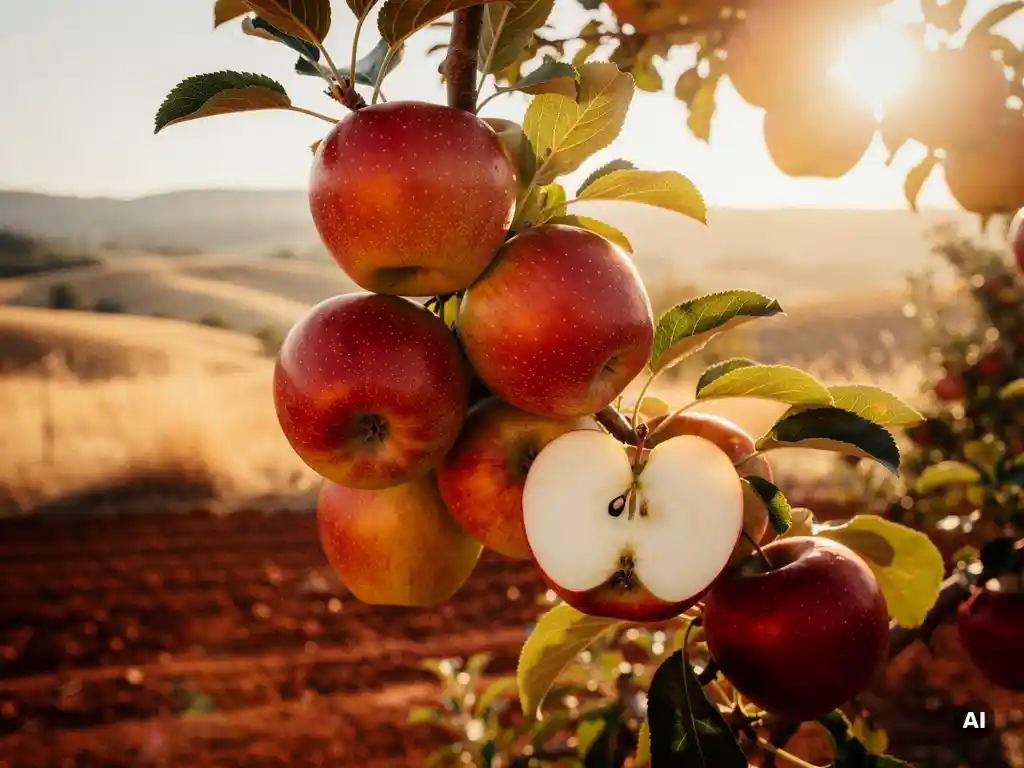
Several apple varieties are specifically developed for warm regions, including low-chill cultivars that require fewer cold winter hours and heat-tolerant varieties bred to set fruit and maintain quality under high summer temperatures. The right choice depends on your specific climate, chilling hours available, and the market you are targeting. Below, we answer the most common questions about apple cultivation in warm weather conditions, and if you want to explore licensing opportunities or variety advice, feel free to get in touch with us.
What makes an apple variety suitable for warm climates?
An apple variety is suitable for warm climates when it can complete its dormancy cycle with fewer chilling hours, set fruit reliably under high temperatures, and maintain acceptable fruit quality without the cold winters that most traditional varieties require. Two traits are especially critical: a low chilling requirement and strong heat tolerance during the growing season.
Most apple varieties were developed in temperate regions where winters are cold enough to provide 800 to 1,200 chilling hours, the cumulative time below around 7°C that triggers dormancy and prepares the tree for spring flowering. In warm regions, that threshold is rarely met. Varieties bred for these environments are selected to break dormancy and flower consistently even when chilling hours fall well below 400.
Beyond dormancy, heat tolerance during fruit development matters enormously. High temperatures at the wrong stage can cause poor colour development, sunburn, reduced firmness, and off-flavours. Apple breeding programs targeting warm regions therefore evaluate varieties across multiple seasons in hot conditions, selecting only those that consistently deliver acceptable fruit quality despite the heat stress.
Which apple varieties are bred to thrive in hot conditions?
Apple varieties bred for hot conditions include low-chill cultivars such as Anna, Dorsett Golden, and Tropic Sweet, which were developed specifically for subtropical and warm-temperate climates. More recently, breeding programs have focused on combining low chilling requirements with improved taste, texture, and disease tolerance to meet modern market standards.
Traditional low-chill varieties like Anna and Dorsett Golden have been grown successfully in regions such as Florida, parts of the Middle East, and warm areas of South Africa and South America for decades. They perform well in terms of fruiting but often fall short on flavour complexity and shelf life compared to premium cultivars.
This is where modern apple breeding programs, including our work at Better3Fruit, are pushing the boundaries. Rather than simply selecting for low chilling requirements, we evaluate varieties for the full package: taste, texture, colour, disease resistance, and grower yield, all under realistic warm-climate growing conditions. The goal is to bring premium-quality apples to regions that have historically had to settle for second-tier cultivars.
How does climate change affect apple variety development?
Climate change is reshaping apple variety development by making warm-climate traits relevant far beyond traditional hot regions. As winters become milder and summers hotter across established apple-growing areas in Europe, North America, and beyond, breeders are under increasing pressure to develop varieties that perform well with reduced chilling and greater heat stress.
Regions that previously had reliable chilling hours are now seeing year-to-year variability that disrupts flowering and fruit set in standard varieties. This unpredictability is driving demand for cultivars with broader climatic adaptability, varieties that can cope whether a winter delivers 600 chilling hours or 300.
At Better3Fruit, climate resilience is one of our primary long-term breeding goals. With over 30,000 new varieties under evaluation at any time, we are actively selecting for traits that will matter in a warmer world: consistent dormancy break across variable winters, heat tolerance during cell division and fruit development, and resistance to pests and diseases that spread more aggressively in warmer conditions. Apple breeding for warm climates is no longer a niche concern, it is becoming central to the future of the entire industry.
What’s the difference between low-chill and heat-tolerant apple varieties?
Low-chill apple varieties are defined by their reduced requirement for cold winter temperatures to complete dormancy, while heat-tolerant apple varieties are defined by their ability to develop and ripen fruit well under high summer temperatures. These are related but distinct traits, a variety can have one without the other, though the best warm-climate cultivars combine both.
A low-chill variety solves the winter problem: it will flower and set fruit even when cold accumulation is limited. But if that same variety cannot handle intense summer heat, fruit quality will still suffer. Conversely, a variety might tolerate summer heat well but still require 900 chilling hours to break dormancy reliably, making it unsuitable for warm regions regardless of its summer performance.
For growers in genuinely warm climates, both traits need to be present. The most commercially viable warm-region apple varieties are those that combine a chilling requirement below 400 to 500 hours with demonstrated fruit quality under sustained summer heat. This combination is what modern breeding programs target, moving beyond the simple low-chill selections of earlier decades toward varieties that can compete on quality in premium markets.
Can club apple varieties be grown in warm regions?
Yes, club apple varieties can be grown in warm regions, provided the variety’s chilling requirement and heat tolerance match the local climate. The key factor is not whether a variety is a club variety, but whether its underlying genetics are suited to warm-weather apple cultivation.
Club varieties are managed through licensed growing programs that control supply, quality standards, and branding. This structure does not inherently limit them to cool climates, it simply means that warm-region growers need to secure a license and meet the quality benchmarks set for that variety. If the variety performs well in warm conditions, there is no structural reason it cannot be part of a club program in those regions.
Our apple and pear varieties at Better3Fruit are licensed worldwide with no preferred partners, meaning growers in warm regions have the same opportunity to obtain a license as anyone else. Varieties like Kanzi® and the fast-emerging Morgana® and Giga® are part of coordinated international programs, and as our breeding work increasingly targets climate resilience, warm-region suitability will become a more prominent part of how we develop and position new club cultivars going forward.
Warm-region apple growing is a genuine and growing opportunity, one that modern breeding is making increasingly viable at a premium quality level. Whether you are a grower exploring new cultivars, a commercial partner looking to develop a market, or simply curious about what is possible in your climate, we are happy to help. Contact us to discuss variety options and licensing opportunities for your region.
This content was generated with the help of AI and it may contain mistakes