
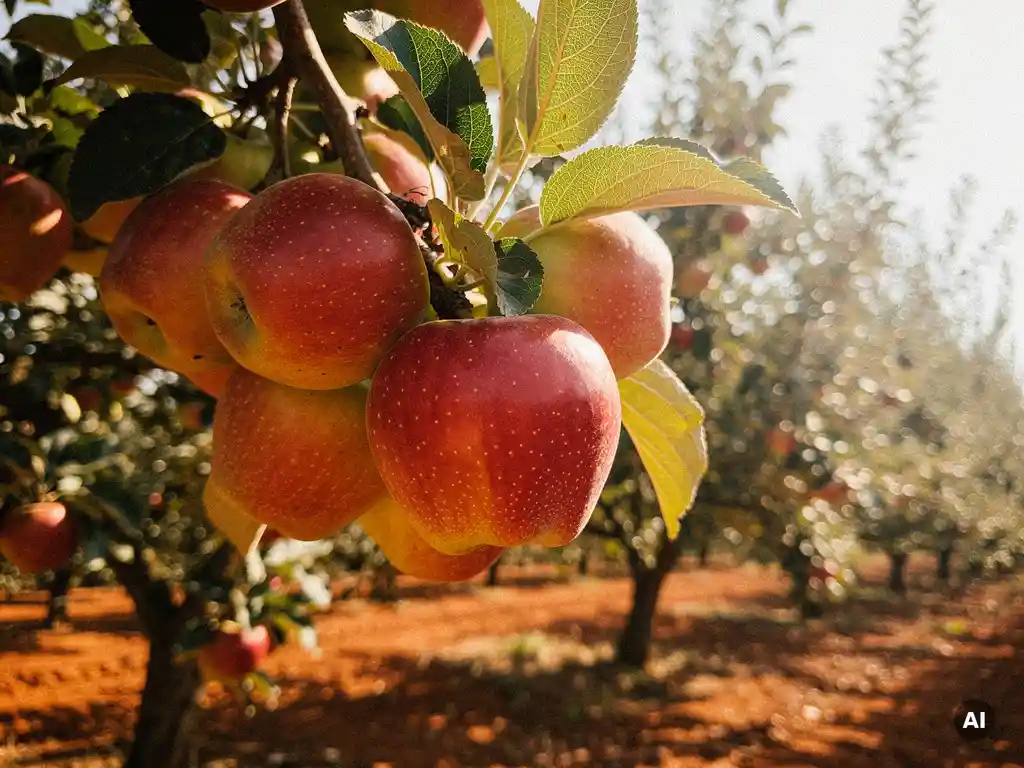
Several apple varieties are licensed for warm climates, including heat-tolerant cultivars bred specifically for low-chill environments where traditional apple growing is challenging. Licensing makes these varieties available to growers, nurseries, and commercial partners worldwide through structured agreements that protect intellectual property while enabling coordinated market development. If you want to explore licensing options directly, feel free to get in touch with us; we are happy to help you find the right fit for your region and growing conditions. Below, we answer the most common questions about apple varieties suited to warm climates and how licensing works.
What makes an apple variety suitable for warm climates?
An apple variety is suitable for warm climates when it requires fewer winter chill hours to break dormancy, tolerates higher summer temperatures without sunburn or flavor loss, and maintains consistent fruit quality in conditions where traditional high-chill varieties would fail to set fruit or ripen properly.
Most conventional apple varieties were developed for temperate zones with cold winters, meaning they need a certain number of hours below a threshold temperature to complete dormancy and flower successfully in spring. In warm or subtropical regions, winters are too mild to meet this requirement, leaving standard varieties unable to produce a reliable crop. Varieties bred for warm climates solve this by having a low chill requirement, sometimes fewer than 300 hours, while still delivering the taste, texture, and appearance that consumers expect.
Beyond chill hours, heat tolerance during the growing season matters enormously. Varieties that perform well in warm climates tend to have thicker cuticles, better resistance to sunscald, and flavor profiles that hold up under warmer ripening conditions. Pest and disease pressure also shifts in warmer environments, so built-in disease tolerance becomes a significant breeding priority for these regions.
Which apple varieties are bred for low-chill environments?
Apple varieties bred for low-chill environments are cultivars specifically selected or developed to complete dormancy with fewer cold hours than standard varieties require. These include both heritage low-chill selections and newer purpose-bred cultivars developed through modern breeding programs targeting warm-region growers.
Traditional low-chill varieties such as Anna and Dorsett Golden were among the earliest options available to growers in warm regions, but they were not bred with today’s commercial market standards in mind. Flavor complexity, shelf life, and visual appeal were often secondary to simply achieving fruit set in a warm climate.
Modern apple breeding programs, including our work at Better3Fruit, apply molecular marker technology to accelerate the development of new cultivars that combine low chill requirements with commercially competitive traits. This means growers in warm regions no longer have to choose between a variety that grows reliably and one that tastes exceptional. The goal is to bring all required traits together in a single cultivar: heat adaptability, strong flavor, attractive appearance, and grower-friendly yield. You can explore our current portfolio of cultivars on our varieties page.
How does apple variety licensing work for growers in warm regions?
Apple variety licensing for growers in warm regions works through agreements between the variety rights holder and licensed nurseries, growers, or commercial partners. These agreements grant the right to propagate and grow a protected variety in exchange for royalty payments, and they typically include quality standards and supply coordination requirements.
For growers in warm climates, the licensing process usually begins with identifying which varieties are approved for their region and which licensed nurseries supply propagation material locally. Because many newer heat-tolerant cultivars are protected by plant breeders’ rights or patents, growers cannot legally propagate them without a valid license.
At Better3Fruit, we license our varieties to partners worldwide with no geographic preference built into our structure. Any grower or nursery, anywhere in the world, can apply for a license for a Better3Fruit variety. Our independence as a privately funded company means we have no prior commitments to preferred partners, which makes the licensing process genuinely open and accessible. Royalties flow back into further breeding investment, ensuring that the varieties available to warm-climate growers continue to improve over time.
What’s the difference between open and club apple variety licenses?
An open apple variety license allows any qualified grower or nursery to access the variety with no volume cap or exclusivity restrictions, while a club apple variety license limits production to a defined group of growers, often within a specific region or marketing organization, to control supply, quality, and brand identity.
Club varieties are managed strategically to build a strong consumer brand. By restricting who can grow a variety and how much they can produce, the license holder ensures that fruit reaching the market consistently meets quality standards and that supply does not outpace demand. This protects the value of the brand for all licensed growers in the club. Kanzi®, one of our most successful commercial releases, is an example of a variety managed through a coordinated club structure that has built significant global brand recognition over the past two decades.
Open licenses, by contrast, offer broader access and are better suited to varieties where wide distribution and volume are the primary goals rather than premium brand positioning. The right licensing model depends on the variety’s market positioning, the target consumer, and the commercial strategy of the variety holder. We carefully evaluate which model fits each variety we release, selecting the approach that gives growers the best commercial opportunity while maintaining the quality that consumers expect.
Which warm-climate regions are seeing the most apple variety development?
The warm-climate regions seeing the most apple variety development in 2026 are parts of South America, South Africa, the Middle East, South and Southeast Asia, and Australia’s warmer growing zones. These regions combine growing consumer demand for fresh apples with climatic conditions that make traditional variety cultivation difficult or impossible.
South America, particularly Brazil and parts of Argentina, has invested significantly in low-chill apple production, with both commercial growers and breeding programs targeting the subtropical zones where standard varieties cannot perform. South Africa’s diverse climate includes warm-region pockets where low-chill cultivars are gaining traction alongside its established temperate apple industry.
In Asia, countries such as India, China’s southern provinces, and several Southeast Asian nations represent enormous emerging markets for fresh apples. Local production of heat-adapted varieties reduces dependence on costly imports and opens opportunities for growers who previously had no commercially viable apple cultivar available to them. The Middle East presents similar dynamics, with strong import demand and a growing interest in local production where water and heat management allow it.
Breeding programs focused on these regions are prioritizing not just chill hour reduction but also climate resilience more broadly, developing varieties that handle irregular rainfall, higher UV exposure, and shifting seasonal patterns. This is central to our long-term breeding strategy at Better3Fruit, where climate resilience and multi-level sustainability are primary goals guiding which traits we select for in each new generation of cultivars.
Finding the right licensed apple variety for a warm climate is a decision that shapes years of orchard investment, so it is worth getting it right from the start. Whether you are a grower exploring low-chill options, a nursery looking to expand your portfolio, or a commercial partner seeking a variety suited to a specific warm-region market, we are ready to help. Contact us to discuss your situation and discover which Better3Fruit varieties are available for licensing in your region.
This content was generated with the help of AI and it may contain mistakes