
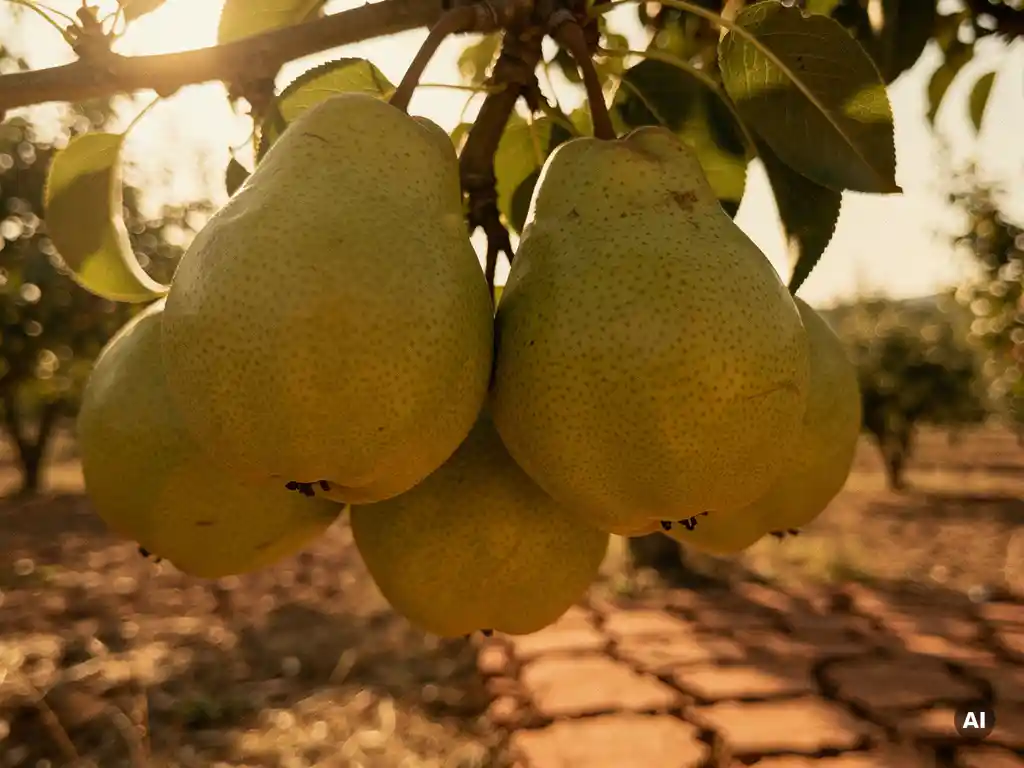
Low-chill pear varieties are cultivars bred to complete their dormancy cycle with fewer cold hours than traditional pears require. Standard pear trees typically need between 800 and 1,200 chill hours, measured as hours below around 7°C, to flower and fruit reliably. Low-chill pears are developed specifically for regions where winters are mild and those cold hours simply never accumulate. Below, we answer the most common questions growers and enthusiasts have about these varieties, from where they thrive to how they taste. If you want to know whether a low-chill variety suits your growing region, feel free to get in touch with us and we will be happy to help.
Where do low-chill pear varieties actually grow best?
Low-chill pear varieties grow best in subtropical and warm-temperate climates where winter temperatures rarely drop below 10°C for extended periods. This includes regions such as coastal areas of the Mediterranean, parts of South Africa, southern Australia, California’s Central Valley, the Middle East, and large parts of South and Southeast Asia. These are precisely the environments where traditional European pear varieties struggle to perform.
In these warm-climate zones, conventional pear trees either fail to break dormancy properly or produce erratic, low-quality crops because they cannot accumulate the chill hours their genetics demand. Low-chill pear varieties sidestep this limitation entirely. They are also increasingly relevant in regions that historically had sufficiently cold winters but are experiencing warmer seasons due to shifting climate patterns, making pear varieties for warm climates a growing priority in modern breeding programs.
How do chill hours affect pear tree flowering and fruiting?
Chill hours act as a biological trigger that tells a pear tree winter has passed and it is safe to flower. Without enough accumulated cold, the tree’s dormancy remains incomplete, leading to delayed, uneven, or absent flowering. Poor fruit set, reduced yields, and lower fruit quality are the direct consequences when a pear tree does not receive its required chill hours.
The mechanism works through the accumulation of cold temperatures over the winter months. As the tree registers hours below a threshold temperature, internal hormonal changes gradually release the growth inhibitors that keep buds dormant. When that threshold total is met, the tree breaks dormancy in a coordinated, healthy way. A tree that falls short of its chill requirement may push out leaves and flowers at different times across the canopy, weakening pollination and stressing the tree’s energy reserves. For low-chill pear varieties, this threshold is genetically set much lower, allowing the tree to complete dormancy even in a mild winter.
What traits define a low-chill pear variety?
A low-chill pear variety is defined primarily by its chilling requirement, typically below 400 to 500 hours, but several other traits are equally important for commercial and home-growing success. The most useful low-chill pears combine a low dormancy threshold with reliable fruit set in warm conditions, heat tolerance during the growing season, and resistance to diseases that are more prevalent in humid, warm climates.
Beyond the chilling requirement itself, growers and breeders look for:
- Consistent flowering timing that aligns with available pollinators in warm-climate growing seasons
- Heat tolerance so that fruit development is not disrupted by high summer temperatures
- Disease resistance, particularly to fire blight and fungal conditions that intensify in warm, humid environments
- Acceptable fruit size and appearance that meets market standards
- Flavour and texture that hold up even when grown without the cold-induced sugaring that traditional pears rely on
The balance of these traits is what separates a genuinely useful low-chill cultivar from one that simply survives in a warm climate without producing commercially or culinarily worthwhile fruit.
How are low-chill pear varieties developed through breeding?
Low-chill pear varieties are developed through targeted cross-breeding programmes that select for reduced chilling requirements across successive generations. Breeders identify parent varieties that already show lower chill requirements or strong performance in mild winters, then cross them to combine those genetics with desirable fruit quality, yield, and disease resistance traits.
Modern pear breeding for warm regions has become significantly more efficient through the use of molecular markers. Rather than waiting years for a seedling to mature and then testing its chill performance in the field, breeders can now screen young plants at the genetic level to identify which individuals carry the markers associated with low chilling requirements. This accelerates the selection process considerably and reduces the cost of evaluating thousands of seedlings.
At Better3Fruit, we apply exactly this approach across our apple and pear breeding programmes. We work with large populations, tens of thousands of new seedlings evaluated each year, and use molecular tools to focus field resources on the most promising candidates. Pear breeding for warm regions is a long-term investment, but modern tools make it possible to bring genuinely superior varieties to market faster than traditional methods allowed. You can explore the varieties we have developed through our variety portfolio.
What challenges do growers face with low-chill pear cultivation?
Growers cultivating low-chill pears in warm climates face a distinct set of challenges compared to traditional pear production. The most significant is managing inconsistent dormancy break in years when winter temperatures are slightly cooler than usual, which can cause the tree to behave unpredictably and flower at suboptimal times.
Other common challenges include:
- Pest and disease pressure that is generally higher in warm, humid climates, requiring more active orchard management
- Pollination logistics, since flowering timing in warm climates may not align well with local pollinator activity or compatible pollinizer varieties
- Fruit quality consistency, as the absence of cold stress during development can affect sugar accumulation, texture, and skin finish
- Market access and consumer familiarity, since low-chill pear varieties are often less well known than established European cultivars, requiring grower effort to build demand
- Limited variety choice, as the range of commercially proven low-chill pear cultivars remains narrower than for apples or traditional pear varieties
Many of these challenges are being addressed through ongoing breeding work and better agronomic guidance tailored to warm-climate production systems. As the availability of purpose-bred low-chill pears improves, growers in warm regions will have more robust options to work with.
Are low-chill pears different in taste and texture from standard pears?
Low-chill pears can taste and feel different from standard European pears, though the gap has narrowed significantly as breeding has improved. Traditional pears like Conference or Comice develop much of their sweetness and characteristic buttery texture through cold-induced processes during dormancy and fruit maturation. In warm climates, without those cold triggers, early low-chill cultivars often produced fruit that was grittier, less sweet, or had a shorter shelf life.
Modern low-chill varieties developed through rigorous breeding programmes have addressed many of these shortcomings. Breeders now select specifically for flavour compounds, texture, and post-harvest performance in warm-climate conditions, rather than simply selecting for survival in mild winters. The result is that newer low-chill cultivars can deliver genuinely enjoyable eating experiences, even if their flavour profile differs somewhat from that of the classic European pear.
Growers and consumers should approach low-chill pears with an open mind about variety. Some will suit fresh eating, others will perform better for processing or cooking. The key is matching the right cultivar to the right end use, which is something that good variety development and grower guidance can make much easier.
As climate patterns continue to shift and demand grows for fruit production in warmer regions, low-chill pear varieties will become an increasingly important part of the global horticultural landscape. Whether you are a grower exploring new options, a breeder looking for collaboration, or a licensing partner interested in emerging cultivars, we would be glad to discuss what we are working on. Get in touch with us to start the conversation.
This content was generated with the help of AI and it may contain mistakes