
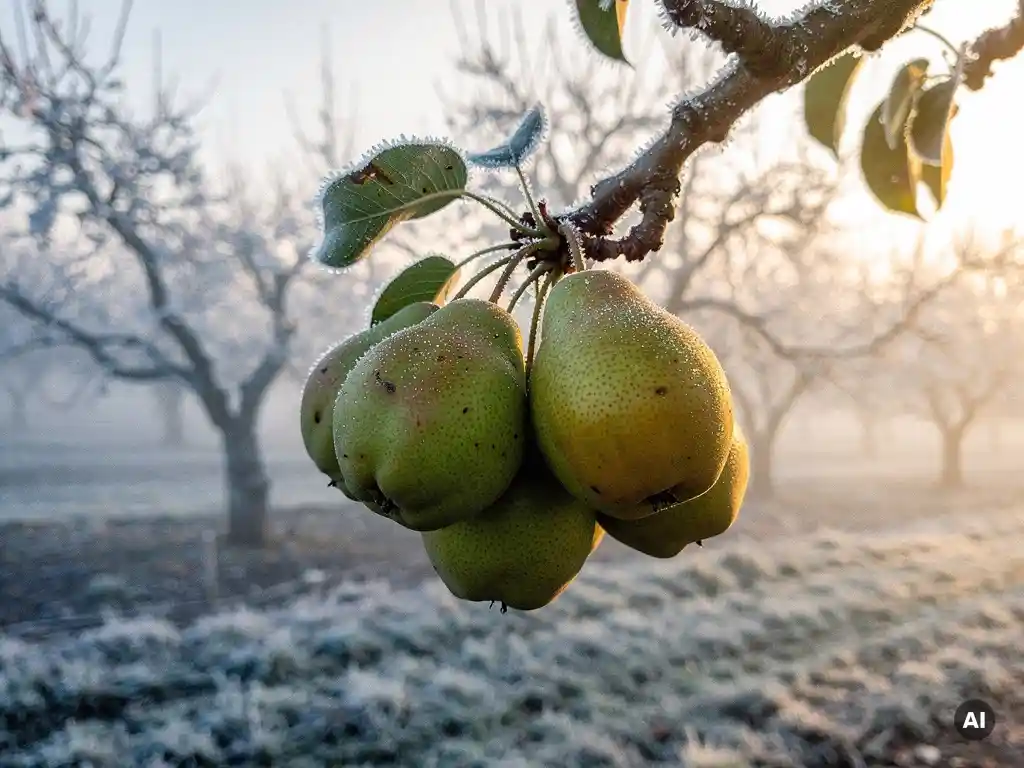
Chill units directly affect pear production by regulating when trees break dormancy and begin flowering. Without sufficient chilling, pear trees struggle to flower uniformly, resulting in poor fruit set, reduced yields, and lower fruit quality. The relationship between chill accumulation and crop performance is one of the most critical factors in pear cultivation, and it is becoming increasingly important as growing seasons shift. Below, we unpack the key questions growers and breeders are asking about chill units and pear production. If you want to explore how breeding can help address chilling challenges, feel free to get in touch with us.
How do chill units affect pear tree dormancy?
Chill units affect pear tree dormancy by acting as a biological signal that tells the tree winter has passed and it is safe to resume growth. Pear trees enter a rest phase in autumn to protect themselves from frost. Only after accumulating enough cold exposure, measured in chill units or chill hours, will they exit dormancy and flower reliably in spring.
During dormancy, a pear tree undergoes internal physiological changes that prepare it for the coming growing season. Chilling temperatures, typically between 0°C and 7°C, trigger the breakdown of dormancy-maintaining compounds within the buds. Once the tree has met its chilling requirement, warming spring temperatures activate bud break and flowering. If the process is interrupted or incomplete, the timing and uniformity of flowering are compromised, which directly affects how much fruit a tree can set and carry to harvest.
What are the chill unit requirements for common pear varieties?
Common pear varieties generally require between 800 and 1,500 chill hours to break dormancy fully, though requirements vary considerably by cultivar. European pear varieties such as Conference and Doyenné du Comice tend to sit at the higher end of this range, while some Asian pear types have lower chilling needs. Understanding the specific requirements of each variety is essential for matching cultivars to growing regions.
The distinction between chill hours and chill units is worth noting. Chill hours simply count the number of hours below a set temperature threshold, while chill unit models such as the Utah Model or the Dynamic Model assign weighted values to different temperature ranges, offering a more precise picture of effective chilling. Growers in marginal climates benefit from using these more sophisticated models to plan variety selection and management decisions with greater accuracy.
What happens to pear production when chill units are insufficient?
When pear trees do not accumulate enough chill units, the consequences for production are significant. Insufficient chilling leads to delayed and uneven bud break, sparse flowering, and poor fruit set. Trees may produce fewer flowers overall, and those that do open often do so at different times, making effective pollination difficult and reducing the final crop load substantially.
Beyond yield losses, fruit quality also suffers when chilling is inadequate. Fruit that does develop may be smaller, misshapen, or have inferior texture and flavor. In severe cases of chilling deficit, trees can show signs of physiological stress such as tip dieback or prolonged foliation delay. For commercial growers, these outcomes translate directly into financial losses and supply chain disruptions, making chilling accumulation a high-stakes variable in orchard management.
How does climate change threaten pear chilling accumulation?
Climate change threatens pear chilling accumulation by raising winter temperatures in many traditional growing regions, reducing the number of hours that fall within the effective chilling range. As winters become milder and shorter, pear orchards in temperate zones are increasingly at risk of chronic chilling deficits, which puts the long-term viability of established varieties under pressure.
The problem is compounded by the unpredictability of seasonal patterns. Warmer autumns delay the onset of dormancy, while early spring warm spells can interrupt chilling before trees have met their requirements. Regions that have historically provided reliable chilling, including parts of Western Europe, South Africa, and the Pacific Northwest, are already recording shifts in chill accumulation trends. For pear growers, this means that varieties and management practices that worked well in previous decades may no longer be suitable for current and future conditions.
What strategies help growers manage low chill unit seasons?
Growers managing low chill unit seasons can use a combination of chemical treatments, site management, and variety selection to protect crop performance. The most widely used approach is the application of hydrogen cyanamide, a dormancy-breaking agent that compensates for insufficient chilling by stimulating uniform bud break. Mineral oils are sometimes used alongside it or as an alternative, particularly where regulatory restrictions apply.
Beyond chemical intervention, growers can take several practical steps to reduce the impact of chilling deficits:
- Select orchard sites with better cold air drainage and natural temperature inversion, which can increase effective chilling accumulation
- Use evaporative cooling systems to keep temperatures within the effective chilling range during warm winter spells
- Shift to lower-chill varieties that are better matched to the available chilling in the region
- Apply careful pruning and canopy management to improve light distribution and reduce tree stress in poor-chill years
- Monitor chill accumulation using modern weather station data and predictive models to make timely management decisions
None of these strategies fully replaces adequate natural chilling, but used together they can meaningfully reduce yield losses in difficult seasons.
How is pear breeding addressing chill unit challenges?
Pear breeding is addressing chill unit challenges by developing new varieties with reduced chilling requirements that can perform reliably in warmer growing conditions. Breeding programs focused on climate resilience aim to select cultivars that break dormancy uniformly with fewer accumulated chill units, without compromising the taste, texture, and yield that growers and consumers expect.
At Better3Fruit, we integrate climate resilience as a primary long-term goal in our pear breeding work. Using molecular markers and large-scale field evaluation, we screen thousands of new pear seedlings every year for traits including dormancy behavior, disease tolerance, and adaptability to changing climatic conditions. Our portfolio of pear varieties reflects this commitment to combining practical grower performance with the quality standards that commercial markets demand. By building climate adaptability into new cultivars from the earliest stages of selection, we aim to give growers and license partners varieties that remain productive and profitable as growing conditions continue to evolve.
Breeding for lower chilling requirements is not a simple trade-off. It demands careful balancing of dormancy behavior with flowering time, frost sensitivity, and fruit development. This is why sustained, long-term breeding programs with large populations under evaluation are essential for making meaningful progress. If you are interested in learning more about how our breeding work can support your operation, contact us to start the conversation.
This content was generated with the help of AI and it may contain mistakes