
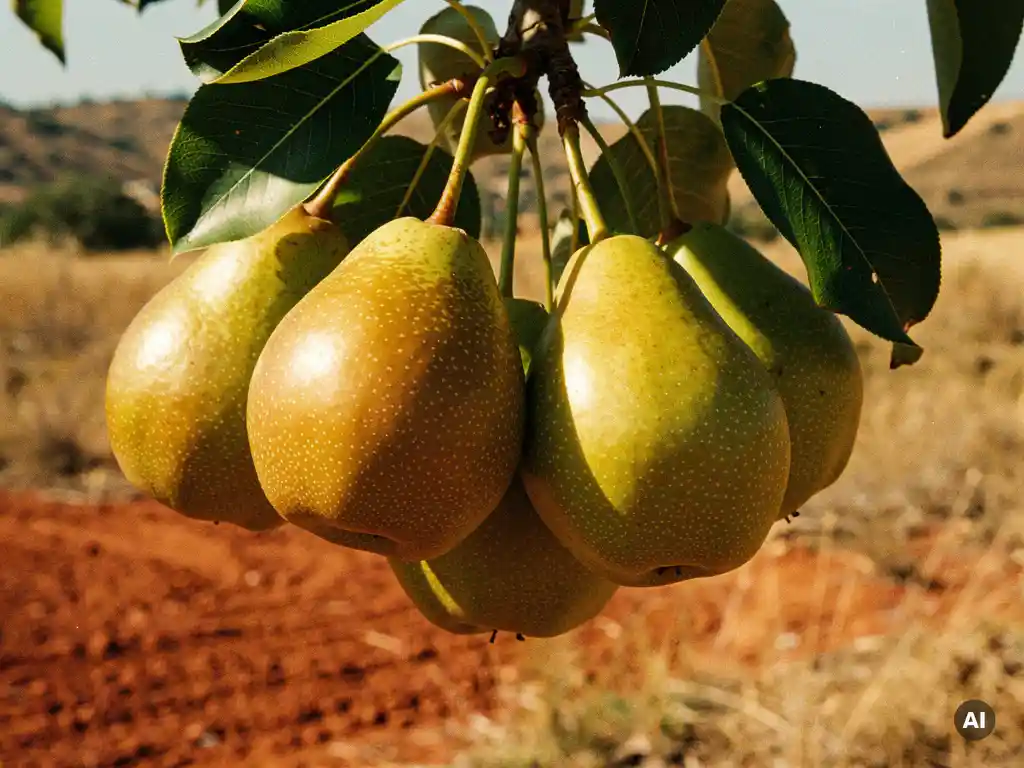
Several pear varieties have been tested in warm growing regions, including heat-tolerant selections bred for low-chill conditions, extended summer periods, and reduced water availability. These trials span regions across Southern Europe, South Africa, South America, and parts of Asia, where traditional pear cultivation has historically struggled. At Better3Fruit, we are actively working on pear breeding programs that address the specific demands of warmer climates, and if you have questions about our work, you are welcome to get in touch with us directly.
Which pear varieties perform best in hot, dry conditions?
Pear varieties that perform best in hot, dry conditions are typically low-chill cultivars or selections specifically bred for reduced winter dormancy requirements, drought tolerance, and heat resilience during fruit development. Asian pear types and certain European-Asian hybrid cultivars have shown the strongest adaptation to these environments, while new breeding lines continue to expand what is possible in warm climates.
Traditional European pear varieties such as Conference or Doyenné du Comice were developed for cool, temperate climates and require significant winter chilling hours to break dormancy and set fruit reliably. In warmer regions, these varieties often produce inconsistent crops, poor fruit set, or early defoliation. By contrast, varieties with lower chilling requirements, often below 400 hours, can complete their dormancy cycle even in mild winters and go on to produce commercially viable crops.
Asian pears, including cultivars from the Pyrus pyrifolia and Pyrus bretschneideri species, have demonstrated stronger natural adaptation to warmer conditions. Their genetic background makes them better suited to regions where winters are short and summers are long and hot. Breeding programs are increasingly crossing these genetic resources with European pear material to combine the eating quality of European pears with the climate resilience of Asian types.
What does ‘tested in warm growing regions’ mean for pear varieties?
When a pear variety is described as tested in warm growing regions, it means the variety has been grown under field trial conditions in locations where average temperatures are higher than traditional pear-growing areas, winter chilling hours are limited, and growing seasons are long and often dry. These trials evaluate whether the variety can set fruit, develop acceptable quality, and perform consistently across multiple seasons.
Variety trials in warm climates go beyond simply planting a tree and observing whether it survives. Researchers and breeders track a range of performance indicators, including fruit set percentage, fruit size, sugar content, firmness at harvest, and susceptibility to heat-related disorders such as sunburn or premature softening. A variety that performs well in a single warm season may still fail if it cannot cope with irregular chilling patterns from year to year.
For breeding companies like us, testing in warm regions is an essential part of the variety development pipeline. A cultivar that only performs well in Belgium or the Netherlands has limited global commercial potential. Demonstrating consistent performance across diverse climatic zones is what allows a variety to be licensed and grown internationally.
Why is it harder to grow pears in warm climates than apples?
Pears are harder to grow in warm climates than apples primarily because they have higher chilling requirements, are more susceptible to fire blight in humid warm conditions, and have a narrower window for optimal fruit development. Apples have been bred more extensively for climate diversity, giving growers a wider selection of warm-adapted cultivars compared to pears.
The chilling requirement is the most significant barrier. Most commercial European pear varieties need between 800 and 1,200 hours of temperatures below 7 degrees Celsius during dormancy. In regions where winters are mild, trees may not receive enough chilling, leading to delayed or uneven bud break, poor pollination, and reduced yields. Apple breeding has produced numerous low-chill cultivars over several decades, but pear breeding has lagged behind in this area.
Fire blight, caused by the bacterium Erwinia amylovora, is another critical factor. Pears are considerably more susceptible to fire blight than apples, and warm, humid springs create ideal conditions for the disease to spread rapidly. In warm growing regions where spring temperatures rise quickly after winter, fire blight pressure can devastate unprotected pear orchards in a matter of days. Breeding for fire blight resistance is therefore not just a quality goal in warm climates but a fundamental survival requirement.
Finally, pear fruit quality is highly sensitive to temperature during the development and ripening phases. Excessive heat can cause premature ripening, internal breakdown, and poor texture. Achieving the buttery, melting flesh that consumers expect from a high-quality pear is genuinely difficult when summer temperatures are consistently above 30 degrees Celsius.
What regions around the world are testing new pear varieties?
New pear varieties are currently being tested in warm growing regions across Southern Europe, South Africa, Chile, Argentina, Australia, and parts of China and India. These regions combine significant agricultural infrastructure with climatic conditions that push traditional pear varieties to their limits, making them ideal locations for evaluating next-generation cultivars.
South Africa is one of the most active regions for warm-climate pear trials. The Western Cape province has a Mediterranean climate with hot, dry summers and mild winters, and growers there have long worked with varieties that can manage lower chilling accumulation. South African researchers and producers regularly collaborate with international breeding programs to evaluate new material under local conditions.
In South America, Chile and Argentina both have significant pear export industries and are testing new varieties in regions where temperatures are rising due to climate change. The Río Negro Valley in Argentina and the Central Valley of Chile are key trial locations where heat tolerance, water use efficiency, and post-harvest performance are all assessed.
Within Europe, regions in Spain, Portugal, and southern Italy are increasingly relevant for warm-climate pear trials as summer temperatures in these areas have intensified. Growers in these regions need varieties that can maintain fruit quality without requiring excessive irrigation or chemical inputs to manage heat stress.
How does pear breeding address the challenges of warm climates?
Pear breeding addresses the challenges of warm climates by selecting parent varieties with low chilling requirements, incorporating genetic resistance to fire blight, and identifying seedlings that maintain fruit quality under high summer temperatures. Modern breeding tools, including molecular markers, allow breeders to screen large populations efficiently and identify promising candidates earlier in the development process.
At Better3Fruit, we use molecular marker technology to accelerate the identification of traits that matter most for warm-climate performance. Rather than waiting years for a seedling to reach bearing age before assessing its chilling requirement or disease resistance, molecular markers allow us to screen at the seedling stage and focus resources on the most promising genetic combinations. This dramatically reduces the time and cost of developing commercially viable warm-climate varieties.
Breeding for warm climates also requires rethinking what a successful pear variety looks like. Traits that are secondary in cool-climate breeding, such as drought tolerance, sunburn resistance, and the ability to ripen evenly without cold storage triggers, become primary selection criteria when the target growing region is warm. This means our breeding populations for warm-climate programs are constructed differently from those targeting traditional European growing zones.
Sustainability is also central to this work. Varieties that perform well in warm climates without requiring intensive irrigation or heavy pesticide programs are not only more commercially attractive but also more aligned with the long-term direction of global agriculture. Building climate resilience directly into the genetics of new pear varieties is one of the most meaningful contributions a breeding program can make to the future of warm-climate fruit production. You can explore our current pear and apple variety portfolio to see the range of cultivars we have developed and are bringing to market globally.
If you are a grower, researcher, or commercial partner interested in warm-climate pear variety trials or licensing opportunities, we would be glad to discuss how our breeding program can support your goals. Contact us to start the conversation.
This content was generated with the help of AI and it may contain mistakes