
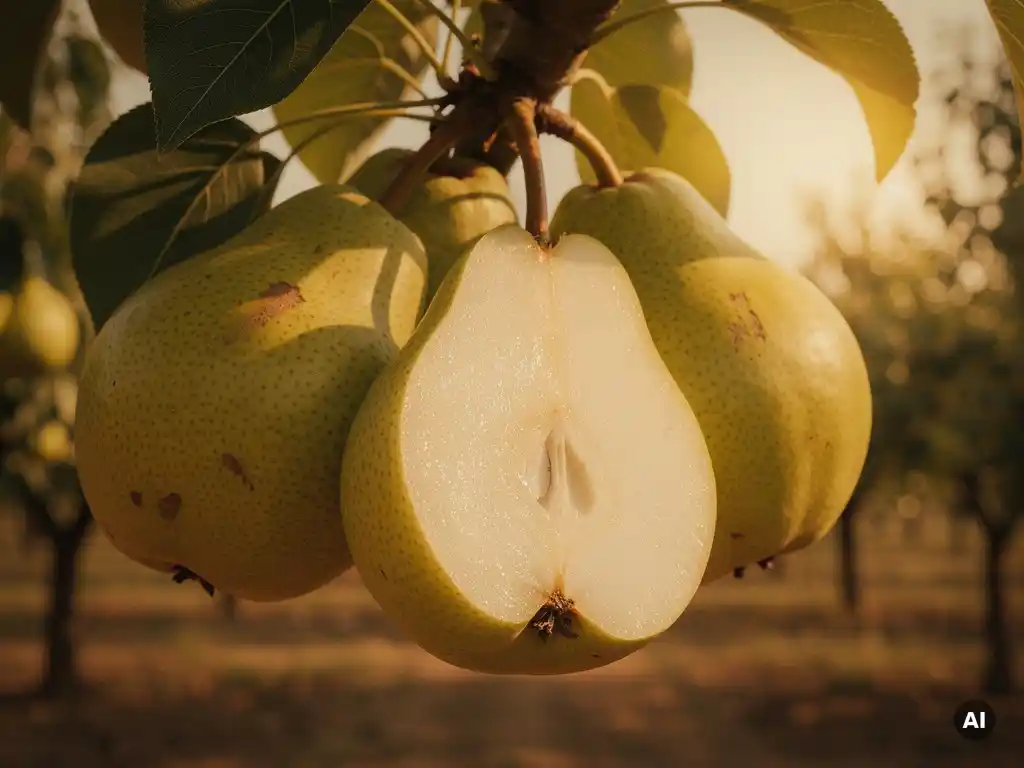
Pear breeding for warm climates is advancing rapidly, with breeders now developing varieties that require fewer winter chill hours, set fruit reliably in high temperatures, and maintain eating quality under heat stress. The shift is being driven by both the expansion of pear cultivation into historically warmer regions and the growing unpredictability of temperatures in traditional growing areas. Below, we answer the most pressing questions growers, retailers, and industry partners are asking about warm-climate pear development in 2026, and if you want to discuss any of these topics directly, feel free to get in touch with us.
Which pear varieties perform best in warm climates?
Pear varieties that perform best in warm climates are those with low chill requirements, strong heat tolerance during bloom, and the ability to develop full flavor without extended cold periods. Asian pear types and certain European-Asian hybrids tend to outperform traditional European cultivars in hot weather conditions, though targeted breeding is steadily expanding the options available to warm-climate growers.
Traditional European pears such as Conference or Williams were developed in temperate climates and depend on significant winter chill to break dormancy and flower uniformly. In warm regions, these varieties often produce erratic flowering, poor fruit set, and inconsistent quality. By contrast, varieties bred or selected specifically for low chill accumulation can complete their dormancy requirements even in mild winters, giving growers in Mediterranean, subtropical, and semi-arid zones a reliable production cycle.
The commercial landscape for warm-climate pear varieties is still developing compared to apples, but the pipeline is growing. Breeders are selecting for varieties that combine low chill requirements with the crisp texture and sweet-tart flavor profile that modern consumers expect. You can explore what is currently available through our variety portfolio to see how breeding is translating into commercial options.
How does heat affect pear flowering and fruit set?
Heat affects pear flowering and fruit set in several interconnected ways. High temperatures during bloom can reduce pollen viability, shorten the effective pollination window, and disrupt the synchronization between flowering and pollinator activity. When temperatures spike above optimal ranges during fruit set, cell division slows and early fruit drop becomes more likely, directly reducing yield potential.
Pear trees are particularly sensitive during the period from bud swell through petal fall. If warm temperatures arrive too early, flowers can open before pollinators are active or before compatible pollen is available. Late frosts following an early warm spell compound the problem further, catching open blossoms at their most vulnerable stage. In regions where spring temperatures are becoming less predictable, this vulnerability is one of the central challenges that pear breeding programs must address.
Beyond the immediate flowering window, sustained summer heat affects fruit development. Excessive heat can cause sunburn, accelerate starch conversion, and reduce the firmness that both retailers and consumers expect from premium pear varieties. Breeders working on warm-climate pear cultivation in hot weather are therefore selecting not just for flowering resilience but for the full arc of fruit development under thermal stress.
What traits do breeders prioritize for warm-climate pear development?
For warm-climate pear development, breeders prioritize low chill requirements, heat-stable flowering, strong fruit set under variable spring conditions, and the ability to develop full eating quality without relying on cold storage to trigger ripening. Disease resistance and drought tolerance are increasingly important secondary traits as growing regions face water scarcity alongside rising temperatures.
Flavor and texture remain non-negotiable. A variety that survives heat but delivers a bland or mealy eating experience will not find commercial success regardless of its agronomic performance. This means breeders must balance stress tolerance with the sensory qualities that drive consumer repeat purchase. Molecular marker technology has become essential here, allowing breeding programs to screen large populations for multiple traits simultaneously rather than waiting years for field evaluation to reveal which seedlings carry the right combination.
Grower yield and orchard management compatibility are also high on the priority list. Warm-climate growers often operate under different labor and input cost structures than their temperate counterparts, so varieties that perform well in high-density planting systems, require fewer spray interventions, and ripen within a commercially viable harvest window are strongly preferred. Our breeding strategy at Better3Fruit integrates all of these dimensions, combining taste, texture, disease tolerance, and climate resilience as interconnected goals rather than competing trade-offs.
How is climate change reshaping pear breeding priorities?
Climate change is reshaping pear breeding priorities by making heat tolerance, drought resilience, and phenological flexibility central objectives rather than secondary considerations. As average winter temperatures rise across traditional pear-growing regions and summer heat events become more frequent and intense, the traits that once defined a successful variety are no longer sufficient on their own.
One of the most significant shifts is the growing importance of chill hour flexibility. Many established pear-growing regions in Europe, North America, and the Southern Hemisphere are recording fewer accumulated chill hours each winter, meaning that varieties bred for those conditions are beginning to underperform. Breeding programs that anticipated this trend have a head start, but the pace of climate change is accelerating the urgency for all programs to build warm-climate adaptation into their core selection criteria.
Climate change is also pushing breeders to think longer-term about where pear production will be viable at all. Regions that are currently too warm for commercial pear cultivation may become viable as new low-chill varieties emerge, while some traditional areas may face declining suitability. This geographic reshuffling is creating new market opportunities but also demands that breeding programs develop varieties with broader adaptability rather than narrow regional optimization. Long-term climate resilience is one of our primary goals, and it informs every stage of our selection process.
What are the biggest challenges in commercializing warm-climate pear varieties?
The biggest challenges in commercializing warm-climate pear varieties are building sufficient supply volume, establishing consumer recognition, and navigating the long lead times between breeding success and market availability. Even when a variety performs exceptionally well in trials, translating that performance into a commercially scaled, branded product takes years of coordinated effort across breeders, nurseries, growers, and retailers.
Supply chain coordination is particularly complex for new pear varieties targeting warm climates because production is often distributed across multiple countries and growing regions. Achieving consistent quality, appearance, and availability across these geographies requires strong licensing structures, clear quality standards, and partners who are committed to building the variety’s market presence over time rather than simply filling short-term demand.
Consumer familiarity is another real barrier. Pear consumption in many markets is dominated by a small number of well-known varieties, and introducing a new cultivar requires sustained marketing investment to shift purchasing habits. This is especially true for varieties with unfamiliar skin colors or textures, even when their eating quality is superior. The most successful commercialization efforts pair a compelling variety with a strategic partner who has the reach and commitment to build genuine consumer demand. At Better3Fruit, we select licensing partners carefully for exactly this reason, prioritizing those who can develop critical mass, maintain quality standards, and grow a recognizable brand around each variety.
If you are exploring opportunities in warm-climate pear production or want to learn more about our breeding program and variety pipeline, we would be glad to connect. Contact us to start the conversation.
This content was generated with the help of AI and it may contain mistakes