
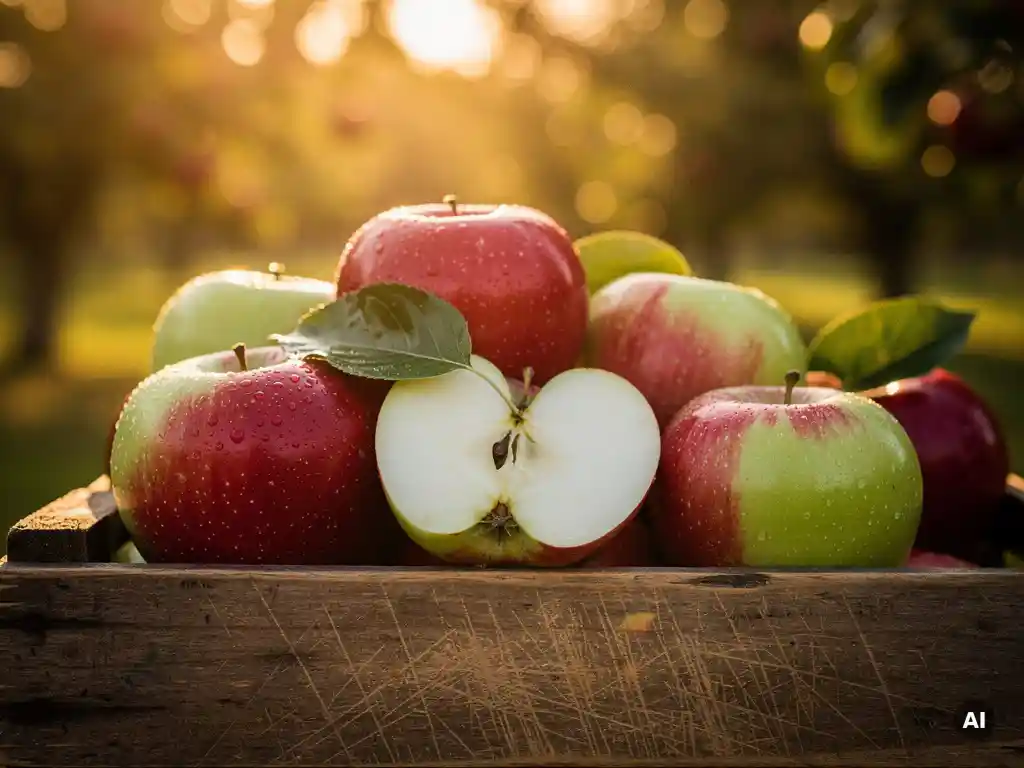
The juiciest and crunchiest apple varieties include Kanzi®, Honeycrisp, Fuji, Jazz, and Envy, apples celebrated for their firm, dense flesh and high moisture content. The best choice depends on whether you prefer a sweet, refreshing bite or a tangy, snappy one. Below, we answer the most common questions about apple texture and flavor so you can find exactly what you are looking for. If you want to explore our own varieties, feel free to get in touch with us directly.
What makes an apple juicy and crunchy?
An apple’s juiciness comes from the water content stored in its cells, while crunch depends on cell wall strength and how tightly those cells are packed together. Apples with high turgor pressure, meaning their cells are firm and full of liquid, deliver both qualities at once. Varieties that balance dense, crisp flesh with abundant juice tend to be the most satisfying to eat.
Two structural factors drive these qualities. First, the size and integrity of the apple’s parenchyma cells (the soft tissue beneath the skin) determine how much juice is released with each bite. Second, the thickness and rigidity of the cell walls control the snap you feel. When cell walls are strong and cells are tightly bound, the apple resists compression until it breaks cleanly, producing that satisfying crunch rather than a soft, mealy give.
Growing conditions also play a significant role. Apples grown in regions with warm days and cool nights tend to develop firmer flesh and more concentrated sugars, which enhances both crunch and perceived juiciness. Harvest timing matters too, apples picked at peak maturity retain their cellular structure far better than those left on the tree too long.
Which apple varieties are the crunchiest?
The crunchiest apple varieties are those with exceptionally firm, dense flesh that resists biting before snapping cleanly. Honeycrisp, Kanzi®, Cosmic Crisp, and SweeTango consistently rank among the crunchiest, thanks to their large, turgid cells and strong cell walls. These varieties maintain their firmness well after harvest, making them reliable choices whether you eat them fresh or use them in salads.
Kanzi®, developed through our breeding program at Better3Fruit, is a particularly good example of engineered crunch. Its parentage, a cross between Gala and Braeburn, combines Gala’s aromatic sweetness with Braeburn’s firm, dense texture. The result is an apple that delivers a sharp, satisfying snap with every bite. Cosmic Crisp, a Washington State University release, is another standout: its exceptionally slow browning rate means it stays appealing long after slicing, while its firmness holds up beautifully.
For those who prefer heritage varieties, Cox’s Orange Pippin offers a firm, nutty bite, and Braeburn remains a benchmark for crispness among classic commercial apples.
Which apples are considered the juiciest?
The juiciest apple varieties are Fuji, Kanzi®, Envy, and Honeycrisp, all known for their high moisture content and the burst of juice they release on the first bite. Fuji apples in particular are celebrated worldwide for their exceptionally juicy, sweet flesh, which comes from their dense cellular structure holding large amounts of liquid.
Juiciness in apples is closely tied to sugar content. Apples with higher natural sugars tend to feel juicier because dissolved sugars increase the osmotic pressure inside cells, helping them retain water more effectively. This is why Fuji and Kanzi®, both relatively high in natural sugars, feel so refreshing to eat compared to drier, starchier varieties like Granny Smith.
Envy, a New Zealand-developed variety, is another frequently cited juicy apple. Its creamy, fine-grained flesh releases juice slowly and evenly, creating a lingering, satisfying mouthfeel rather than an immediate flood. For maximum juiciness, eating these varieties at the right temperature matters: slightly chilled apples (around 10 to 15 degrees Celsius) tend to taste noticeably juicier than room-temperature ones.
What’s the difference between sweet-juicy and tart-crunchy apples?
Sweet-juicy apples are high in natural sugars and moisture, delivering a soft, refreshing sweetness, think Fuji, Gala, or Envy. Tart-crunchy apples have higher malic acid content alongside firm flesh, producing a sharp, snappy bite, think Granny Smith, Braeburn, or Pink Lady. The key distinction is the balance between sugar and acid, which shapes both flavor and perceived texture.
Sweet-juicy apples
Sweet-juicy varieties tend to have a lower acid-to-sugar ratio, which softens the flavor profile and emphasizes the fruit’s natural moisture. They are often preferred for fresh eating, lunchboxes, and pairing with mild cheeses or nut butters. Varieties like Fuji and Gala are classic examples, while Kanzi® sits interestingly in between, sweet-forward but with enough Braeburn acidity to give it complexity and a firm bite.
Tart-crunchy apples
Tart-crunchy varieties have a higher concentration of malic acid, which creates that mouth-puckering sharpness alongside their firm texture. This combination makes them excellent for cooking, baking, and pairing with strong flavors like aged cheddar or cured meats. Granny Smith is the most recognizable example globally, but Braeburn and Pink Lady offer a more nuanced tartness with greater aromatic complexity.
How does apple breeding improve juiciness and crunch?
Apple breeding improves juiciness and crunch by deliberately selecting parent varieties that carry the genetic traits responsible for firm cell walls, high moisture retention, and dense flesh. Modern breeding programs use molecular markers to identify these traits early in a seedling’s development, allowing breeders to select the most promising candidates years before a tree ever bears commercial fruit.
At Better3Fruit, we use exactly this approach. With over 30,000 new varieties under evaluation at any time and 10,000 new seedlings entering the field each year, we screen systematically for the texture and flavor traits that consumers value most. Molecular marker technology lets us identify whether a seedling carries the right combination of genes for crunch, juiciness, disease tolerance, and yield, without waiting a decade for a full evaluation cycle.
The result is varieties like Kanzi® and our newer releases, Morgana® and Giga®, which combine eating quality with grower-friendly traits. Breeding for crunch and juiciness is not just about taste: it also involves selecting for post-harvest performance, ensuring that firmness and moisture content hold up through storage and transport so consumers get the same experience whether they buy an apple in October or March. You can explore our full range of apple and pear varieties to see how these traits come together in practice.
When is the best time to eat apples for peak crunch and juice?
The best time to eat an apple for peak crunch and juiciness is as close to harvest as possible, or within the recommended storage window for that variety. Freshly harvested apples have the highest turgor pressure in their cells, which is directly responsible for both snap and juice release. As apples age, cell walls weaken and moisture migrates, leading to the soft, mealy texture that signals an apple past its prime.
That said, some varieties actually benefit from a short period of cold storage after harvest. Controlled atmosphere storage, used widely in commercial apple supply chains, slows the natural ripening process and can preserve crunch and juiciness for months. Honeycrisp and Cosmic Crisp, for example, are well-documented for holding their texture exceptionally well under proper storage conditions.
At home, keeping apples refrigerated rather than stored at room temperature significantly extends their eating quality. A crisp, juicy apple left on a kitchen counter for a week will lose noticeably more firmness than one kept in the fridge. For the very best experience, eat your apples slightly chilled and within a few days of purchase, that is when apple texture and flavor are at their most vibrant.
Whether you are a grower, retailer, or simply passionate about great-tasting fruit, we are always happy to talk about what makes an apple truly exceptional. Get in touch with us to learn more about our varieties and breeding program.
This content was generated with the help of AI and it may contain mistakes