
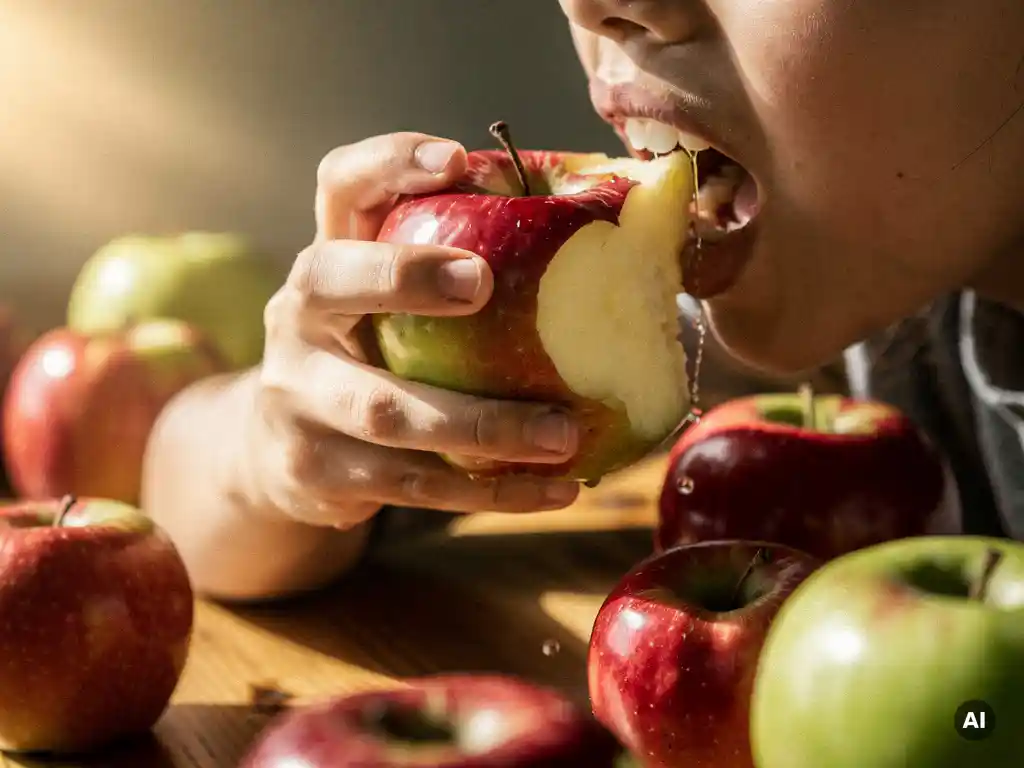
Ease of eating directly increases fruit consumption among young people. When fruit requires minimal effort to prepare, peel, or eat without mess, children and teenagers are far more likely to choose it over less convenient snack alternatives. This effect is especially strong in settings where young people make their own food choices, such as schools, after-school activities, and social situations. The sections below explore the key questions behind this relationship, from the barriers that reduce fruit intake to how apple breeders like us at Better3Fruit are responding to the challenge. If you want to learn more about our work, feel free to get in touch with us.
Why do children and teenagers eat less fruit than recommended?
Children and teenagers eat less fruit than recommended primarily because fruit often loses the competition to convenient, highly processed snack foods. When a piece of fruit requires washing, peeling, cutting, or produces sticky residue on hands, young people tend to reach for something easier instead. Inconvenience is one of the most consistent barriers to healthy eating habits in this age group.
Beyond convenience, taste preferences play a significant role. Many young consumers find certain fruits too sour, too bland, or inconsistently sweet, which discourages repeat consumption. If a child bites into an apple that is mealy or lacks flavour, that single experience can shape their attitude toward the fruit for months.
Social context matters too. Teenagers in particular are sensitive to how eating looks in front of peers. A fruit that drips juice, stains fingers, or requires awkward biting is less likely to be chosen in a social setting. The combination of inconvenience, inconsistent taste, and social self-consciousness creates a pattern where fruit intake remains well below recommended daily levels throughout adolescence.
How does ease of eating influence food choices in young people?
Ease of eating influences food choices in young people by reducing the friction between wanting to eat healthily and actually doing so. When a snack can be eaten quickly, cleanly, and without preparation, it fits naturally into the fast-paced rhythm of a young person’s day. Fruit that meets these criteria competes directly with packaged snacks on convenience, which is one of the most powerful drivers of food selection in this demographic.
Young people, especially teenagers, make a large proportion of their daily food choices independently. In those moments, the decision is rarely a careful nutritional calculation. It is a quick, intuitive response to hunger, habit, and availability. Fruit that is easy to eat removes the hesitation that would otherwise tip the choice towards a less healthy alternative.
Research in consumer behaviour consistently shows that reducing effort at the point of choice increases the likelihood of a behaviour being repeated. For fruit consumption, this means that every barrier removed, whether that is a tough skin, a messy core, or an unpredictable texture, increases the probability that a young person will eat fruit again tomorrow.
What fruit characteristics make eating easier for young consumers?
The fruit characteristics that make eating easiest for young consumers include thin, tender skin that does not require peeling, a crisp and juicy texture that delivers immediate sensory satisfaction, a manageable size that fits in one hand, and a clean eating experience with minimal juice drip or residue. Together, these traits lower the effort required and make fruit genuinely snack-ready.
Texture is particularly important. A crisp, firm bite signals freshness and triggers a positive eating experience that young consumers associate with quality. By contrast, a soft or mealy texture is one of the most commonly cited reasons children reject an apple or pear, even when the flavour is acceptable.
Flavour consistency also matters more than many growers realise. A fruit that tastes reliably sweet and balanced every time builds trust with young consumers. If the experience varies significantly from one piece to the next, children quickly lose confidence in that fruit as a snack choice. Predictable, pleasant flavour is a quiet but powerful driver of repeat consumption and healthy eating habits over time.
Does snack-ready fruit actually increase how much young people eat?
Yes, snack-ready fruit does increase how much young people eat, and the effect is measurable in practical settings. Studies in school environments have shown that when fruit is pre-sliced, presented attractively, and requires no preparation, consumption rates rise significantly compared to when the same fruit is offered whole and uncut. Removing the effort barrier is one of the most effective levers for improving fruit intake among children.
The principle extends beyond preparation. Fruit that is inherently easy to eat, without any cutting or processing needed, delivers the same benefit by design. A small, crisp apple with a thin skin and balanced sweetness can be eaten in a few minutes with no mess and no tools, making it a genuinely competitive snack option in the same way a packaged biscuit or cereal bar is.
When fruit competes on convenience as well as taste, young people choose it more often. Over time, this shift in daily habits contributes to better overall fruit intake and helps establish healthy eating patterns that can persist into adulthood.
How are apple breeders designing varieties for easier eating?
Apple breeders are designing varieties for easier eating by selecting for traits that directly address the barriers young consumers face, including thin but durable skin, consistent crispness, reliable sweetness, and a size and shape that suits snacking. Modern breeding programmes use molecular markers to identify these traits early in the development process, dramatically speeding up the time it takes to bring a consumer-ready variety to market.
At Better3Fruit, we place ease of eating at the centre of our breeding strategy alongside taste, texture, and long-term sustainability. Our breeding programme evaluates tens of thousands of new varieties each year, specifically assessing how each candidate performs against real consumer expectations, including those of younger audiences. Varieties like Morgana® and Giga® reflect this approach, combining strong flavour profiles with eating characteristics that make them genuinely accessible to children and teenagers.
We also consider how a variety performs after harvest and through the supply chain. A fruit that arrives at a school canteen or a family kitchen in peak condition, with consistent texture and flavour, is far more likely to be eaten than one that has softened or lost its appeal in transit. Breeding for post-harvest resilience is therefore part of breeding for ease of eating. You can explore our full range of varieties on our apple and pear varieties page.
What role do schools and parents play in making fruit more accessible?
Schools and parents play a decisive role in making fruit accessible to young people by controlling the environment in which food choices are made. When fruit is visible, available, and presented as a normal and appealing snack option, children are significantly more likely to eat it. The physical and social environment shapes behaviour more powerfully than information or instruction alone.
What schools can do
Schools can increase fruit consumption by placing fruit at eye level in canteens, offering it as the default snack option, and ensuring that what is available is genuinely easy to eat. Pre-portioned fruit, varieties with thin skin, and consistent quality all reduce the hesitation children feel when deciding whether to pick up a piece of fruit. Positive peer modelling, where eating fruit is normalised across a group, also has a measurable effect on individual behaviour.
What parents can do
At home, parents influence fruit intake most effectively through availability and habit formation. Keeping fruit visible on the counter, packing it in lunchboxes without requiring children to prepare it themselves, and choosing varieties that children genuinely enjoy all contribute to higher consumption. Involving children in selecting fruit at the market or shop also builds a sense of ownership that makes them more likely to eat what they have chosen. The habits formed in childhood around fruit intake tend to persist, making the home environment one of the most important spaces for building lasting healthy eating habits.
Making fruit easier to eat is not a single action but a shared responsibility across breeders, growers, schools, and families. When all parts of the chain work together, from developing the right variety to placing it in the right environment, fruit consumption among young people improves in a meaningful and lasting way. If you are interested in how our breeding work supports this goal, we invite you to get in touch with us to start the conversation.
This content was generated with the help of AI and it may contain mistakes